

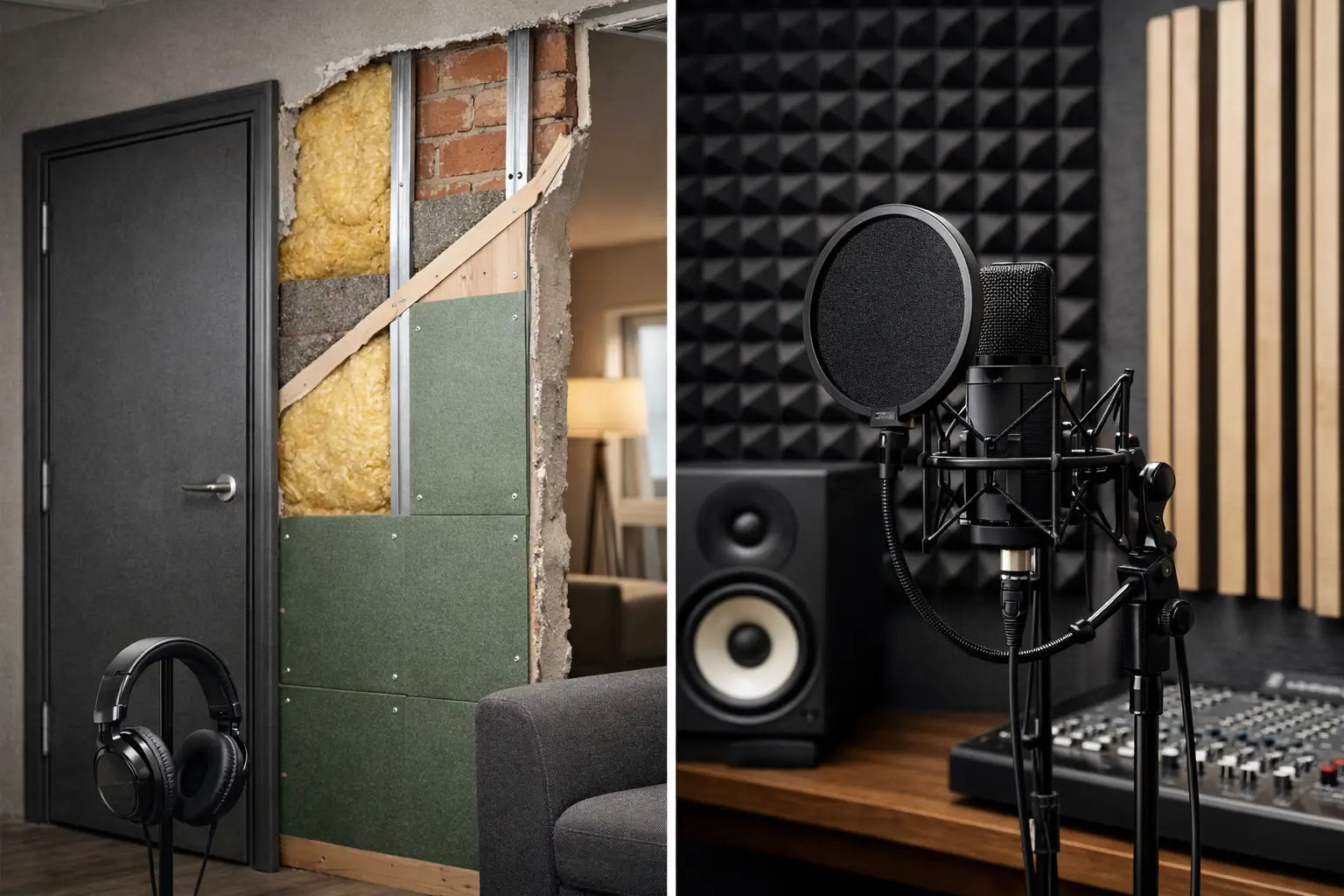
The difference between soundproofing vs acoustic treatment usually becomes obvious the moment a space is finished and still does not perform the way it should. The walls may look immaculate, the speakers may be premium, and the seating may be beautifully placed, yet the room still leaks noise to adjacent areas or sounds harsh, echoey, and fatiguing once the system is turned on. These are not the same problem, and they are not solved with the same approach.
For homeowners planning a private cinema, developers fitting out premium residences, or designers shaping a refined commercial environment, this distinction matters early. If it is addressed too late, the project often pays twice - once for finishes, and again for corrective work hidden behind them.
Soundproofing vs acoustic treatment: what is the difference?
At the simplest level, soundproofing is about stopping sound from traveling from one space to another. Acoustic treatment is about improving how sound behaves inside the room itself. One controls transmission. The other controls reflections, reverberation, clarity, and balance.
That difference sounds straightforward, but it is where many projects go off track. A client may ask for a room to be soundproof when the real concern is speech intelligibility, flutter echo, or boomy bass. Just as often, someone installs decorative acoustic panels expecting them to keep movie sound from reaching the next bedroom. They will not.
Soundproofing works by limiting the energy that passes through walls, ceilings, floors, doors, glazing, and mechanical penetrations. Acoustic treatment works by shaping the listening environment through absorption, diffusion, and low-frequency control. Both are essential in performance spaces, but they solve very different problems.
What soundproofing is designed to do
When a room needs privacy, containment, or isolation, soundproofing is the priority. This is especially critical in home cinemas, music rooms, offices, meeting rooms, gyms, worship spaces, and any area where volume or confidentiality matters.
Effective soundproofing relies on construction, not surface decoration. The principles are mass, decoupling, damping, and airtightness. A heavier wall generally blocks more sound than a lighter one. A decoupled assembly helps prevent vibration from traveling directly through the structure. Damping reduces resonance between layers. Airtightness matters because even small gaps around doors, sockets, ducts, or recessed lighting can compromise the result.
This is why true sound isolation is best planned before finishing materials are installed. It may involve upgraded wall assemblies, resilient channels, acoustic insulation, isolated ceilings, sealed doors, acoustic glazing, floating floors, or mechanical noise control. The exact strategy depends on what kind of noise you are containing and how much isolation is required.
Low-frequency sound is the usual challenge. Deep bass from a cinema subwoofer or performance system travels far more aggressively through structure than casual conversation. Stopping it requires more than thicker curtains or foam on the wall. It requires engineered assemblies and careful detailing.
What acoustic treatment is designed to do
Acoustic treatment begins once sound is inside the room. Here, the goal is not to stop it from escaping but to make it sound correct, controlled, and enjoyable where people actually listen.
In untreated spaces, sound reflects off hard surfaces such as glass, marble, drywall, concrete, and large flat ceilings. That can create echo, smeared dialogue, sharp treble, uneven bass, and a room that feels louder than it should. In a cinema, it can blur speech and weaken immersion. In an office, it can reduce concentration. In a mosque, auditorium, or classroom, it can compromise speech intelligibility where clarity matters most.
Acoustic treatment is tailored to the purpose of the room. Absorptive panels reduce excessive reflections. Bass traps help manage low-frequency buildup. Diffusers preserve energy while scattering reflections for a more natural and spacious presentation. Soft furnishings can help at the margins, but serious performance requires proper analysis of room dimensions, speaker placement, seating positions, and finish materials.
In premium environments, treatment should never feel like an afterthought. It can be integrated into wall paneling, fabric systems, slatted wood features, ceiling details, and architectural finishes so the room sounds exceptional without looking overtly technical.
Why people confuse the two
The confusion often comes from products marketed as catch-all acoustic solutions. Foam tiles, fabric panels, rugs, curtains, and upholstered surfaces can improve room acoustics, sometimes dramatically. That leads people to assume they are also stopping sound transmission. In most cases, they are not.
If your cinema sounds less echoey after adding wall panels, that is acoustic treatment working. If your neighbors can still hear the action scene, soundproofing has not been addressed. Likewise, if you build a heavily isolated room with thick assemblies but leave the interior acoustically untreated, you may achieve privacy while ending up with a room that still sounds disappointing.
A high-performance space needs the right answer to the right problem.
Soundproofing vs acoustic treatment in real spaces
A luxury home cinema usually needs both. The room should contain cinematic impact without disturbing bedrooms, living areas, or neighboring properties. At the same time, it must deliver articulate dialogue, controlled bass, and an enveloping soundstage. Sound isolation protects the rest of the home. Acoustic treatment protects the experience inside the room.
In an executive office or boardroom, the balance may shift. Privacy is often critical, especially for meetings and calls, so soundproofing around partitions, doors, and glazing matters. Inside the room, acoustic treatment keeps speech crisp and reduces the fatigue caused by reverberant surfaces.
In a gym or retail environment, full soundproofing may not always be practical across the entire property, but acoustic treatment can still make the space more comfortable and controlled. In auditoriums, schools, worship spaces, and hospitality venues, interior acoustic performance is often as important as AV system quality. Even excellent speakers cannot compensate for a poorly behaved room.
Which one do you need?
It depends on the outcome you are trying to achieve.
If the priority is preventing sound from escaping or entering, you need soundproofing. If the priority is improving clarity, reducing echo, and creating a more refined listening environment, you need acoustic treatment. If the room is a dedicated cinema, music space, performance venue, or any premium environment where volume and quality both matter, you likely need both from the outset.
This is also where project value can be protected. It makes little sense to invest in premium speakers, projection, luxury finishes, and bespoke joinery only to leave the room acoustically unresolved. The same is true in reverse. An elegantly treated room that lacks proper isolation can still become a problem for the wider property.
Why timing matters in premium projects
The best moment to address soundproofing is during design and construction. Once ceilings are closed, walls are painted, and custom finishes are installed, structural acoustic upgrades become more disruptive and more expensive.
Acoustic treatment offers slightly more flexibility because some elements can be integrated later, but the results are stronger when planned alongside lighting, HVAC grilles, screen placement, speaker locations, and interior finishes. That coordination is what separates a technically acceptable room from a genuinely elevated one.
For architects, interior designers, and property developers, this is not only an acoustic issue. It is a coordination issue. Ceiling coffers, decorative cladding, air conditioning noise, motorized curtains, and concealed speakers all influence the final result. When these systems are engineered together, the space performs as a whole rather than as a collection of expensive parts.
The cost question, honestly answered
Acoustic treatment is often more affordable and less invasive than true soundproofing. That makes it tempting to pursue treatment first, especially in retrofit situations. Sometimes that is the right call, particularly when the main complaint is echo or weak sound quality rather than noise leakage.
Soundproofing, by contrast, can be construction-heavy and therefore more expensive. But where privacy, containment, or bass isolation is non-negotiable, there is no shortcut. A thinner solution may save money upfront and fail entirely in practice.
The smarter approach is not to ask which one is cheaper. It is to ask which problem is costing the room its purpose.
A better way to plan the room
In sophisticated residential and commercial projects, acoustics should be treated as part of the design language, not a correction after occupancy. That means identifying noise-sensitive adjacencies, understanding how the room will be used, selecting finishes that support performance, and engineering the audio environment before equipment and furniture are locked in.
This is where a specialist integrator adds real value. Companies such as I-Trust Systems approach cinema rooms, AV spaces, and premium interiors as complete environments, where isolation, treatment, system design, and aesthetics are resolved together rather than in isolation.
The most successful spaces are rarely the loudest or the most decorated. They are the ones that feel composed the moment sound begins - private when they should be private, clear when they should be clear, and immersive without strain. If you are weighing soundproofing vs acoustic treatment, the right question is not which one matters more. It is what the room should feel like when every detail is working exactly as intended.
Share:
What Is Home Automation, Really?
Wired vs Wireless Automation: Which Fits Best?