

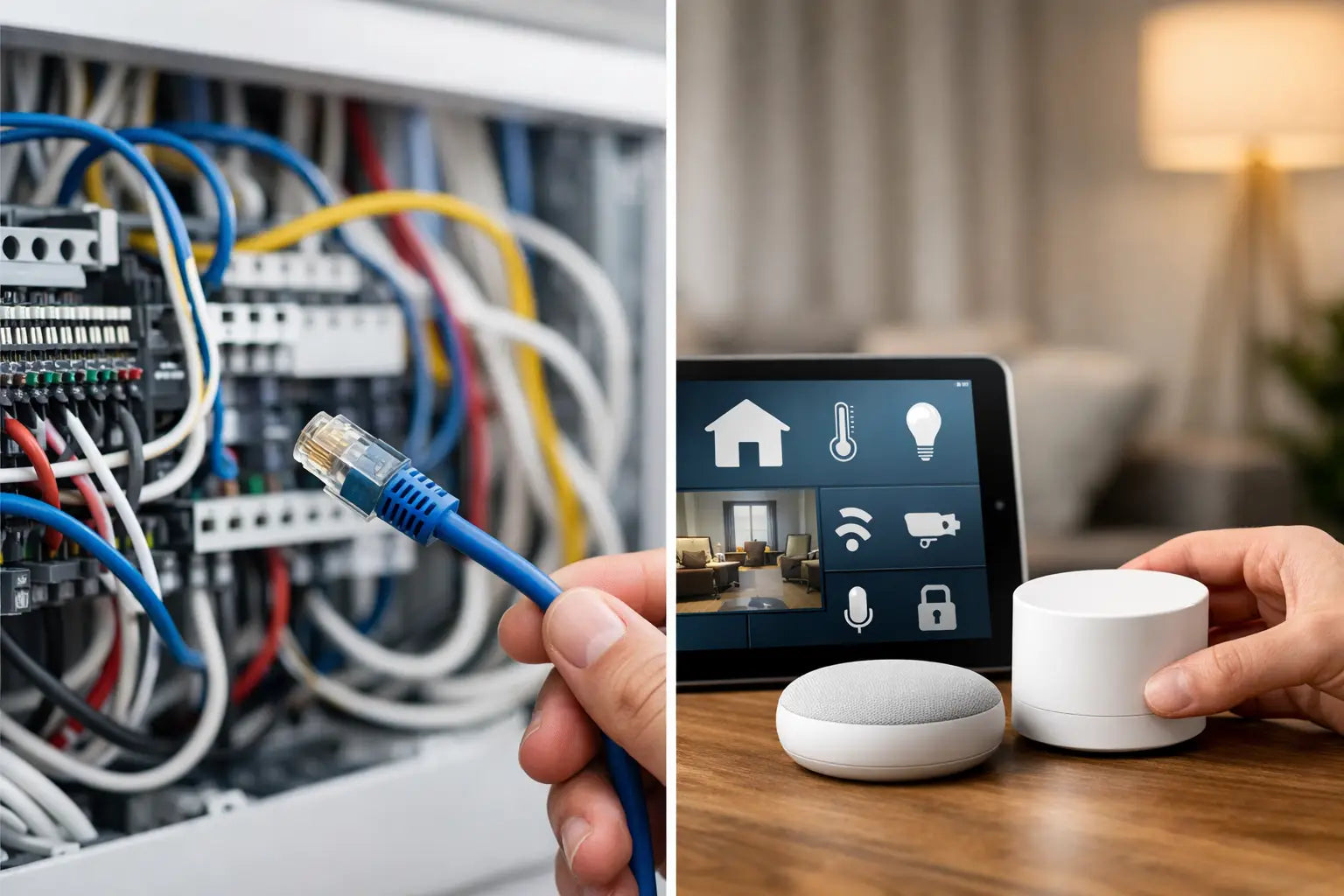
When a client is building a villa, fitting out a private cinema, or upgrading a commercial space, one question appears early and keeps resurfacing: wired vs wireless automation. It sounds like a simple technical choice, but it shapes far more than control method. It affects reliability, finish quality, future upgrades, installation timing, and how refined the entire experience feels once the space is complete.
In premium environments, automation is not just about turning lights on from a phone. It is about creating a home or business that behaves with intention. Lighting scenes should respond instantly. Curtains should move quietly and on cue. Climate control should feel effortless. Audio, security, access, and AV should work together without visual clutter or daily friction. That is why the wired versus wireless decision deserves careful planning rather than a quick product comparison.
Wired vs Wireless Automation in Real Projects
The right answer depends on the stage of the project, the construction method, the performance expectations, and how integrated the space needs to be. For a new-build luxury residence, a wired control backbone often provides the strongest foundation. For an existing property where walls and ceilings are already complete, wireless can be a highly effective route to intelligent control without major disruption.
The mistake is assuming one is modern and the other is outdated. In reality, both are current. Both can be elegant. Both can be specified well or poorly. The real difference lies in how each system behaves over time and how well it aligns with the architecture.
What wired automation really means
Wired automation uses physical control cabling between devices such as switches, dimmers, relays, sensors, processors, and controlled loads. In a residence, this may govern lighting circuits, motorized curtains, HVAC interfaces, security layers, gate control, distributed audio, and cinema environments. In commercial settings, it can also coordinate meeting rooms, retail lighting, prayer halls, fitness audio zones, and large-format AV systems.
Because communication occurs over dedicated wiring, the system is generally more stable and less exposed to interference from surrounding networks or changing signal conditions. That makes wired systems particularly attractive where response time, consistency, and scale matter.
What wireless automation really means
Wireless automation uses radio-based communication between devices rather than relying on extensive control cabling. This can include smart switches, sensors, thermostats, motor controllers, locks, and gateways that communicate over common wireless protocols or brand-specific ecosystems.
Wireless is often the practical choice when the property is already finished, when renovation access is limited, or when the client wants a meaningful upgrade without reopening walls. In the right application, it can deliver a polished user experience with less installation time and lower disruption.
Performance matters more than trend
For high-end projects, reliability is usually the deciding factor. A beautiful interface means very little if key scenes respond inconsistently or devices occasionally fall offline. This is where wired systems often justify their reputation. They tend to offer stronger long-term consistency, especially when many subsystems are integrated into one environment.
If a home includes lighting control, AC control, curtain automation, multi-room audio, access control, perimeter security, and a dedicated cinema, the automation layer is carrying serious responsibility. In that context, wired infrastructure offers confidence. It creates a more deterministic environment, which matters when clients expect every press, schedule, and scene to perform without hesitation.
Wireless, however, is not automatically unreliable. A well-designed wireless system can perform very well, particularly in smaller homes, apartments, retrofit projects, or spaces where the scope is focused on lighting, climate, and a limited number of smart devices. Problems tend to arise when wireless is asked to do too much across challenging structures, dense materials, or sprawling floor plans without proper network planning.
Design freedom and visual refinement
Luxury spaces demand more than functionality. They demand restraint. Technology should enhance the architecture, not compete with it.
Wired automation has a strong advantage here because it can be designed from the start as part of the building fabric. Keypads can be selected to complement interior finishes. Equipment can be centralized. Wall clutter can be reduced. Lighting scenes can replace banks of switches. Motorized shading, HVAC, and AV can be integrated into a clean control philosophy that feels considered rather than improvised.
Wireless systems can also look refined, but they are often more constrained by the devices available within a given ecosystem. Battery-powered sensors, retrofit switches, and add-on components may solve practical problems, yet they do not always offer the same architectural elegance as a fully engineered wired solution.
For architects, designers, and homeowners focused on finish quality, this difference matters. The experience of luxury is often built from what you do not see.
Installation timing changes everything
This is where the wired vs wireless automation conversation becomes less theoretical and much more practical.
If the property is under construction or undergoing a major renovation, wiring for automation should be considered early. At that stage, the cost and complexity of adding control cable pathways, central panels, structured wiring, speaker cable, sensor locations, and future-ready conduits are far more manageable. The result is a cleaner and more capable system.
If the property is already finished, wireless may be the more intelligent decision. Retrofitting a fully wired automation system into completed luxury interiors can be invasive and expensive if the project was not prepared in advance. In those cases, a carefully selected wireless platform can deliver excellent everyday control while preserving the existing finishes.
This is why strong system design begins with the building timeline, not just a product catalog.
Scalability and long-term ownership
Many clients do not automate everything at once. They may begin with lighting and climate control, then add security, distributed audio, gate access, irrigation, acoustic zones, or cinema integration later. The question is not just what the system can do now. It is what it can support three or five years from now.
Wired systems usually offer a stronger path for large-scale expansion. They are especially well suited to custom scenes, deeper subsystem integration, and larger properties with multiple floors, outbuildings, guest areas, landscaped zones, or specialized rooms. They also tend to serve premium commercial spaces better, where uptime and system logic are central to operations.
Wireless can scale, but there is often a threshold where complexity increases faster than elegance. More gateways, more device dependencies, and more network variables can gradually reduce the simplicity that made wireless attractive in the first place.
For clients thinking in terms of estate-level living or multi-zone commercial performance, infrastructure deserves a long view.
Cost is not as simple as cheap versus expensive
Wireless is often perceived as the budget-friendly choice, and in many retrofit scenarios that is true. Installation is typically faster, labor is lower, and there is less need for invasive works. For targeted upgrades, that can produce strong value.
But in new construction, wired systems can be more cost-efficient over the life of the project than they first appear. When planned correctly, they reduce compromise later. They support cleaner integration, stronger reliability, and more sophisticated control logic. They also help avoid the piecemeal layering of disconnected smart products that often leads to frustration, visual inconsistency, and eventual replacement.
For premium homes and commercial environments, the more relevant question is not which option has the lowest initial number. It is which system protects the quality of the space and supports the desired experience without recurring irritation.
When wired automation is the stronger choice
Wired automation is usually the better fit for new-build villas, large residences, bespoke cinema rooms, and integrated commercial spaces where multiple systems need to behave as one. It is also the preferred route when the client values precision, understated design, and long-term performance over quick deployment.
This approach suits projects where lighting moods, climate zones, shading, audio, security, and AV are all part of a unified design narrative. In these spaces, control is not an accessory. It is part of the architecture.
When wireless automation makes more sense
Wireless automation is often the right answer for completed homes, apartments, selective renovations, and projects that need smart functionality with minimal disruption. It can also work well for clients who want fast results in a guest suite, office, retail unit, or smaller property without embarking on major building work.
When specified carefully, wireless can deliver convenience, scene control, scheduling, and app-based management in a way that feels polished and modern. The key is being honest about scope. It performs best when its limits are respected.
The best systems are often hybrid
In many premium projects, the smartest answer is neither fully wired nor fully wireless. It is a hybrid approach.
A property may use wired infrastructure for core lighting control, AV distribution, security, and equipment rooms, while using wireless devices in selected retrofit areas, garden zones, detached spaces, or later-phase additions. This balance allows the project to preserve reliability where it matters most while keeping flexibility for evolving needs.
That is often how experienced integrators approach complex environments. They do not force a doctrine. They build around the architecture, the user journey, and the level of performance the space deserves.
For clients who expect technology to feel invisible, elegant, and dependable, the best decision is rarely about following a trend. It is about choosing the control strategy that fits the building as precisely as the lighting, finishes, and acoustics do. When that alignment is right, automation stops feeling like technology and starts feeling like the space has finally learned how to live with you.
Share:
Soundproofing vs Acoustic Treatment
Luxury Cinema Room Guide for Elegant Homes