

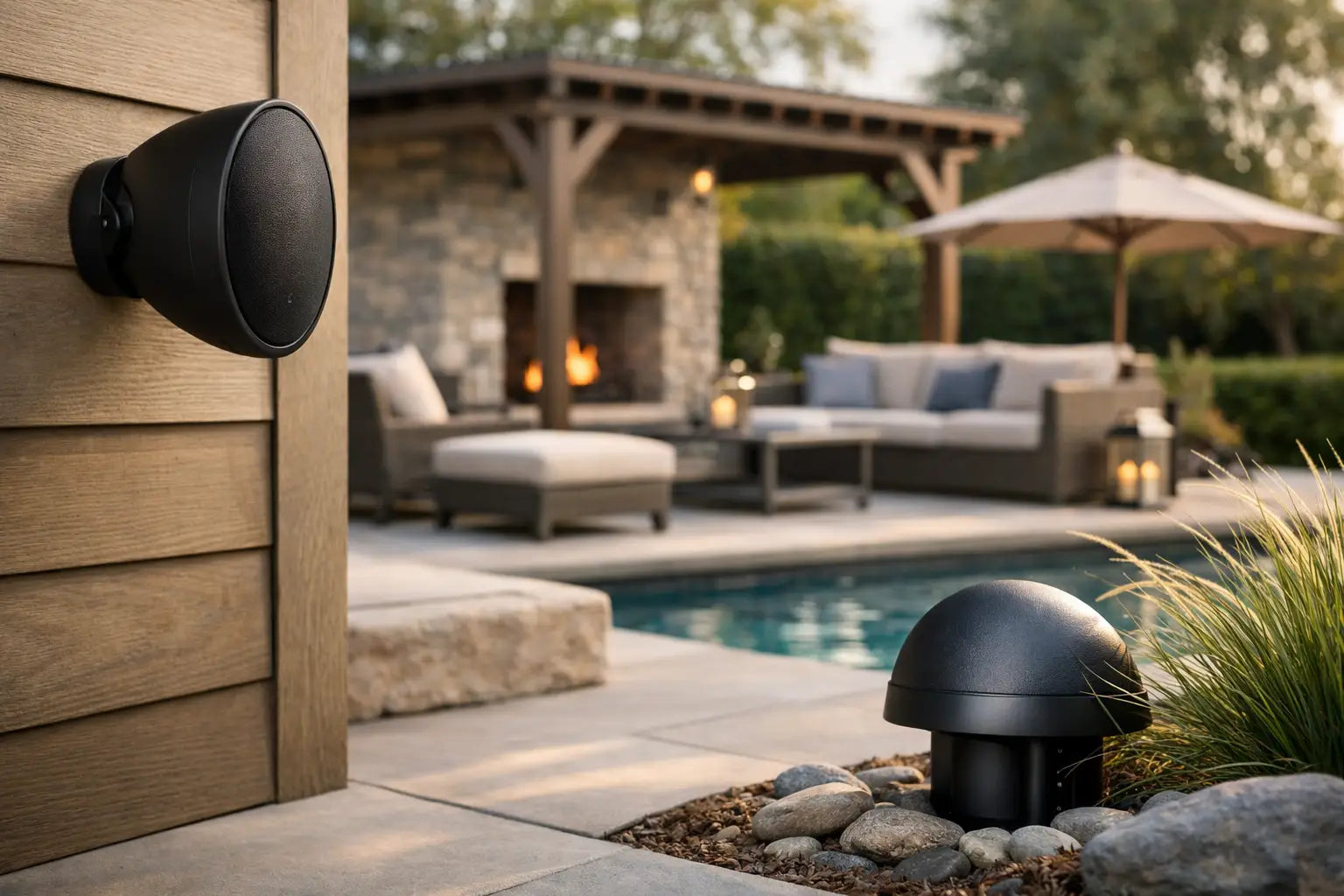
A beautifully designed terrace can still feel incomplete when music is limited to a portable speaker on a table. The sound is localized, the volume rises to compensate, and the atmosphere quickly becomes less refined. Properly engineered outdoor speakers change that equation, bringing balanced, room-filling sound to patios, gardens, pool decks, courtyards, and entertaining areas without compromising the architecture around them.
For a luxury residence or commercial venue, the goal is not simply to make music louder outdoors. It is to create an environment where sound feels present, even, and effortless - whether guests are gathered around an outdoor dining table, moving between a pool and lounge area, or enjoying a quiet evening under the landscape lighting.
Outdoor Speakers Are a Design Decision, Not an Add-On
Outdoor audio is often considered late in a project, after paving, planting, lighting, and furniture have already been selected. That approach usually leads to visible equipment, uneven coverage, and avoidable installation compromises. The best results begin with audio planning alongside the landscape, architectural, and lighting design.
A high-performance outdoor system considers the way people use the space. A narrow side terrace has different acoustic needs than an expansive garden. A pool deck needs sound that remains clear over splashing water and conversation. A restaurant terrace or hotel courtyard requires controlled coverage that establishes atmosphere without disturbing adjacent tables or neighboring properties.
This is where placement matters more than raw power. One or two oversized speakers aimed across an open area may seem practical, but they create hot spots near the speakers and weak sound farther away. A distributed system uses multiple carefully placed speakers at lower volume. The result is smoother coverage, better speech and vocal clarity, and a more comfortable listening experience throughout the space.
Choosing the Right Outdoor Speaker Format
There is no single correct outdoor speaker for every property. The ideal format depends on the architecture, landscape layout, intended listening level, and visual direction of the project.
Surface-Mount Speakers for Defined Zones
Surface-mount speakers are well suited to covered patios, pergolas, cabanas, balconies, and outdoor kitchens. Installed beneath eaves or mounted discreetly on walls and beams, they can deliver powerful, articulate audio while remaining visually restrained.
They are particularly effective where the seating area has clear boundaries. In a covered outdoor lounge, for example, a pair or small group of premium weather-rated speakers can provide an intimate listening zone with excellent detail. Their finish can often be selected to complement exterior paint, timber, stone, or metalwork.
Landscape Speakers for Gardens and Open Areas
For larger gardens, landscaped pathways, and poolside environments, satellite landscape speakers offer a more natural approach. These compact speakers can be placed among planting beds, hardscape edges, and trees, directing sound toward seating and circulation zones rather than projecting it broadly across the property.
Because they are distributed throughout the landscape, they require less volume than conventional wall-mounted alternatives. That is a meaningful advantage for villas and estates where the owners want immersive music without turning the garden into a loudspeaker. When specified thoughtfully, the speakers visually recede while the sound appears to come from the environment itself.
In-Ground Subwoofers for Depth Without Visual Clutter
Outdoor music needs more than high frequencies and vocals. Bass creates warmth, scale, and a convincing sense of presence, especially across open-air spaces where low-frequency energy dissipates quickly. An in-ground subwoofer can provide that foundation while keeping large enclosures out of sight.
This approach is especially valuable for landscape systems. Small satellite speakers handle the detailed midrange and treble, while a concealed subwoofer supports the lower frequencies. The system sounds fuller at moderate listening levels, which is often preferable to using fewer speakers at excessive volume.
Architectural Speakers for Contemporary Exteriors
Some projects call for speakers that integrate directly into architectural elements. Depending on the construction, discreet models may be incorporated into ceilings, soffits, planters, or custom-built structures. These installations demand early coordination, precise weatherproofing, and service access, but the visual result can be exceptional.
The trade-off is that highly concealed installations should never sacrifice acoustic performance for appearance. Speaker placement, enclosure requirements, drainage, and vibration control must be resolved by an AV engineering team, not improvised on site after finishes are complete.
Weather Resistance Means More Than a Rain Rating
Outdoor equipment must withstand far more than occasional rainfall. Direct sun, humidity, airborne dust, irrigation spray, pool chemicals, salt air, and extreme temperature changes all affect long-term performance. A speaker rated for outdoor use is a starting point, not the entire specification.
In coastal environments, corrosion resistance deserves particular attention. Hardware, brackets, grilles, cable terminations, and amplifier locations should all be selected for the conditions of the property. Near pools, equipment should be positioned carefully to avoid persistent exposure to chlorinated mist. In gardens, drainage and irrigation patterns must be reviewed before landscape speakers or subwoofers are installed.
Cabling is equally important. Outdoor-rated speaker cable, protected conduit, sealed connections, and properly planned routes protect the system and simplify future maintenance. Premium projects should not rely on exposed wiring or temporary connections that undermine an otherwise refined exterior.
Control Should Feel Effortless
The most elegant outdoor audio system is one that disappears from daily operation as well as from view. Homeowners should be able to select a playlist, adjust a zone, or turn on music for the garden from a wall keypad, touch panel, smartphone, or integrated smart home interface.
Zoning adds genuine value when a property has several outdoor destinations. The pool, dining terrace, fire pit, and garden pavilion can play the same music at a unified level, or each can operate independently. During a dinner party, the terrace may need low-level background music while the poolside area carries a more energetic playlist. That flexibility is difficult to achieve with standalone wireless speakers.
A properly integrated system can also coordinate with lighting scenes and broader automation. A single entertaining command might set the terrace lighting, open automated shades, activate selected outdoor speakers, and prepare the appropriate audio source. The technology remains sophisticated, but the experience is simple.
Sound Quality Depends on Engineering
Outdoor spaces do not behave like living rooms. There are no walls to contain sound, reflective surfaces vary dramatically, and ambient noise changes by the hour. Wind, traffic, water features, conversation, and outdoor HVAC equipment all influence how music is perceived.
That is why system design should begin with coverage planning rather than product selection alone. An experienced integrator evaluates the size and shape of each zone, speaker aiming, likely listening positions, expected background noise, and the relationship between the property and its surroundings. Amplification is then matched to the speaker load and desired performance level, with headroom for clean playback rather than strain at higher volumes.
For commercial settings, this discipline is even more critical. A gym terrace, retail destination, hospitality venue, mosque courtyard, or school campus may require paging, scheduled playback, multiple audio sources, and priority control. Reliability, system protection, and straightforward staff operation become as important as musical detail.
The Value of a Complete Outdoor Audio Plan
Premium outdoor audio performs best when it is designed as part of a complete environment. Lighting reveals the architecture after sunset. Landscape design frames movement and gathering. Automation reduces friction. Well-planned sound gives the entire space rhythm, energy, and a sense of occasion.
At I-Trust Systems, outdoor audio can be considered within a broader technology strategy that includes multi-room music, lighting control, home automation, security, and professional AV. This coordinated approach protects design intent while ensuring every component works together as one considered system.
Before selecting speakers, walk the property at the times it will be used most. Stand by the pool at midday, sit at the dining terrace after dark, and consider how the garden feels during a larger gathering. Those observations will reveal where sound should be heard, where it should remain subtle, and how an outdoor audio system can make the space feel truly complete.
Share:
A Conference Room AV Checklist for Premium Spaces
Multi Zone Audio Guide for Luxury Spaces