

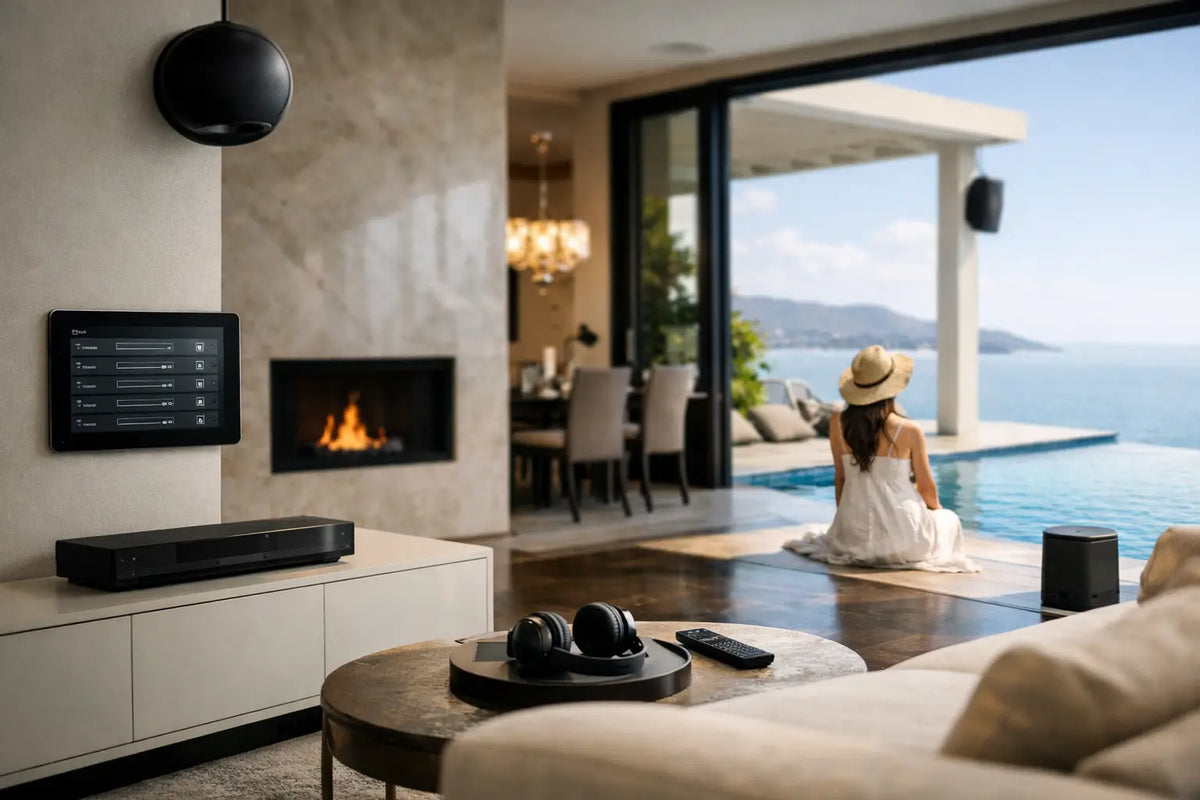
A home can have exceptional finishes, considered lighting, and beautifully proportioned rooms, yet still feel incomplete when sound is limited to one space. A multi zone audio guide begins with a simple principle: every area should sound appropriate to its purpose, while remaining effortless to control. Morning music in the kitchen, a refined playlist on the terrace, and cinema-grade impact in a dedicated theater can coexist without competing for attention.
For luxury residences and high-specification commercial environments, multi-zone audio is not simply about adding speakers to more rooms. It is an engineered soundscape that brings atmosphere, convenience, and architectural harmony to the entire property.
What Multi-Zone Audio Really Means
A multi-zone audio system divides a property into independently controlled listening areas, or zones. A zone may be a single room, such as a study or primary suite, or a group of connected spaces, such as an open kitchen, dining room, and family room. Each zone can play its own source at its own volume, or multiple zones can be grouped to play the same audio together.
That distinction changes how a property is experienced. A family member can enjoy a podcast in the gym while guests listen to background jazz by the pool. During an event, the main living areas and garden can be grouped for a consistent soundtrack. Later, the system can return each area to its own setting without a complicated sequence of remotes, switches, and standalone speakers.
The best installations are designed around how people move through a space. Sound should follow the rhythm of daily life, not force occupants to adapt to the technology.
Why Audio Zoning Belongs in Premium Design
Luxury is often felt through details that do not demand attention. Concealed speakers, calibrated volume levels, and intuitive scene control preserve the visual integrity of the interior while making the home more engaging to live in.
A properly specified system also avoids the common weakness of portable or disconnected audio products: inconsistent coverage. One oversized speaker may fill a room with sound, but it rarely delivers even detail across a large living area. It may be too loud near the source and weak at the far end of the room. Distributed speakers, placed according to room dimensions, ceiling height, furnishing layout, and acoustic conditions, create a more balanced result.
For architects and interior designers, this is especially valuable. Ceiling speakers can be discreetly integrated into painted surfaces, outdoor speakers can be concealed within planting and landscape features, and wall speakers can be finished to complement the interior scheme. The system becomes part of the architecture rather than an afterthought placed on top of it.
A Multi Zone Audio Guide to Planning the Right System
The equipment matters, but planning matters first. A refined result starts before drywall is closed, millwork is installed, or ceiling details are finalized. Early coordination allows speaker positions, wiring routes, equipment ventilation, network coverage, and control interfaces to be resolved cleanly.
Start With How Each Space Will Be Used
Not every room needs the same sound system. A breakfast area may need gentle, even background music. A media lounge may benefit from deeper bass and more precise imaging. A home gym requires energy and sufficient output, while a bedroom needs quiet control and a low-level listening option that does not disturb the rest of the home.
Commercial applications require the same discipline. A retail environment may need carefully paced background music across several floors. A restaurant may require independent control for indoor dining, private rooms, reception, and terrace seating. In a mosque, school, auditorium, or fitness facility, zoning can support clearer communication as well as music playback.
The question is not simply, “Where should speakers go?” It is, “What should people hear here, and how should it feel?”
Define Zones With Purpose, Not Just Walls
A room is not automatically a zone. In an open-plan villa, the kitchen, dining area, and lounge may function as one entertaining space at certain times and as separate areas at others. The system should reflect that flexibility.
There is also a practical trade-off. More zones create greater independence, but they can add equipment, programming, and budget. Grouping adjacent low-priority spaces can be a smart choice when they are usually used together. By contrast, bedrooms, offices, outdoor areas, and entertainment rooms often justify independent control because their listening needs are distinctly different.
Choose the Right Speaker Type for the Architecture
In-ceiling speakers are a popular choice for living rooms, corridors, kitchens, bedrooms, and covered outdoor areas because they offer discreet coverage. In-wall speakers may be appropriate where ceiling construction is unsuitable or where a more directional presentation is desired. Architectural speakers can be finished or concealed to preserve highly curated interiors.
For gardens, pools, and terraces, weather-rated landscape speakers and buried subwoofers can create a far more natural result than mounting conventional speakers on exterior walls. The sound appears to come from the environment, spreads evenly across the space, and can remain enjoyable without excessive volume.
A dedicated cinema or media room is different again. It may call for a purpose-built surround sound system, acoustic treatment, subwoofer integration, and speaker placement tailored to the seating plan. Multi-zone audio can connect that room to the wider home, but it should not compromise the performance of the cinematic experience.
Plan Sources, Control, and Automation Together
Modern systems can provide access to streaming services, network music libraries, television audio, turntables, and other sources throughout the property. The ideal source selection depends on the household or venue. Some clients want a simple streaming-first experience; others want high-fidelity listening in selected rooms, including dedicated amplification and premium speakers.
Control should be equally considered. A well-designed interface can allow music to start from a touchscreen, keypad, phone, tablet, or voice control. For larger residences, programmed scenes are often more useful than individual commands. A “Morning” scene might activate soft music in the kitchen and dressing room. An “Entertain” scene can group the living spaces and terrace, adjust lighting, and set the appropriate initial volume.
Convenience should not come at the expense of privacy or reliability. Wired infrastructure, professional network design, and thoughtfully selected control platforms remain essential, particularly in large properties with multiple users and demanding audiovisual systems.
Sound Quality Depends on More Than Speakers
Premium audio is shaped by the relationship between equipment, room acoustics, and installation quality. Even excellent speakers can disappoint when they are placed without reference to the room. Hard stone floors, expansive glass, tall ceilings, and minimal furnishings can create reflections that reduce clarity and make music feel harsh at higher volumes.
Acoustic treatment is not always visually obvious, nor should it be. Absorptive wall finishes, acoustic ceilings, soft furnishings, discreet panels, and carefully managed speaker placement can improve intelligibility while protecting the character of the space. In cinemas, media rooms, and commercial venues, acoustic design is often the difference between loud sound and genuinely immersive sound.
Amplification is equally important. Each zone requires adequate power for its size, speaker sensitivity, and intended listening level. Underpowered systems can sound strained, while excessive output without appropriate calibration can create discomfort and disturb neighboring rooms. Engineering is what allows the system to feel effortless at both low and high volumes.
Avoid the Common Mistakes
The most expensive mistake is treating multi-room audio as a late-stage accessory. Retrofitting is possible, and wireless solutions can be useful where wiring is impractical, but early design typically provides cleaner installation, greater reliability, and more options for invisible integration.
Another mistake is using identical speaker specifications everywhere. A corridor, a double-height living room, and an outdoor dining terrace have different acoustic demands. Matching the solution to the application creates better performance and prevents unnecessary spending.
Finally, avoid building a system around too many disconnected apps and remotes. Premium technology should simplify daily life. If a guest cannot understand how to play music in a room within moments, the control experience needs refinement.
The Value of a Professionally Integrated System
A multi-zone system becomes more valuable when it works alongside lighting, shading, climate, security, and home cinema. This is where integration moves beyond convenience. Music can respond to a scene, turn off automatically when the property is armed, or provide appropriate ambiance as exterior lighting transitions into evening mode.
For developers, this level of coordination strengthens a property’s market appeal. For homeowners, it creates a residence that feels composed and personal from the moment they arrive. For commercial decision-makers, it provides reliable control of the customer or guest experience across multiple spaces.
I-Trust Systems approaches multi-zone audio as part of a complete environment, balancing acoustic performance, elegant design integration, dependable infrastructure, and simple control. The result is not a collection of speakers. It is a carefully orchestrated experience tailored to the property.
The right system should disappear into the background until the moment it is needed. Then, whether the occasion is a quiet morning, a family gathering, or a full-scale celebration, every space can sound exactly as it should.
Share:
Outdoor Speakers That Elevate Every Exterior
How Access Control Improves Security in Luxury Homes