

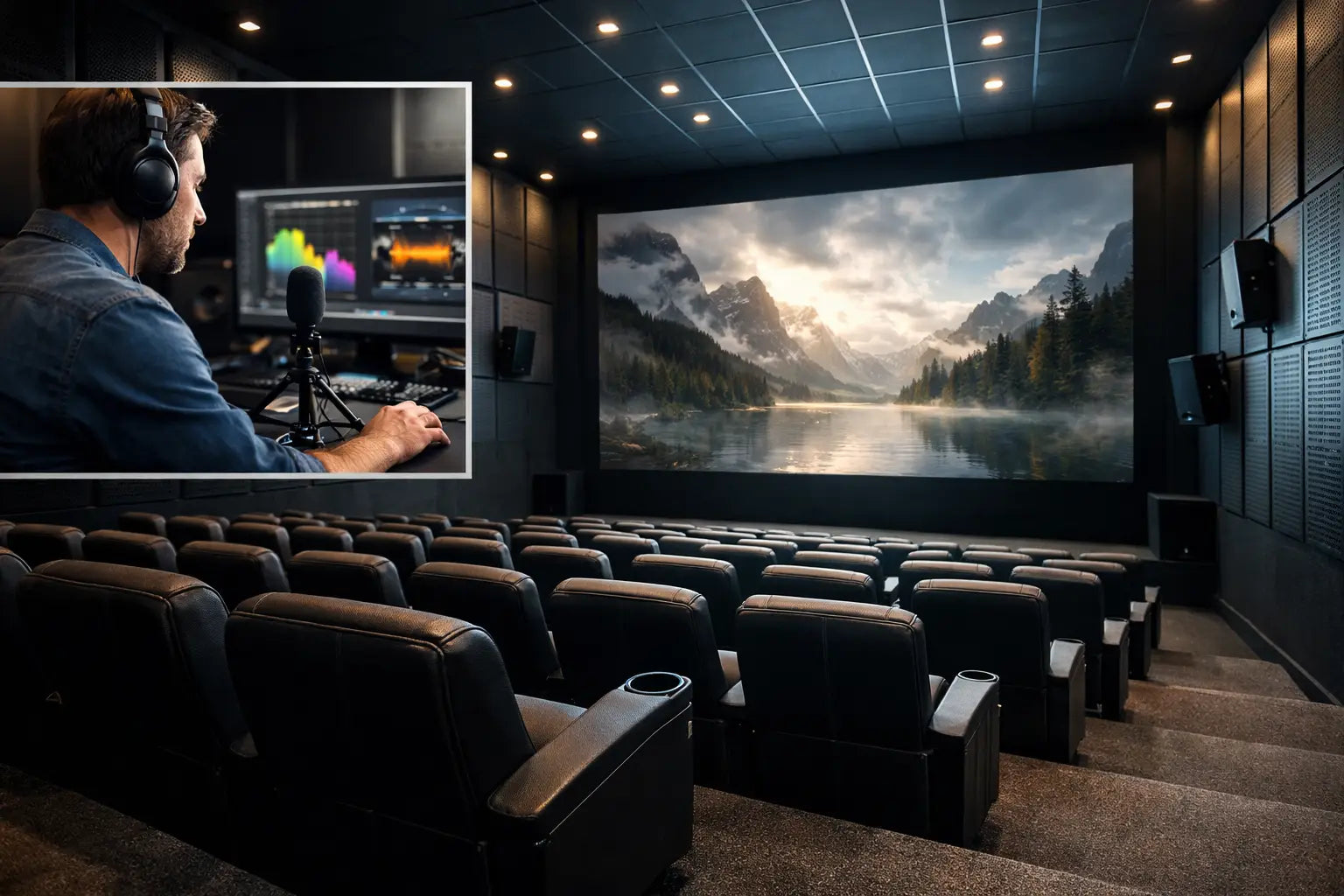
A private cinema can have an exceptional projector, a large-format screen, and beautifully tailored seating, yet still feel disappointing if dialogue is blurred, bass overwhelms the room, or sound carries into the rest of the home. To design cinema acoustics properly is to shape the room as carefully as the technology within it. The result is not simply louder sound. It is a more convincing, more private, and more emotionally engaging cinematic experience.
For luxury residences, acoustic performance should be considered at the earliest design stage. It influences room dimensions, wall construction, HVAC routing, lighting integration, furniture placement, and the finish materials that define the theater’s character. When these elements are coordinated from the beginning, the room can perform at a reference level without looking technical or overtreated.
Design Cinema Acoustics Around the Room First
Every cinema room has an acoustic personality before a single speaker is installed. Its length, width, ceiling height, openings, and construction materials affect how low frequencies build up, how reflections travel, and how easily sound escapes into adjacent spaces.
A square room is often challenging because similar dimensions can cause standing waves to reinforce at the same frequencies. This may produce bass that is powerful in one seat and almost absent a few feet away. A room with more varied proportions usually gives the design team a better starting point, although a carefully engineered system can improve even a constrained room.
Ceiling height matters as much as floor area. A higher ceiling can create a more generous sense of scale and make it easier to accommodate projector placement, acoustic clouds, concealed speakers, and architectural lighting. In lower-ceiling spaces, the design must be more precise. Layered ceiling details, shallow treatments, and carefully selected speaker locations can preserve both headroom and performance.
The best approach is to assess the space before interior finishes are finalized. Moving a doorway, revising a bulkhead, or adjusting the rear wall early in the process is far more elegant and cost-effective than trying to correct a finished room with visible panels later.
Sound Isolation Is Not the Same as Acoustic Treatment
These two disciplines are often confused, but they solve entirely different problems. Sound isolation limits sound transmission between the cinema and the rest of the property. Acoustic treatment controls how sound behaves inside the cinema itself. A high-performance theater usually needs both.
Isolation is essential when the room is near bedrooms, living spaces, a home office, or neighboring residences. It requires attention to mass, decoupling, airtight construction, and structural connections. Specialized wall and ceiling assemblies can reduce transmission, but their performance is only as strong as their weakest detail. A poorly sealed door, recessed light opening, or unplanned cable penetration can compromise an otherwise sophisticated build.
Doors deserve particular attention. A standard interior door is rarely adequate for a dedicated theater. Acoustic-rated doors, perimeter seals, automatic door bottoms, and properly designed frames help retain cinematic impact within the room. Where space and budget allow, a sound-lock entry with two doors can elevate privacy significantly.
Treatment addresses a different question: what does the audience hear once the sound is in the room? Bare glass, stone, polished plaster, and hardwood can be visually striking, but excessive hard surfaces create reflections that reduce clarity. Conversely, covering every surface with absorptive material can make a cinema feel lifeless and unnaturally dull. The goal is balance, not silence.
Control Reflections Without Losing Energy
In a well-designed theater, the front soundstage should feel focused and stable. Voices should appear to come directly from the actors on screen, even when the audience is seated off center. Surround effects should travel around the room with precision rather than becoming a vague wash of sound.
This is achieved by managing early reflections from side walls, ceilings, and the rear of the room. Acoustic absorption at critical reflection points improves intelligibility and stereo imaging. Diffusion can then scatter energy in a controlled way, helping the room feel spacious without introducing distracting echoes.
Fabric wall systems are particularly valuable in luxury cinema design because they can conceal absorption, diffusion, wiring, and speaker locations behind a refined finish. The visible surface may be a rich acoustic textile, timber detail, or custom panel composition, while the engineering works discreetly behind it. This allows the theater to retain the visual confidence of a designed interior rather than resembling a recording studio.
The amount of treatment depends on the room volume, seating capacity, speaker system, and intended use. A compact family cinema may need a different balance than a larger screening room designed for hosting guests. Multi-purpose spaces also require compromise. If a room must function as both a lounge and a cinema, adaptable furnishings, concealed treatments, and intelligent control presets become especially valuable.
Bass Requires Its Own Strategy
Low frequencies are where many impressive-looking cinemas fail. Subwoofers produce the impact behind an engine note, a score’s deepest swell, or a cinematic explosion, but bass energy is difficult to control because of its long wavelengths.
Placing one subwoofer in a corner may create dramatic output, but it can also exaggerate room modes and make bass uneven across the seating area. Multiple subwoofers, positioned and calibrated as a system, can provide more consistent results from seat to seat. This is often the more refined solution for a premium theater, even if the overall volume is never pushed to extremes.
Bass traps and purpose-built low-frequency treatment can further reduce boominess, particularly in smaller rooms. These treatments do not need to be visually intrusive. They can be integrated behind front walls, within risers, at rear corners, or inside architectural millwork.
Integrate Speakers, Screen, and Seating as One System
Acoustics cannot be separated from AV engineering. Speaker placement, screen type, seating layout, and room treatment must be designed together.
For a truly cinematic presentation, the front left, center, and right speakers should be positioned with the screen in mind. An acoustically transparent projection screen allows speakers to sit behind the image, aligning dialogue and on-screen action more naturally. This arrangement also preserves the visual purity of the front wall, especially when paired with concealed acoustic treatment and a custom proscenium detail.
The main listening position should not be placed arbitrarily in the center of the room. Center placement can coincide with problematic bass behavior. A professional design considers sightlines, screen viewing angles, riser height, speaker coverage, and acoustic response before finalizing seat locations.
Seating itself affects acoustics. Large leather recliners absorb and reflect sound differently from slim upholstered chairs. A room with two rows requires thoughtful elevation, adequate space behind the rear seats, and speaker locations that serve every guest rather than only the front row. Comfort and performance should reinforce each other.
Keep Mechanical Noise Out of the Experience
Even an expertly treated theater can be undermined by a noisy air-conditioning system, projector fan, or equipment rack. Mechanical noise is especially noticeable during quiet dialogue and atmospheric scenes.
HVAC should be designed with low-noise ducts, appropriate air velocity, isolated equipment, and carefully planned supply and return locations. The equipment rack may need ventilation, but it should not introduce audible fan noise into the theater. Locating source equipment outside the room is often preferable when project conditions allow.
Lighting and automation should also support the room’s acoustic design. Quiet motorized curtains, dimmable architectural lighting, concealed control interfaces, and scene-based operation remove distraction from the experience. At I-Trust Systems, this level of coordination is central to creating cinemas that feel composed, not assembled from separate products.
Calibrate After Installation, Then Fine-Tune by Ear
No cinema acoustic plan is complete when construction ends. Measurement and calibration translate the design into real-world performance. Professional tools can identify response irregularities, timing differences, and speaker level variations that are not obvious by sight alone.
Digital room correction can be highly effective, particularly at low frequencies, but it is not a substitute for proper construction and treatment. Software cannot stop sound passing through a door, correct an unsuitable room shape, or fully resolve uncontrolled reflections from hard surfaces. It should be the final layer of refinement, not the first solution.
Once the system is measured, listening matters. A theater should be tested with familiar dialogue, orchestral music, action sequences, and quieter dramatic scenes. The objective is clarity at realistic listening levels, controlled impact when the soundtrack demands it, and a consistent experience throughout the seating area.
A remarkable cinema does not announce its acoustic engineering. It lets every whisper remain intelligible, every musical cue feel dimensional, and every powerful scene arrive with authority while the technology disappears into the room. That is the standard worth designing for before the first wall is closed.
Share:
10 Best Smart Lighting Scenes for Luxury Homes
12 Villa Lighting Control Ideas That Feel Effortless