

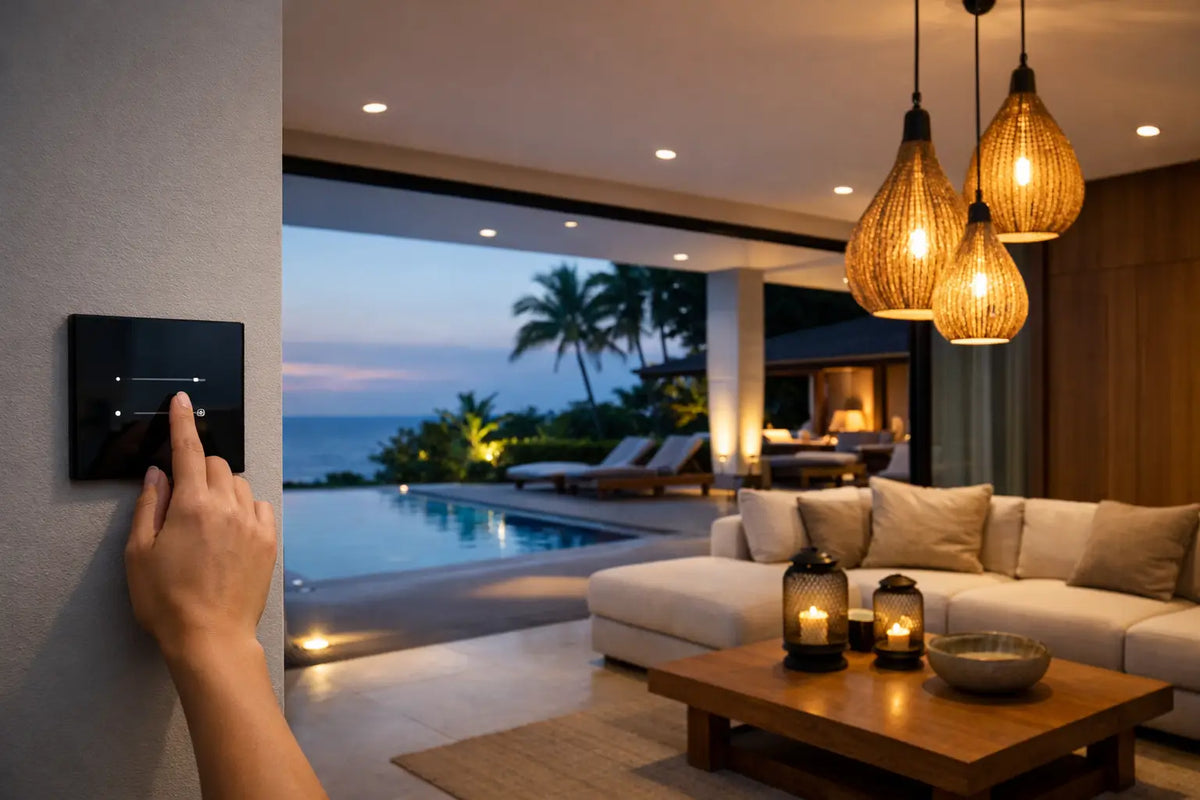
A beautifully designed villa can lose its impact the moment every light is controlled by a different switch, remote, or mobile app. The strongest villa lighting control ideas do more than turn fixtures on and off. They shape atmosphere, protect the architecture after dark, support daily routines, and make a large residence feel composed rather than complicated.
For premium homes, lighting control should be considered early, alongside interior finishes, HVAC, curtains, security, and AV. Retrofitting is possible, but a considered design during construction or renovation gives the system the cleanest appearance, the most reliable wiring strategy, and the best result for every room.
Start With Light Layers, Not Individual Fixtures
The foundation of sophisticated lighting is layering. A villa should rarely depend on one ceiling light to carry an entire space. Ambient light establishes the room's overall brightness, accent light reveals art, textures, joinery, or architectural details, and task light supports reading, cooking, dressing, and work.
Control these layers independently, then bring them together in scenes. In a formal living room, for example, recessed downlights may provide general illumination, wall washers may emphasize stone or artwork, and decorative pendants may become the visual centerpiece. A single keypad can activate each element at the appropriate level without requiring the homeowner to manage multiple circuits.
This approach is especially valuable in villas with double-height spaces, open-plan reception areas, statement staircases, and extensive glazing. The larger the volume, the more important it becomes to give light a clear purpose.
Build Scenes Around the Way the Villa Is Used
A scene is a pre-programmed lighting setting that adjusts multiple fixtures at once. It is the difference between owning dimmers and living with a genuinely intelligent environment. Rather than presenting a long list of controls, define scenes around moments that happen naturally in the home.
Arrival Should Feel Considered
An arrival scene can illuminate the driveway, entrance path, façade, foyer, and selected living areas at a welcoming level. If the residents return late, the system can also lower curtains, adjust the air conditioning, and activate a discreet security status display. The home responds before anyone reaches for a switch.
The goal is not to make every light bright. Excessive entrance lighting can flatten architecture and create glare through large windows. Better results come from guiding the eye: softly lit landscaping, a defined front door, and enough interior light to create warmth from the exterior.
Entertaining Needs Flexibility
A villa often hosts more than one kind of gathering. A dinner party, a family celebration, and a formal reception each need different lighting balance. An entertaining scene might reduce direct downlighting, raise concealed cove lighting, illuminate artwork, and create a gentle glow in circulation areas.
The dining table deserves particular attention. Decorative lighting over the table should be dimmable and carefully positioned, while surrounding light remains low enough to keep guests comfortable. If the villa includes a bar, majlis, lounge, or outdoor terrace, coordinated scenes allow the event to flow from one area to the next without visual interruption.
Evening and Night Modes Protect Comfort
Bright white light after sunset can make a refined home feel clinical. An evening scene should transition gradually toward warmer, lower-level illumination in bedrooms, lounges, and hallways. This is not only more inviting, it also makes polished materials, timber, fabrics, and stone feel richer.
For night mode, use low-level pathway lighting rather than overhead fixtures. A hallway, dressing room, bathroom route, or staircase can illuminate at a very low percentage when motion is detected. This protects sleep, reduces glare, and provides safe navigation for children, guests, and older family members.
Use Daylight to Your Advantage
Villas with expansive windows are often flooded with natural light, but sunlight changes significantly throughout the day. Lighting control becomes more effective when it works in partnership with automated shades and curtains.
Daylight sensors can reduce artificial lighting where natural brightness is already sufficient. Motorized window treatments can lower during peak afternoon sun to protect furnishings and reduce heat gain, then rise again as daylight softens. The right strategy preserves views while helping HVAC systems operate more efficiently.
This must be designed room by room. A west-facing family room needs a different response from a north-facing study. In spaces with dramatic views, fully automatic shades may feel intrusive if they move at inconvenient times. A thoughtful system allows automation to manage routine conditions while giving residents immediate manual control from a keypad, touchscreen, or app.
Make Keypads Part of the Interior Design
Wall controls are among the most frequently touched elements in a home. In a luxury villa, a bank of mismatched switches can undermine even the most carefully finished interior. Replace visual clutter with elegant, engraved keypads that control scenes rather than individual fixtures.
A typical main keypad might include Arrival, Entertain, Relax, All Off, and Night. Bedrooms may include separate controls for bedside reading, dressing, and blackout shades. The labels should be intuitive enough for guests to understand without instruction.
Finish selection matters. Keypads can be coordinated with wall finishes, metal hardware, and interior detailing so that the technology feels intentional, not added afterward. In some projects, discreet keypads are preferable. In others, a sculptural control surface is part of the design language. The answer depends on the architecture and the client's preferences.
Extend Control Beyond the Main Rooms
Some of the best villa lighting control ideas focus on spaces that are easily overlooked. A dressing room benefits from bright, high-quality task lighting around mirrors, with softer general light for early mornings and late evenings. A pantry or service corridor benefits from occupancy sensors. A home office needs lighting that supports screen work without reflections. A gym may need energizing brighter scenes for training and low-level settings for stretching or recovery.
Home cinemas require even more precise control. Step lights, wall sconces, cove lighting, and screen-adjacent fixtures should be independently dimmable. A movie scene can lower lights slowly as the projector starts, close curtains, and activate the AV system. During a pause, lighting can rise just enough for guests to move safely without breaking the atmosphere.
In bathrooms, lighting should be practical without becoming harsh. Consider separate vanity, shower, cove, and night-light circuits. High-quality dimming is essential here, particularly when glossy stone, mirrors, and glass can amplify glare.
Treat Exterior Lighting as Part of the Architecture
Landscape and façade lighting should not be an afterthought. At night, exterior lighting defines how the villa is perceived from the street and how the property feels from inside. It can highlight mature trees, textured walls, water features, entry columns, and outdoor art while maintaining dark areas that preserve depth and privacy.
Avoid the temptation to light every surface. A controlled composition is more elegant than excessive brightness. Downlighting from trees can create a natural moonlight effect over pathways, while low-angle grazing can reveal the character of stone or textured cladding. Pool lighting, terrace lighting, and garden pathways should work together without reflecting aggressively into bedrooms or neighboring properties.
Automation also improves exterior security. The system can follow astronomical timing, activate selected zones when a gate opens, or trigger brighter pathway and perimeter lighting when integrated with approved security events. These responses should be carefully calibrated. Security lighting must be useful, but it should not make the property feel exposed or disrupt the calm of the home.
Choose Dimming Technology With the Fixtures in Mind
Premium lighting control depends on compatibility. Not every LED fixture dims in the same way, and not every dimmer produces smooth, flicker-free performance at low levels. A beautiful lighting plan can be compromised by poor driver selection, mismatched control protocols, or inadequate load planning.
For villas, the choice may involve phase dimming, 0-10V, DALI, or other professional control approaches. There is no universal answer. The best option depends on fixture specification, project scale, desired integration level, wiring infrastructure, and future expansion plans.
This is where engineering matters. A lighting control specialist should review fixture schedules, LED drivers, dimming curves, emergency requirements, panel capacity, and control locations before installation. Mock-ups are worthwhile for feature spaces such as formal lounges, bedrooms, façade lighting, and cinema rooms. Seeing the actual fixtures dim at night can prevent expensive revisions later.
Integrate Lighting With the Whole Home
Lighting becomes more valuable when it communicates with the wider villa system. A Goodnight scene can turn off selected lights, lower shades, arm designated security zones, and set bedrooms to a comfortable temperature. An Away scene can switch off nonessential circuits, close curtains, and simulate occupancy in selected areas if desired.
Voice control and mobile apps can be useful, particularly for quick adjustments, but they should not replace physical controls. A premium home needs dependable keypads that work instantly, even when a phone is unavailable or a guest is unfamiliar with the system. The best experience combines tactile control, intelligent automation, and discreet access from a mobile device.
For large residences, centralized monitoring also helps identify a failed driver, offline device, or programming issue before it becomes a daily inconvenience. I-Trust Systems approaches lighting as part of a complete connected environment, aligning control, AV, climate, curtains, and security around the way the property is actually lived in.
Design for Change, Not Just Opening Day
A villa evolves. Families change, rooms gain new functions, and owners may add artwork, renovate a wing, or convert a lounge into a study. A system with spare panel capacity, clear documentation, and scalable programming can adapt without dismantling finished walls.
Ask early how the system will be serviced, who will maintain the project records, and whether new scenes can be added after handover. Reliable hardware is essential, but long-term value also comes from thoughtful commissioning and support.
The finest lighting control is rarely noticed as technology. It is felt in the calm of a softly lit corridor, the drama of an evening façade, and the ease of one button that makes the entire villa feel exactly right.
Share:
How to Design Cinema Acoustics for Pure Immersion
A Villa Automation Project Example That Works