

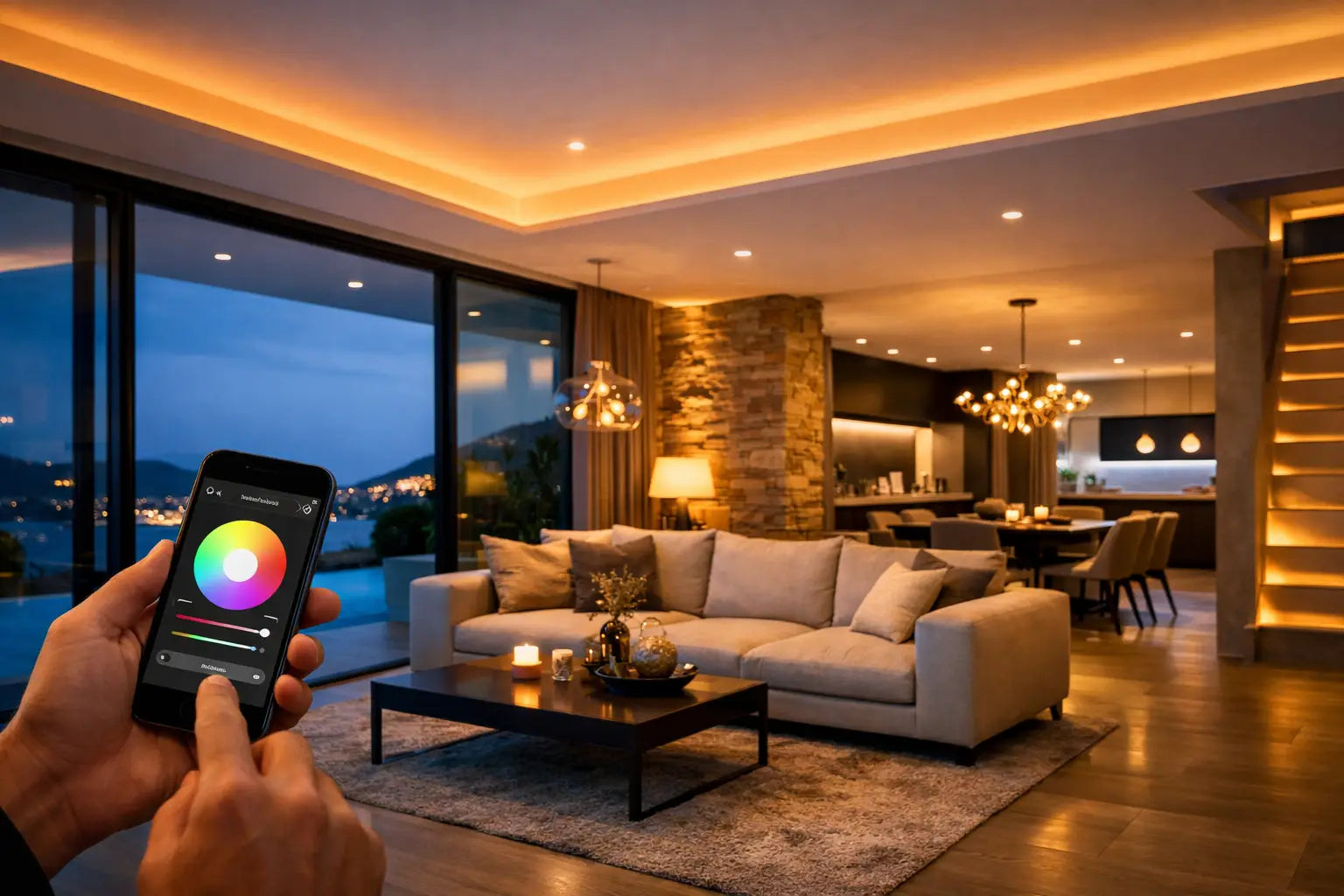
A beautifully designed home can lose its impact the moment every light comes on at full brightness. The best smart lighting scenes do more than switch fixtures on and off. They shape how an entry feels at arrival, how artwork is perceived, how a dinner table photographs, and how easily a family moves from a lively evening to a quiet night.
For a luxury residence, lighting scenes should feel invisible in operation and exacting in effect. One touch, a keypad command, a voice request, or a sensor trigger can coordinate architectural lighting, decorative fixtures, motorized shades, climate settings, audio, and security. The result is not simply convenience. It is a home that responds with the right atmosphere at the right moment.
What Makes a Lighting Scene Worth Designing?
A scene is a pre-programmed combination of lighting levels, color temperature, fixture groups, and often connected systems. The strongest scenes are not built around novelty. They are built around the daily rhythms of the people who live in the property.
That distinction matters. A scene with saturated color effects may be impressive for a few minutes, while a carefully tuned evening scene can improve comfort every day for years. In premium interiors, restrained layering usually delivers the most refined result: warm indirect light, subtle accents, controlled glare, and focal illumination where it supports architecture, art, or activity.
The exact settings depend on the room, daylight exposure, finishes, ceiling height, and fixture specification. A polished stone floor, for example, may require lower output than a matte timber floor to avoid harsh reflections. This is why scene design should follow lighting design and commissioning, not replace it.
1. Arrival: A Composed Welcome Home
An arrival scene establishes the experience before anyone reaches the front door. Exterior pathway lights, façade accents, landscape lighting, and the entrance canopy can rise gradually as the gate opens or the driveway sensor detects a vehicle. Inside, the foyer, corridor, and key living areas can come alive at a warm, welcoming level.
This scene is particularly effective when it also opens selected curtains after sunset, adjusts the AC to an occupied setting, and disarms designated security zones. It should feel gracious rather than theatrical. Avoid illuminating every room at once. The goal is to create an inviting visual route through the home while preserving the calm of unoccupied spaces.
2. Morning: Gentle Light Before the Day Begins
The morning scene is best designed as a gradual transition, not an abrupt command. Bedroom cove lighting can begin at a very low warm level, then increase over 10 to 20 minutes. Motorized shades can open in stages to introduce daylight without creating glare, especially in east-facing rooms.
In a primary suite, this scene can extend to the bathroom, wardrobe, and kitchen. The wardrobe may need clear, high-quality task lighting, while the bathroom benefits from flattering vertical illumination around the mirror. The kitchen can shift toward a cleaner, more alert color temperature without becoming cold or clinical.
For households with different schedules, personal scenes are more useful than a single whole-home morning command. One resident may want a soft 5:30 a.m. route to the gym, while another prefers blackout shades and darkness until later.
3. Entertain: A Room Designed for Conversation
A successful entertaining scene gives the room depth. Rather than flooding a living room or formal lounge with overhead light, it layers indirect ceiling illumination, wall-washers, table lamps, and discreet accents around art, joinery, and textured materials. Guests can see one another clearly, but the space still has shadow, warmth, and visual hierarchy.
For dining, the pendant or chandelier should remain the focal point, typically dimmed enough to flatter faces while still illuminating the table. Peripheral lighting should be lower than the dining zone. If every fixture is equally bright, the room becomes visually flat.
This scene can also activate multi-room audio at a background level and set shades for privacy. For large villas, it may be useful to create separate scenes for an intimate dinner, a family gathering, and a larger reception. More people generally require brighter circulation areas, but not necessarily brighter seating areas.
4. Dinner: Focused, Warm, and Unhurried
Dinner deserves its own scene because it is more focused than general entertaining. The dining table should be illuminated with warmth and precision, while nearby spaces recede. A warm dimming range is especially valuable here, allowing light to feel increasingly candle-like as the evening progresses.
Avoid strong downlights aimed directly at chairs or reflective dining surfaces. They create facial shadows and unwanted glare. Instead, combine decorative light over the table with soft wall illumination and low-level ambient light around the room perimeter.
In open-plan homes, the dinner scene can subtly dim the kitchen after service while maintaining safe task lighting at the island. This keeps the dining area visually composed without making the rest of the space inconvenient to use.
5. Cinema: The Best Smart Lighting Scene for Immersion
A dedicated cinema requires more than a simple “lights off” button. The cinema scene should lower the room in stages: sconces and ceiling accents fade down, step lights remain at a safe low level, blackout shades close, and the projector, screen, AV processor, and surround sound system prepare for playback.
For a bespoke cinema, the scene should be calibrated around the screen and room finishes. Any direct light on the screen compromises contrast. At the same time, complete darkness can make movement uncomfortable. Low-level aisle, riser, or floor lighting solves this without distracting from the image.
A pause scene is equally valuable. When the movie pauses, selected lights can rise gently to around 20 to 30 percent, allowing guests to move, refresh drinks, or speak comfortably. When playback resumes, the system returns to the previous viewing state with one command.
6. Relax: A Softer Version of Evening
Relax is the scene most homeowners use without thinking about it. It is ideal for reading, casual television, quiet conversation, or simply settling into the home after work. Living areas shift to warm, lower-level lighting, with decorative and indirect sources doing most of the work.
This scene should not be too dark to function. Reading corners need localized task lighting, and circulation routes should remain visible. The difference lies in control: the room is no longer lit for cleaning, hosting, or work. It is lit for restoration.
In spaces with premium artwork or architectural stone, a carefully restrained accent level can maintain character after dark. The purpose is to reveal texture and form, not turn every feature into a display.
7. Work: Clear Light for Focus and Video Calls
A home office scene must prioritize visual performance. Desk lighting should reduce eye strain, while ambient light balances contrast between screens and surrounding surfaces. If video calls are frequent, front-facing light should be soft and even, avoiding strong backlighting from windows.
Color temperature is a matter of preference and time of day. Many people work well with a neutral white setting, while warmer light may be preferable in the late afternoon. The key is consistency. A workspace should not change dramatically every time clouds pass overhead or someone adjusts a dimmer.
For executive home offices, smart shading is often as important as smart lighting. Automated shades can manage daylight glare and preserve the exterior view, which is preferable to closing heavy drapery during the working day.
8. Night Path: Safe Movement Without Waking the Home
Night Path is one of the most practical scenes in an intelligent home. Motion sensors can trigger low-level lighting in bedrooms, dressing areas, hallways, bathrooms, and stairs after a chosen hour. The light should be warm and dim enough to protect night vision, not bright enough to signal morning.
This is especially valuable in multigenerational homes, properties with children, and large residences where bedrooms are separated from kitchens or guest suites. It also reduces the need to search for switches in the dark.
A well-designed Night Path scene should be localized. If someone walks into a bathroom at 2 a.m., the entire floor should not illuminate. Presence detection, timed fade-outs, and carefully zoned fixtures keep the home quiet and discreet.
9. Away: Security That Still Looks Lived In
An Away scene can turn off nonessential interior loads, close shades, adjust HVAC setbacks, arm security, and activate selected exterior lighting. However, a premium property should not appear abandoned. Vacation lighting can vary selected interior lights at realistic times, especially in street-facing areas.
The trade-off is energy use versus perceived occupancy. A highly active simulation may be unnecessary in a gated community with full-time security, while an isolated property may benefit from more deliberate patterns. Integration with gate access, surveillance, and perimeter lighting makes this scene considerably more effective than lighting control alone.
10. Goodnight: Close the Home with One Command
The Goodnight scene is the final check that should not require walking through the entire property. It turns off main living areas, lowers or closes shades, confirms doors and security status, adjusts climate settings, and leaves only necessary bedroom and pathway lighting active.
For larger homes, Goodnight can be configured by zone. Parents may close the ground floor while keeping children’s rooms active, or a guest wing may remain independent from the primary suite. This level of control feels far more considered than a single whole-home shutdown.
How to Make Scenes Feel Bespoke, Not Preprogrammed
The most successful smart lighting scenes are refined after the installation, when the home is furnished and occupied. Fabric colors, art placement, furniture layouts, and personal habits all affect the final settings. A scene that looked correct in an empty room may need lower levels once reflective surfaces and decorative fixtures are in place.
Physical keypads also deserve careful planning. The most frequently used commands should be obvious, elegantly labeled, and available where people naturally enter a room. Apps are useful for adjustment, but a luxury home should never require a phone just to create a comfortable atmosphere.
At I-Trust Systems, scene programming is approached as part of a complete environment: lighting, shades, AV, climate, and security working with the architecture rather than competing for attention. The finest result is not a house that feels automated. It is a house that feels instinctively ready for the life taking place inside it.
Start with the moments that happen every day - arriving home, dining, relaxing, and going to bed - then let the technology earn its place through comfort, beauty, and effortless control.
Share:
How to Automate Villa Curtains in Style
How to Design Cinema Acoustics for Pure Immersion