

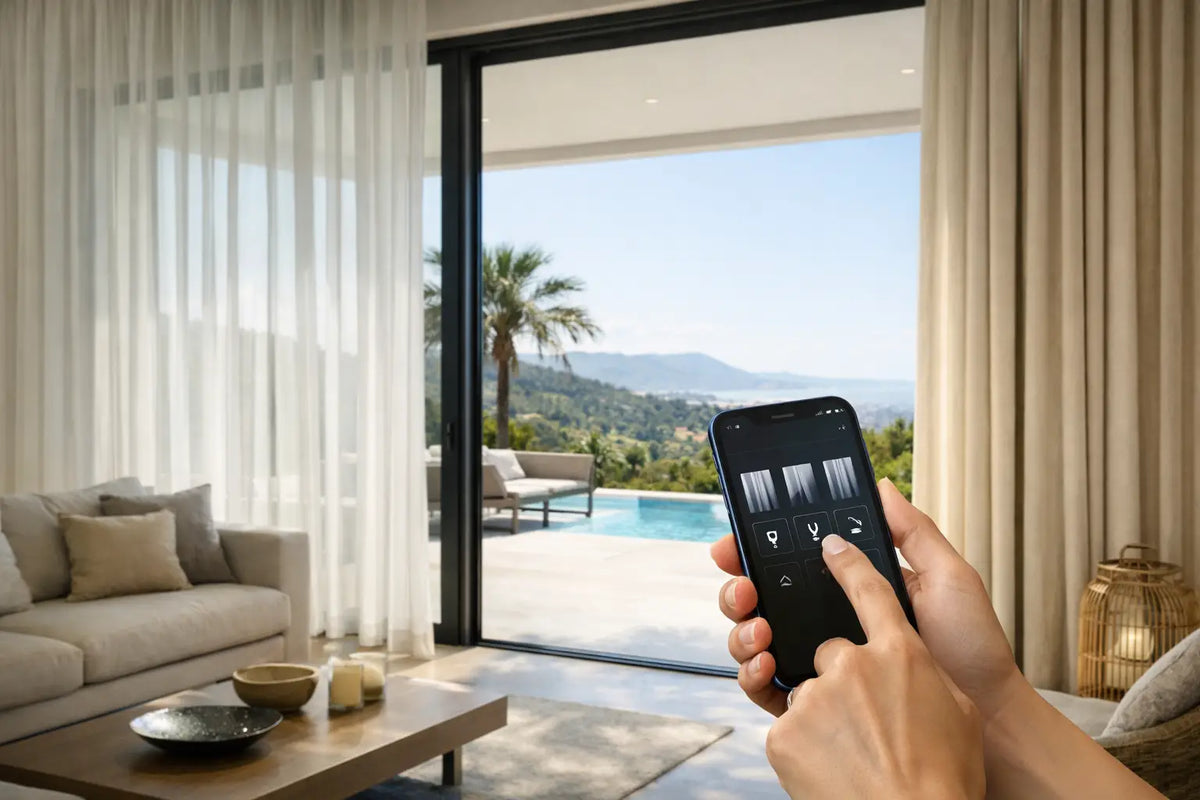
A villa’s most impressive spaces are often defined by light: morning sun across a double-height living room, garden views from a primary suite, or the soft glow that sets the tone for an evening reception. To automate villa curtains is to make those moments intentional. Rather than walking from room to room to adjust heavy drapes, homeowners can shape privacy, comfort, and ambiance with a touch, a schedule, or a scene designed around the way they live.
Curtain automation is not simply a motor added to a track. In a luxury residence, it is a carefully engineered layer of the wider environment - coordinated with lighting, climate control, security, and audiovisual systems while remaining visually discreet. The result should feel effortless: curtains that open silently at sunrise, shades that reduce glare before a film begins, and drapery that closes as the home transitions into the evening.
Why Automate Villa Curtains?
Large villas present a particular challenge. They often feature expansive glazing, tall windows, multiple facades, and richly layered window treatments. Manual operation becomes inconvenient quickly, especially where curtains are high, wide, unusually heavy, or located in rooms used only at certain times of day.
Automation brings a level of consistency that manual control cannot. In a west-facing family room, curtains can respond to the strongest afternoon sun to protect furnishings and maintain a more comfortable indoor temperature. In bedrooms, blackout drapes can close automatically at night and open gently in the morning. For a home that is unoccupied for part of the year, programmed curtain movement can also support a more lived-in appearance.
The appeal is equally aesthetic. A well-designed system preserves the architecture and interior design rather than competing with it. Tracks may be recessed into a ceiling pocket, concealed behind a pelmet, or integrated into custom joinery. Motors are selected for their quiet operation and appropriate pulling capacity, so even full-height, lined drapery moves with composure.
Start With the Window Treatment, Not the Technology
The most successful projects begin before the final curtains are ordered. Fabric weight, heading style, lining, stack-back allowance, window geometry, and ceiling detail all affect the motorized solution. A curtain that looks exceptional in a sample room may need a different track configuration once it spans a 20-foot wall of glass.
There are two primary categories to consider: decorative drapery and functional shades. Drapery introduces softness, acoustic warmth, and a more formal visual presence. Roller shades, Roman shades, and other shading systems can offer more precise solar control with a cleaner architectural profile. Many villa interiors use both: a discreet shade for daytime glare and UV management, paired with drapery for privacy and evening atmosphere.
This is where early coordination with the architect and interior designer matters. Ceiling pockets must be correctly sized, power provisions need to be planned, and access for future service should be considered without compromising the finish. Retrofitting is possible in many cases, but new construction and renovation projects offer the greatest freedom to conceal equipment and deliver a truly tailored result.
Motor Selection Is About More Than Strength
A motor must be sized for the total weight of the treatment, the track length, and the configuration. Center-opening curtains, single-stack systems, curved tracks, and angled windows each require specific planning. Heavy interlined drapes may call for a higher-capacity motor, while a lightweight sheer in a guest suite can use a more compact solution.
Noise is another important consideration. Premium systems are designed to operate quietly, but the track quality, installation accuracy, and fabric construction influence the final experience. In bedrooms, home theaters, and contemplative spaces, quiet movement is not a luxury detail - it is part of the performance standard.
Ways to Automate Villa Curtains
The right control method depends on the home’s size, the owner’s habits, and the level of integration desired. A standalone remote control can suit a single room or a limited retrofit. For a full villa, centralized automation usually delivers a more refined and practical outcome.
Wall keypads provide immediate, intuitive control at the point of use. A bedside keypad might offer Open, Close, and Stop functions alongside lighting scenes. In a living area, one engraved button can prepare the room for entertaining by lowering shades, adjusting the lights, and starting background music.
App control adds flexibility, particularly when homeowners are traveling or managing multiple residences. Voice control can be useful for simple commands, although it should complement rather than replace physical controls. Guests, children, and household staff should be able to operate essential functions without needing to locate a phone or remember a voice command.
The most elegant option is scene-based control. Instead of asking a homeowner to manage each treatment individually, the system responds to a purpose:
- Good Morning opens bedroom curtains gradually, raises selected shades, and activates a gentle lighting scene.
- Away Mode closes vulnerable ground-floor treatments, adjusts lighting behavior, and supports the home’s security routine.
- Cinema Mode lowers blackout shades or closes drapery, dims the room, and prepares the audiovisual system.
- Entertain balances privacy and views across principal living spaces while setting the desired lighting atmosphere.
Integrate Curtains With Light, Climate, and Security
Curtains become far more valuable when they are part of a connected home rather than an isolated feature. A lighting system can signal the transition from day to evening, prompting drapery to close at a chosen level of exterior darkness. Climate control can use shading as a supporting strategy, reducing solar gain before HVAC equipment has to work harder.
In rooms with delicate finishes, artwork, hardwood floors, or luxury textiles, automated shades can help limit prolonged direct sunlight. This does not eliminate the need for proper glazing and interior material selection, but it gives homeowners a more disciplined way to manage exposure.
Security integration deserves a measured approach. Closing curtains at night can add privacy, and selected scenes can be triggered when the alarm is armed. However, security should never depend solely on visible curtain movement. A complete strategy includes properly designed access control, surveillance, perimeter protection, and reliable automation programming.
For a home cinema, automated drapery has a particularly dramatic role. When the room shifts from a social lounge to a dedicated viewing environment, curtains can close, lights can dim, and the screen or projector can activate in a coordinated sequence. The technology disappears into the experience, which is exactly the point.
Design Details That Separate a Premium Installation
A premium curtain automation project is defined by what is not obvious. Wiring is planned rather than exposed. Track alignment is exact. Curtain returns, overlap, and stack-back are calculated so the treatment opens cleanly without covering more glass than necessary. Controls are positioned where they are useful, not simply where there was an available wall box.
Power should be addressed early. Hardwired motors are generally ideal for new builds and major renovations because they avoid the ongoing maintenance associated with batteries. Battery-powered systems can be valuable for selective retrofits where routing power would disturb finished walls or ceilings. The trade-off is straightforward: batteries offer installation flexibility, while wired systems offer long-term convenience and consistency.
Reliability also depends on the control infrastructure. In a large villa, professionally designed wired, wireless, or hybrid systems should account for construction materials, equipment locations, network stability, and future expansion. A single impressive demo is not the benchmark. Daily operation, serviceability, and graceful recovery after a power interruption are what define a dependable installation.
Planning a Curtain Automation Project
Begin with the rooms that will benefit most. Primary bedrooms, formal living areas, media rooms, glass-heavy spaces, and hard-to-reach windows are usually the strongest candidates. From there, establish whether the goal is privacy, glare control, energy management, theater performance, or a complete lifestyle experience. The answer determines the treatment type and control logic.
A detailed site assessment should document window dimensions, ceiling conditions, fabric specifications, electrical access, and the desired integration with other systems. It should also consider how the curtains will be used by everyone in the home. The owner may prefer app-based scenes, while staff may need simple wall controls and clear override options.
For villas under construction, include automation drawings in the electrical and interior design package early. For completed homes, prioritize solutions that respect the existing architecture and finishes. A thoughtful retrofit can still deliver a sophisticated result, but it requires careful coordination to avoid visible compromises.
I-Trust Systems approaches curtain automation as part of a complete intelligent environment, aligning engineering precision with the visual standards expected in luxury interiors. The goal is not to add another gadget to the home. It is to create a setting that responds beautifully, quietly, and reliably to every hour of the day.
The right automated curtains should never demand attention. They should simply make a sunrise more welcoming, a private evening more comfortable, and every carefully designed room feel exactly as it was meant to feel.
Share:
Commercial AV System Guide for Premium Spaces
10 Best Smart Lighting Scenes for Luxury Homes