

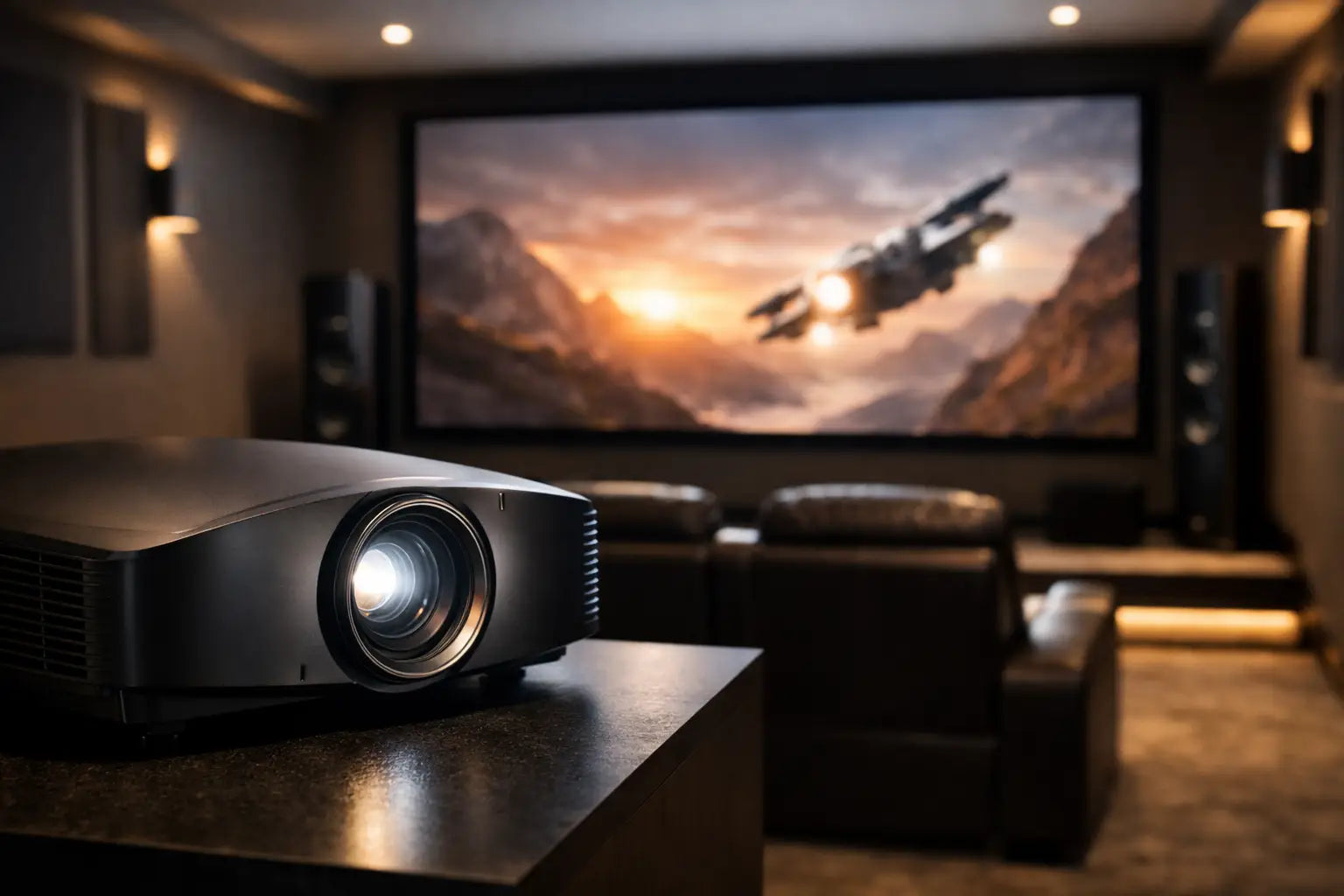
A luxury cinema room can carry exquisite seating, acoustic paneling, and beautifully integrated lighting, yet still feel underwhelming the moment the image appears flat, dim, or poorly scaled. That is why high end projectors for home theater deserve more attention than a simple spec-sheet comparison. In a serious media space, the projector is not just a display device. It is the visual engine of the entire experience.
The difference becomes obvious the first time a properly specified projector is paired with the right screen, calibrated to the room, and integrated with the rest of the environment. Blacks gain depth, motion feels composed rather than processed, and skin tones stop looking electronic. More importantly, the room starts behaving like a private cinema rather than a living room with expensive equipment.
What sets high end projectors for home theater apart
Premium projectors justify their position through image integrity, optical quality, installation flexibility, and long-term performance. Entry-level models often advertise impressive brightness or 4K compatibility, but that does not guarantee a convincing cinematic image. In high-performance rooms, contrast control and lens quality usually matter more than marketing shorthand.
A high-end projector is expected to resolve fine detail without harshness, maintain strong black levels in dark scenes, and preserve highlight information without washing out the rest of the frame. That balance is difficult to achieve. It depends on the imaging technology, the light source, the lens assembly, the video processing, and how well the projector is matched to the room itself.
There is also a tactile difference in premium categories. Better chassis design reduces vibration and fan noise. Better optics maintain focus consistency across the entire screen. Better installation tools allow the image to be placed precisely without compromising geometry. In a bespoke cinema, these details are not cosmetic. They are what separate a system that merely works from one that feels effortless.
The technologies behind a premium projection system
The conversation around projector technology usually centers on DLP, LCD, and LCoS-derived platforms. Each has strengths, and the right choice depends on priorities.
DLP projectors are often admired for crispness, stable motion, and a clean, punchy image. In some environments, especially where motion handling is critical, they can perform beautifully. The trade-off is that black level performance in darker rooms may not satisfy clients seeking the richest cinematic depth, and some viewers are sensitive to color breakup on certain designs.
3LCD systems typically offer strong color brightness and a vivid presentation. They can be highly effective in multipurpose spaces or rooms that are not entirely light controlled. However, for a reference-grade dark theater, some buyers may prefer alternatives that deliver more nuanced shadow detail and deeper apparent contrast.
LCoS-style projection, including premium implementations from leading cinema-focused brands, is often favored in dedicated theaters because it tends to produce exceptional black levels, smooth gradation, and a filmic character that suits serious movie viewing. These models are often priced accordingly, but for clients building a true cinema room, this is frequently where the image begins to feel appropriately luxurious.
Then there is the light source. Traditional lamp-based projectors can still offer excellent performance, especially in carefully chosen models, but laser projection has become increasingly attractive in premium installations. Laser light engines provide stronger consistency over time, faster startup, and less maintenance. That said, laser alone does not make a projector high end. A mediocre optical system with a laser badge is still mediocre.
Choosing for the room, not just the brochure
One of the most common mistakes in projector selection is buying for brightness alone. More lumens may sound reassuring, but in a dedicated home theater with proper light control, excessive brightness can actually work against a refined image if not balanced correctly with screen size, gain, and calibration.
The room should lead the specification. A dark, acoustically treated cinema with controlled surfaces can support a projector chosen primarily for contrast, tonal subtlety, and reference image quality. A family lounge that hosts sports during the day and movies at night may need a brighter, more flexible projector paired with an ambient light-conscious screen strategy. Neither approach is wrong. The mistake is applying the same answer to both spaces.
Screen size matters just as much. A projector that looks outstanding on a 110-inch screen may struggle to maintain impact at 160 inches. Throw distance also changes the conversation. If the room architecture limits placement, lens shift, zoom range, and optical performance at that distance become part of the decision. Premium rooms deserve precision here, because image geometry issues are far more noticeable when every other design element is refined.
Why lens quality matters more than many buyers expect
In upper-tier home cinema, the lens is often the quiet differentiator. It affects focus uniformity, edge clarity, light transmission, and perceived depth. A projector may claim impressive resolution, but if the lens cannot render that detail consistently across the image, the result is compromised before the content even reaches the screen.
This becomes especially relevant on large-format screens. In smaller installations, slight softness at the edges may go unnoticed. In a premium theater, where seating positions are optimized and viewers expect a composed image from every seat, lens precision becomes essential. This is one reason higher-end projectors command a significant premium. You are not paying only for brightness or chipset capability. You are paying for optical integrity.
HDR, contrast, and the reality of cinematic performance
Many buyers ask whether a projector can deliver the same HDR impact as a high-end flat panel. The honest answer is no, not in the same way. Projection and direct-view displays create brightness and contrast differently. A projector cannot brute-force specular highlights like a premium OLED or micro-LED panel.
What it can do, when properly selected and calibrated, is create scale, immersion, and image naturalism that a flat panel often cannot match. Good HDR on projection is about balance. It should preserve shadow depth, prevent highlights from clipping aggressively, and maintain believable color volume across varied scenes. In a true theater environment, that cinematic coherence often matters more than raw peak brightness.
This is where careful tuning becomes indispensable. High end projectors for home theater reveal their value when calibration is treated as part of the system rather than an optional afterthought. Factory presets are rarely enough for a luxury installation.
Integration is what makes the room feel effortless
The projector should never be considered in isolation. In premium homes, the visual system must align with audio design, lighting scenes, automation logic, ventilation strategy, and interior detailing. A projector that performs beautifully but creates fan noise, light spill, control friction, or awkward ceiling placement is not the right projector for that project.
This is why integrated cinema design matters. The projector has to work with the screen type, surround sound layout, source equipment, control interface, and room finishes. It may need to disappear into architectural millwork or coordinate with a lift mechanism. It may need dedicated cooling or precise mounting geometry. In luxury projects, elegance is not added at the end. It is engineered from the start.
For clients building a complete entertainment environment, this is where a specialist integrator adds real value. Companies such as I-Trust Systems approach projection as one component in a fully orchestrated experience, where image quality, acoustic performance, automation, and spatial design support one another.
When a premium projector is worth the investment
Not every room needs a flagship model. If the space has uncontrolled daylight, casual viewing habits, or limited attention to acoustics, a very expensive projector may never show its full capability. In those cases, budget may be better allocated across shading, sound treatment, screen selection, and control.
A premium projector becomes easier to justify when the room is purpose-built, the screen is large, the content is primarily film or prestige streaming, and the client expects a polished, cinematic result rather than a functional big picture. It also makes sense when design cohesion matters. In luxury homes, visual performance and architectural integration tend to be judged together.
The best buying decision is rarely about chasing the most expensive model. It is about selecting the projector that fits the room, the screen, the content, and the lifestyle of the client. Sometimes that means prioritizing native contrast. Sometimes it means installation flexibility, laser longevity, or quieter operation. The right answer is specific, and that is exactly why bespoke cinema design continues to outperform one-size-fits-all product shopping.
A great home theater does not begin with a projector and work outward. It begins with the experience you want to feel when the lights fade, the soundtrack rises, and the screen comes alive. Choose the projector that serves that moment with precision, and the room will reward you every time you press play.
Share:
Small Luxury Home Theatre Design Done Right
Why Is Smart Home Automation Important?