

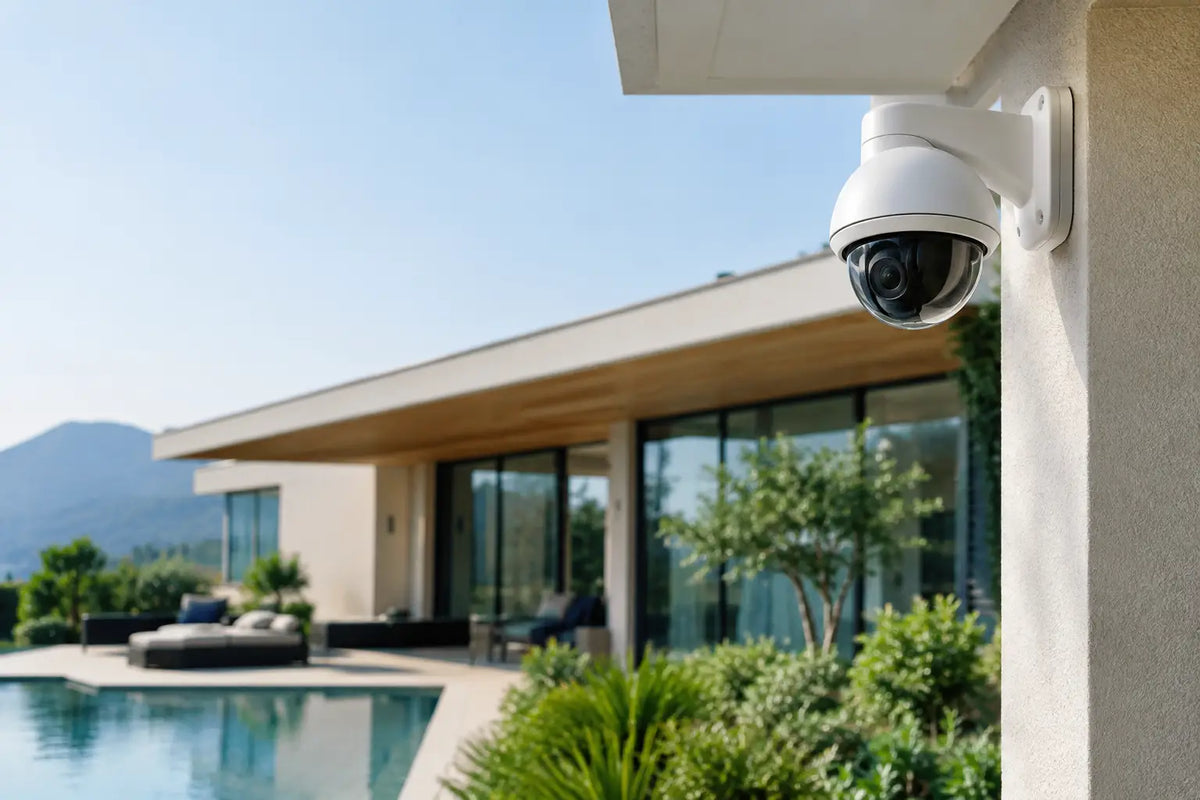
A luxury villa should feel open, composed, and private, not watched from every corner. Effective villa security camera placement protects the approach to the property, the spaces that matter most, and the people within it - while respecting architecture, landscaping, and everyday comfort. The difference is not simply the number of cameras installed. It is the discipline of placing each one with a clear purpose.
For an estate with layered boundaries, multiple entrances, guest areas, outdoor amenities, and service access, security design must begin before devices are selected. A camera that sees a face clearly at the front entrance serves a different role from one that tracks movement along a distant perimeter. When those roles are planned as part of a complete smart home system, the result is discreet protection with centralized, intuitive control.
Start With the Villa's Arrival Experience
The front gate, driveway, pedestrian entrance, and main door deserve the most deliberate attention. These points establish who arrives, when they arrive, and how they move toward the home. A camera at the gate should capture approaching vehicles and visitors before they reach the property, ideally with a view that supports license plate recognition where permitted and technically appropriate.
At the main entrance, the priority changes from broad awareness to identification. Position a camera at a height and angle that captures faces without looking straight down at visitors. A premium video doorbell or a discreetly integrated entrance camera can provide clear two-way communication while preserving the clean lines of stone, timber, metalwork, or glass.
Avoid mounting an entrance camera so high that it records only the top of a head, or so low that it is easily obstructed or tampered with. Lighting matters just as much. Strong backlighting from a glass facade or a bright driveway can compromise the image unless the camera and scene are designed to manage it.
Design Villa Security Camera Placement by Zone
A well-designed system treats the villa as a set of security zones, each with its own objective. This approach prevents a common mistake: using wide-angle cameras everywhere and assuming the entire property is covered. Wide views are useful for context, but they are not always suitable for identification.
Perimeter and Boundary Lines
Perimeter cameras should observe likely access routes rather than merely stare across large stretches of wall or landscaping. Place them at gates, side passages, rear boundaries, and points where someone could move from a neighboring property or public area toward the residence.
For expansive grounds, camera elevation and lens selection require careful engineering. A camera mounted too high may offer an impressive overview but weak detail at ground level. A lower, strategically placed unit near a passageway often provides a more useful image. Mature trees, architectural screens, water features, and seasonal growth should be considered early, as each can create blind spots over time.
Where the property has a long driveway, use more than one view when the layout warrants it. One camera can establish the vehicle's approach, while another captures the driver and vehicle at a controlled point closer to the gate or residence.
Exterior Living and Amenity Areas
Pools, terraces, outdoor kitchens, gardens, garages, and guest houses require a more nuanced approach. These are active lifestyle spaces, not simply exterior zones. Cameras should protect access points and circulation paths without creating an intrusive feeling for family members and guests.
For example, a camera aimed toward the gate leading into a pool area is usually more appropriate than one pointed directly at lounge seating. A view of the exterior door serving an outdoor kitchen can confirm access without constantly recording the dining area. This is where thoughtful placement supports security and preserves the relaxed atmosphere that makes a villa exceptional.
Garages and detached structures should receive dedicated coverage. In addition to the main garage door, consider side doors, internal access doors, storage rooms, and the route connecting the garage to the villa. These spaces often hold valuable vehicles, equipment, and direct paths into the home.
Service, Delivery, and Staff Access
Luxury residences frequently have a side gate, staff entrance, delivery point, utility yard, or back-of-house corridor. These areas should never be an afterthought. They can be among the busiest access points on the property, yet are often less visible from the main residence.
Place cameras to document arrivals and departures at service gates and doors, with coverage of delivery handoff areas where appropriate. A properly integrated system can send a discreet alert to a wall keypad, mobile device, or central control interface when a person enters a designated zone. The goal is not to create friction for staff or visitors. It is to give the homeowner clear awareness without requiring constant monitoring.
Cover Doors and Windows, Not Just Open Space
Every exterior door is a decision point in the security plan. Main doors, patio sliders, balcony doors, basement access, roof entries, and doors connecting guest accommodations to the grounds should be reviewed individually. Cameras work particularly well when paired with door and window contacts, access control, smart locks, and exterior lighting.
The camera provides visual confirmation. The contact sensor confirms whether an opening has been breached. Lighting improves image quality and can create an immediate deterrent. Together, these systems offer a more complete picture than any camera can provide alone.
Windows require judgment. It is rarely necessary, or desirable, to point a camera at every window. Instead, identify vulnerable ground-floor windows, concealed side elevations, and large glazed openings that are difficult to observe from the street or neighboring homes. The camera should watch the approach to these openings, not intrude into private interior spaces.
Protect Privacy Through Deliberate Placement
Security should never compromise the comfort and dignity of the household. Bedrooms, bathrooms, dressing rooms, and other private spaces should not have cameras. Indoor coverage, if requested, is best reserved for entry halls, formal circulation areas, valuables rooms, or unoccupied vacation properties, with clear household policies and properly managed user access.
Outdoor camera angles also deserve restraint. Avoid capturing neighboring homes, private gardens, or public areas beyond what is necessary for the property boundary. Depending on location, community rules and privacy laws may affect where cameras can be directed and whether audio recording is permitted. A professional design team should account for these requirements before installation, not after a complaint arises.
Privacy masking can help where a useful camera view includes an adjacent property or a sensitive area. It should be treated as a design safeguard, not a substitute for careful positioning.
Make Night Coverage Part of the Architecture
A camera system is only as strong as its performance after dark. Infrared illumination can be highly effective, but reflective stone, glass walls, polished metal, and dense landscaping can create glare or uneven exposure. In premium homes, the better solution is often a combination of camera capability and carefully planned architectural lighting.
Low-level pathway lighting, controlled driveway illumination, and targeted light at entrances can improve usable footage while enhancing the villa's nighttime presentation. Motion-triggered lighting may suit a remote side passage or utility yard, while a primary entrance may benefit from consistent, elegant illumination.
Do not assume that more light always means better video. A bright fixture aimed directly into a camera lens can wash out faces and vehicle details. The camera and lighting plan should be tested together after installation, in real nighttime conditions.
Choose Camera Types After Placement Is Defined
The desired view should determine the camera type, lens, and mounting method. Compact turret or dome cameras may suit soffits and covered entrances where discretion is essential. Bullet cameras can be effective for longer outdoor views and visible deterrence. Pan-tilt-zoom cameras are valuable for large grounds, but they should complement fixed cameras, not replace them. A PTZ camera can look in only one direction at a time.
For a refined installation, conceal cabling within walls, ceiling voids, conduits, or landscape routes wherever possible. Camera finishes, mounting plates, and equipment locations should coordinate with the villa's material palette. A security system can be highly capable without becoming a visual distraction.
Integrate Cameras Into Daily Living
The most elegant security experience is one that feels effortless. Rather than relying on a collection of separate apps, camera views can be integrated with access control, gates, alarms, intercoms, lighting, and automation scenes. A homeowner might view the front gate from a bedside touchscreen, open access for an expected guest, and receive a priority alert only when the system detects activity in an armed area.
Recording strategy should be tailored as carefully as placement. Continuous recording provides a complete timeline for key exterior zones, while event-based recording may be suitable for lower-risk areas. Storage duration, remote access permissions, cybersecurity, and backup power all deserve consideration, especially for villas that are vacant for part of the year.
At I-Trust Systems, camera placement is approached as part of the property's wider technology and lifestyle design. The objective is not to cover walls with devices. It is to create a composed, intelligent environment where protection, privacy, and architectural intent work together.
The best time to plan cameras is before ceilings close, landscape lighting is finalized, and exterior finishes are complete. A measured design at that stage gives every camera a purpose, every cable a hidden route, and every arrival at the villa the quiet assurance of being properly seen.
Share:
What Is Lighting Control? A Guide for Better Spaces
In-Wall Versus Ceiling Speakers Compared