

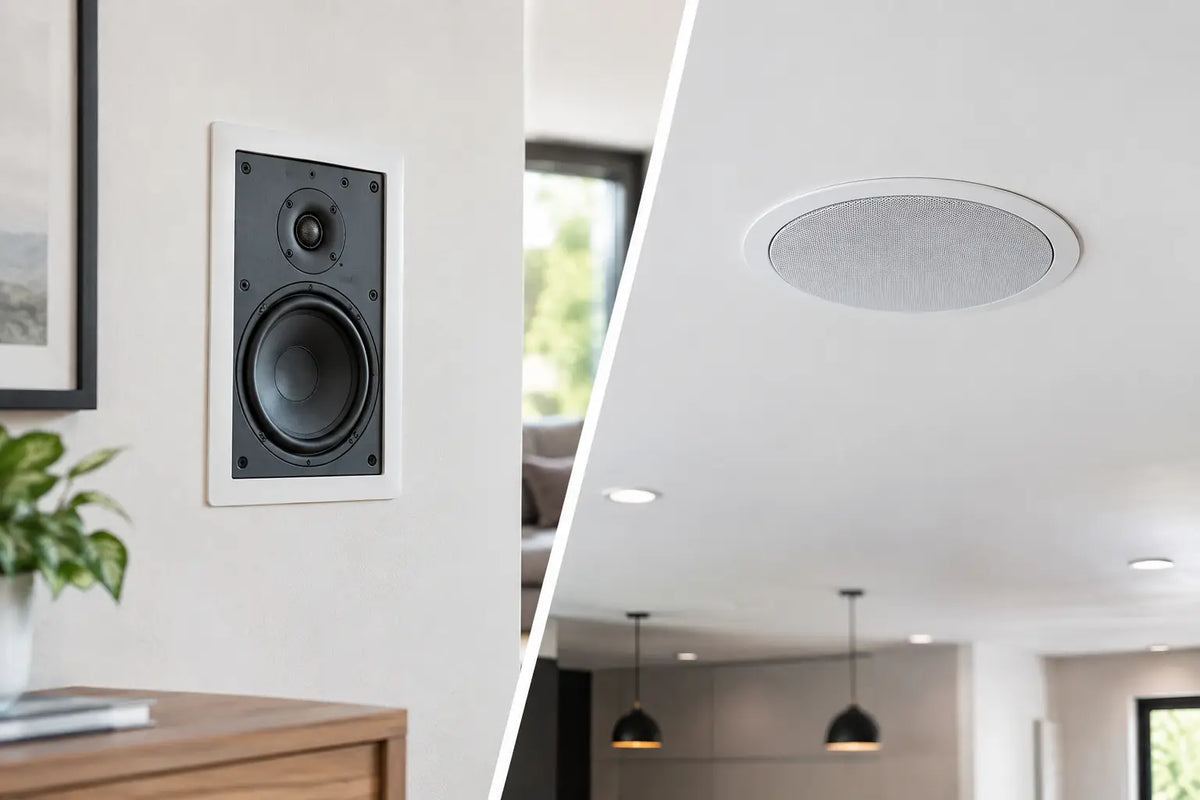
A beautifully designed room should not have its visual calm interrupted by speaker cabinets, exposed wiring, or equipment that feels like an afterthought. That is why the question of in wall versus ceiling speakers is central to premium AV planning. Both can disappear into the architecture while delivering exceptional sound, but they serve different listening habits, room layouts, and performance expectations.
The right choice is not simply about where a speaker can fit. It is about directing sound toward the listener, preserving the interior concept, managing acoustics, and ensuring the system supports the way the space will actually be used. A refined multi-room audio system, cinema room, formal living area, or hospitality environment deserves a solution engineered around the room rather than selected from a catalog.
In-Wall Versus Ceiling Speakers: The Core Difference
In-wall speakers are installed vertically within a wall, typically at or near ear height when seated or standing. They project sound forward into the room, which makes them especially effective for focused music listening, television audio, front-channel cinema sound, and spaces where imaging and dialogue clarity matter.
Ceiling speakers are mounted overhead and disperse sound downward. They are a natural fit for distributed background music, whole-home audio, kitchens, bathrooms, corridors, dressing rooms, patios with covered ceilings, and commercial areas where broad, even coverage matters more than a dedicated listening position.
Neither option is inherently superior. In-wall speakers generally create a more natural front-facing soundstage, while ceiling speakers offer exceptional discretion and coverage across open-plan spaces. The engineering decision begins with the intended experience.
When In-Wall Speakers Are the Better Choice
For a media room, formal lounge, or television wall, in-wall speakers are often the more compelling solution. Their placement can closely mirror the layout of conventional floor-standing or bookshelf speakers without consuming floor space or disturbing a carefully considered interior scheme.
Better dialogue and front-stage realism
Human voices come from in front of us, not above us. When left, center, and right channels are installed in the front wall around a display or projection screen, dialogue feels anchored to the action on screen. This is particularly valuable in luxury home cinema installations, where the objective is not merely volume but believable scale, clarity, and emotional impact.
An in-wall center channel positioned behind an acoustically transparent screen can be exceptionally effective in a purpose-built cinema. In a television room, carefully placed in-wall left, center, and right speakers can provide a clean architectural finish while creating a convincing cinematic presentation.
Stronger stereo imaging for music
A properly designed pair of in-wall speakers can create a defined stereo image, with vocals centered and instruments placed across a stable soundstage. This matters in spaces intended for attentive listening, such as a lounge, office, library, or dedicated entertainment room.
Speaker location remains critical. The two speakers should be positioned symmetrically where possible, with reasonable separation and a clear relationship to the primary seating area. Mounting them too high or too close together weakens the result, regardless of speaker quality.
A cleaner answer for feature walls
In-wall speakers work beautifully with stone, timber, marble-look panels, custom millwork, and modern television walls, provided the construction allows for them. Grilles can be color-matched, painted, or integrated with surrounding finishes. The result is technology that supports the architecture rather than competing with it.
There are practical considerations. Exterior walls may have insulation, moisture barriers, or structural constraints. A wall cavity may also be too shallow for certain models. In these cases, a purpose-built back box, shallow-depth speaker, or alternative placement may be required.
Where Ceiling Speakers Excel
Ceiling speakers are the discreet workhorses of whole-home audio. In spaces where people move around rather than sit in one listening position, their wide dispersion helps maintain consistent sound from one end of the room to the other.
Whole-home audio and entertaining
A ceiling speaker system is ideal when music should follow the flow of daily life. In a kitchen, breakfast area, hallway, ensuite, dressing room, or covered outdoor zone, the goal is usually elegant ambient sound rather than a precise stereo image. Ceiling speakers keep surfaces clear and make it easy to build independent audio zones throughout a property.
For entertaining, this approach is particularly effective. Guests can move between the kitchen, living space, terrace, and garden without dramatic changes in volume or tone. With intelligent control, each zone can play the same playlist or operate independently.
Coverage in large and open spaces
Open-plan homes often need multiple speakers rather than one powerful pair. Ceiling models can be spaced to provide balanced coverage, reducing the need to raise the volume in one area just to hear it in another. This creates a more comfortable, polished listening experience.
The same principle applies to commercial projects. Boutiques, gyms, offices, restaurants, mosques, schools, and reception spaces benefit from distributed ceiling audio that delivers intelligible announcements or background music without visually crowding the environment.
Atmos and immersive cinema effects
Ceiling speakers have an important role in premium home cinema, but usually not as the main front speakers. They are ideal for Dolby Atmos height channels, placing rain, aircraft, ambient effects, and musical detail above the audience. Used alongside in-wall or on-wall front and surround speakers, they add the vertical dimension that makes an immersive soundtrack feel genuinely cinematic.
Sound Quality Depends on More Than Placement
The belief that in-wall speakers always sound better than ceiling speakers is too simplistic. High-performance models in either category can produce impressive results when matched to the application and installed correctly. The larger issue is whether the speaker is being asked to do a job that suits its orientation.
A ceiling speaker can sound excellent for music during dinner, but it is rarely the best choice for a television’s front channels. Likewise, an in-wall speaker may provide superb detail in a sitting room but be unnecessarily complex for a small bathroom where a single ceiling speaker provides everything the room needs.
Enclosure design also has a major impact. Some architectural speakers use integrated back boxes to control rear sound, protect against dust, and deliver more predictable bass response. Others rely on the wall or ceiling cavity, which can vary significantly from one construction site to another. Acoustic treatment, insulation, speaker calibration, amplifier quality, and source material all influence the final result.
Installation Details That Shape the Outcome
Premium architectural audio should be coordinated early, ideally before drywall, plaster, ceiling details, and joinery are finalized. This allows the AV design to account for framing, HVAC ducts, lighting positions, curtain pockets, fire-rated assemblies, access panels, and insulation.
Avoid placing ceiling speakers directly beside air-conditioning vents, as airflow and mechanical noise can distract from the experience. In-wall speakers should not be squeezed into unsuitable cavities or positioned where cabinetry, artwork, or door swings compromise their performance. If speakers are installed in a ceiling below another occupied room, appropriate acoustic isolation can also reduce sound transfer between floors.
For high-end interiors, grille placement deserves as much attention as fixture placement. A ceiling filled with downlights, diffusers, smoke detectors, and speakers can quickly look busy. Coordinating speaker alignment with lighting grids and architectural lines creates a far more intentional finish.
Choosing the Right Layout for Each Space
Many of the strongest systems combine both formats. A villa may use ceiling speakers for everyday multi-room music, in-wall speakers around the main television wall, hidden subwoofers for low-frequency impact, and ceiling speakers again for immersive cinema height effects. The result is not a compromise. It is a system where each component is assigned the role it performs best.
For a living room centered around television and movies, prioritize in-wall speakers across the front stage and consider in-wall or carefully positioned surround channels. For kitchens, bedrooms, bathrooms, and circulation areas, ceiling speakers typically deliver the right balance of coverage, discretion, and value. In a dedicated cinema, the design should begin with screen size, seating positions, room dimensions, and acoustic treatment, then establish the speaker architecture around those decisions.
I-Trust Systems approaches this as an integrated design exercise, balancing speaker performance with lighting, automation, room finishes, and the practical realities of construction. That level of coordination is what separates an installed speaker from an environment that sounds as polished as it looks.
The most satisfying audio systems are rarely the ones with the most visible equipment. They are the ones that make music feel present, dialogue feel natural, and every room feel ready for the moment - while leaving the architecture free to speak for itself.
Share:
Villa Security Camera Placement That Looks Refined
Why Do Villas Need Automation? A Better Way to Live