

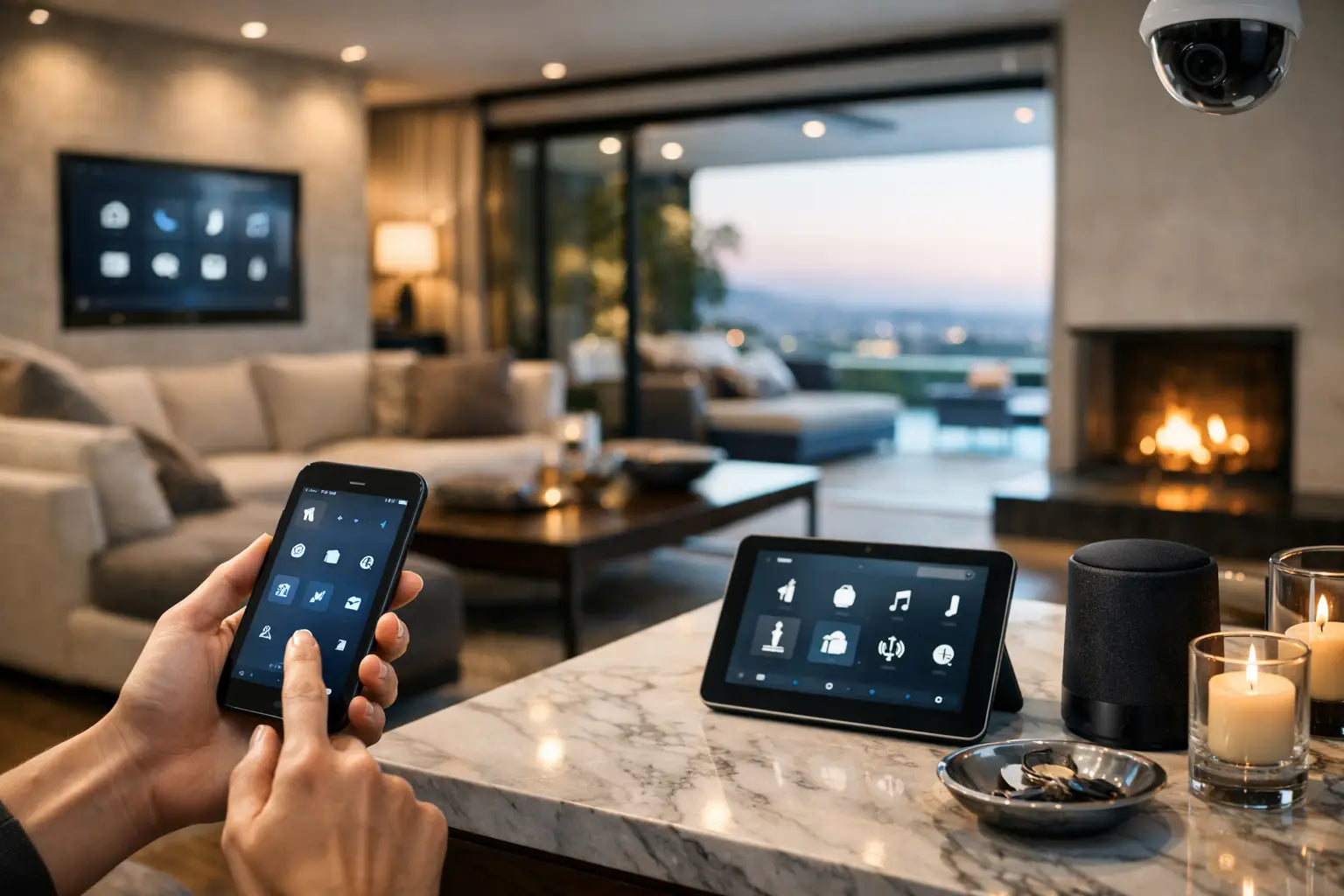
A luxury home should not require a wall of switches, a collection of unrelated apps, or repeated adjustments throughout the day. The best smart home automation guide begins with a different expectation: technology should respond to the way the property is lived in, while remaining discreet enough to preserve the architecture, interiors, and atmosphere that make the home distinctive.
For a villa, penthouse, or large custom residence, automation is not simply about turning lights on from a phone. It is a coordinated system for lighting, climate, shades, security, entertainment, and communication. When these elements are planned as one environment rather than purchased as separate gadgets, the result feels considered, reliable, and genuinely personal.
What Smart Home Automation Should Deliver
A well-designed smart home creates useful moments without demanding attention. A single “Arrive Home” scene can illuminate the entrance, adjust the air conditioning, raise selected shades, disarm approved areas, and bring background music into the living spaces. At night, a “Goodnight” command can close curtains, turn off common-area lighting, arm the perimeter, and leave only low-level pathway lighting active.
The value is not the number of devices connected. It is the quality of the experience. A premium system should reduce visual clutter, simplify daily routines, and give every room a sense of purpose. It should also provide dependable manual control. Elegant keypads, touch panels, and carefully placed switches remain essential, especially for guests, staff, children, and anyone who prefers a physical control to an app or voice command.
Automation also supports the practical side of luxury living. Climate zones can prevent energy from being wasted in unoccupied rooms. Water-leak sensors can alert the homeowner before a minor failure becomes costly damage. Security cameras and access control can provide visibility without turning the home into an intimidating technical space.
Start With the Lifestyle, Not the Devices
The most expensive mistake in a smart home project is choosing products before defining how the property needs to perform. A device-first approach often produces fragmented controls, inconsistent finishes, and features that look impressive in a showroom but add little value after installation.
Begin by mapping the home in zones. Public areas such as the foyer, living room, dining room, pool deck, and garden will often need entertaining scenes, flexible lighting, and distributed audio. Private zones require more personal control over temperature, blackout shades, wake-up lighting, and privacy. Service areas may prioritize monitoring, access, lighting schedules, and operational reliability.
Then consider the people who will use the space. A family home may need simple everyday scenes and parental controls. A frequently occupied vacation residence may require remote monitoring, occupancy simulations, and easy handover to staff. A developer may need a platform that can be replicated across multiple residences while allowing each owner to personalize selected features.
This early planning stage should also account for the interior design. Control keypads need to complement wall finishes. Motorized shade pockets must be coordinated with ceiling details. Speakers, sensors, cameras, and access readers should be placed with equal respect for performance and aesthetics. Retrofitting these considerations later is possible, but it is usually more expensive and less refined.
The Core Systems in a Smart Home Automation Guide
Lighting and shading create the atmosphere
Lighting control is often the most visible expression of home automation. Rather than controlling fixtures individually, a scene-based system brings layers of light together: ambient illumination, architectural accents, task lighting, artwork lighting, and exterior lighting. A dining scene, for example, should feel very different from a cleaning scene or a late-night gathering.
Motorized curtains and shades make lighting more intelligent. They can respond to time of day, solar exposure, privacy needs, and entertainment modes. In a media room, blackout shades and lighting can work together to prepare the space for a film. In a living area with expansive glazing, shades can reduce heat gain while maintaining a comfortable, composed visual effect.
The right approach depends on the room. Fully automated daylight response may be appropriate for a glass-heavy façade, while a formal lounge may benefit more from manually selected scenes that preserve the designer’s intended mood.
Climate control should be precise, not merely connected
Connected thermostats are useful, but premium climate control goes further. Large homes often have different environmental conditions between bedrooms, living areas, kitchens, gyms, dressing rooms, and outdoor-adjacent spaces. Zone-based control allows temperature settings to follow occupancy and use rather than treating the entire property as one environment.
Integration can also coordinate HVAC with shades, door contacts, and schedules. If a terrace door remains open, the system can alert the homeowner or adjust the affected climate zone. If the house is unoccupied for an extended period, it can operate in an energy-conscious setback mode while protecting sensitive finishes, wine storage, or equipment rooms.
Security should be designed into the experience
Security works best when it feels natural to use. A professionally integrated system can bring together cameras, access control, intrusion detection, video intercom, gate control, and smart locks under a consistent interface. The homeowner should be able to see who is at the gate, grant access where appropriate, and check key areas remotely without moving between multiple applications.
There are trade-offs to consider. More cameras do not automatically mean better security, and highly visible devices may conflict with the design language of a luxury residence. Camera placement, lighting conditions, recording requirements, network capacity, and local privacy expectations all need professional attention. The goal is informed protection, not unnecessary surveillance.
Audio, television, and cinema deserve dedicated engineering
Multi-room audio transforms ordinary spaces into places people want to spend time. Music can follow the family from the kitchen to the terrace, or remain independent in each room. Properly selected architectural speakers can deliver full sound while preserving clean ceilings and walls.
For a dedicated cinema, the performance depends on much more than a projector and large screen. Room proportions, speaker placement, acoustic treatment, sound isolation, seating position, lighting, HVAC noise, and equipment ventilation all shape the final experience. A cinema that looks luxurious but has poor dialogue clarity or distracting reflections will never feel complete.
This is where engineering and interior design must work together. Acoustic panels can become part of the visual composition, hidden speakers can be selected carefully, and lighting can support both safe movement and cinematic immersion.
Build the Foundation Before the Finishes
Wireless products have a place, particularly in completed homes and smaller upgrades. Yet a large or high-value project benefits from a planned infrastructure. Structured cabling, dedicated equipment locations, reliable Wi-Fi coverage, network segmentation, backup power, and accessible service pathways make the system easier to maintain and expand.
The network deserves particular attention. Every camera, access point, touchscreen, streaming device, television, controller, and smart appliance depends on it. Weak coverage or an undersized network can make even premium equipment feel unreliable. For this reason, network design should be treated as a core building service, not an afterthought added after furniture arrives.
During construction, coordinate low-voltage wiring with electrical, HVAC, joinery, lighting, and interior teams. Confirm speaker positions before ceilings close. Reserve suitable ventilation and power for equipment racks. Plan conduit routes for future upgrades. These decisions are largely invisible when the home is finished, but they determine whether the technology performs with confidence for years.
Choose Control That Feels Effortless
A smart home should offer choice without creating confusion. The most successful systems combine keypads for immediate actions, touchscreens for detailed control, mobile access for convenience, and voice control where it is genuinely useful. Voice commands are excellent for simple requests such as adjusting lights or playing music, but they should not be the only way to operate essential functions.
Keep scenes intuitive and named around real behavior. “Morning,” “Entertain,” “Movie,” “Away,” and “Goodnight” are more useful than technical labels. Avoid creating dozens of obscure automations that only the installer understands. A system should be sophisticated behind the scenes and simple at the point of use.
At I-Trust Systems, this balance is central to bespoke integration: advanced engineering is designed to support a home’s lifestyle and visual character, rather than compete with it.
Plan for Service, Privacy, and Change
A home automation system is a long-term asset, not a one-time installation. Select an integration partner that can document the system, provide training, support future updates, and remain available as the property evolves. New residents, changing family routines, renovation work, and upgraded entertainment equipment should not require rebuilding the entire system.
Privacy also needs clear decisions. Use secure account credentials, controlled remote access, protected network architecture, and appropriate permissions for family members, guests, and staff. Remote access is valuable, but it should be managed with the same care as physical access to the home.
The finest smart homes do not announce their technology at every turn. They create the right light, temperature, sound, security, and sense of arrival before anyone has to ask. When every detail is designed around the people who live there, intelligence becomes part of the home’s character.
Share:
How Multi Room Audio Works in a Luxury Home
10 Best Luxury Home Cinema Features for Villas