

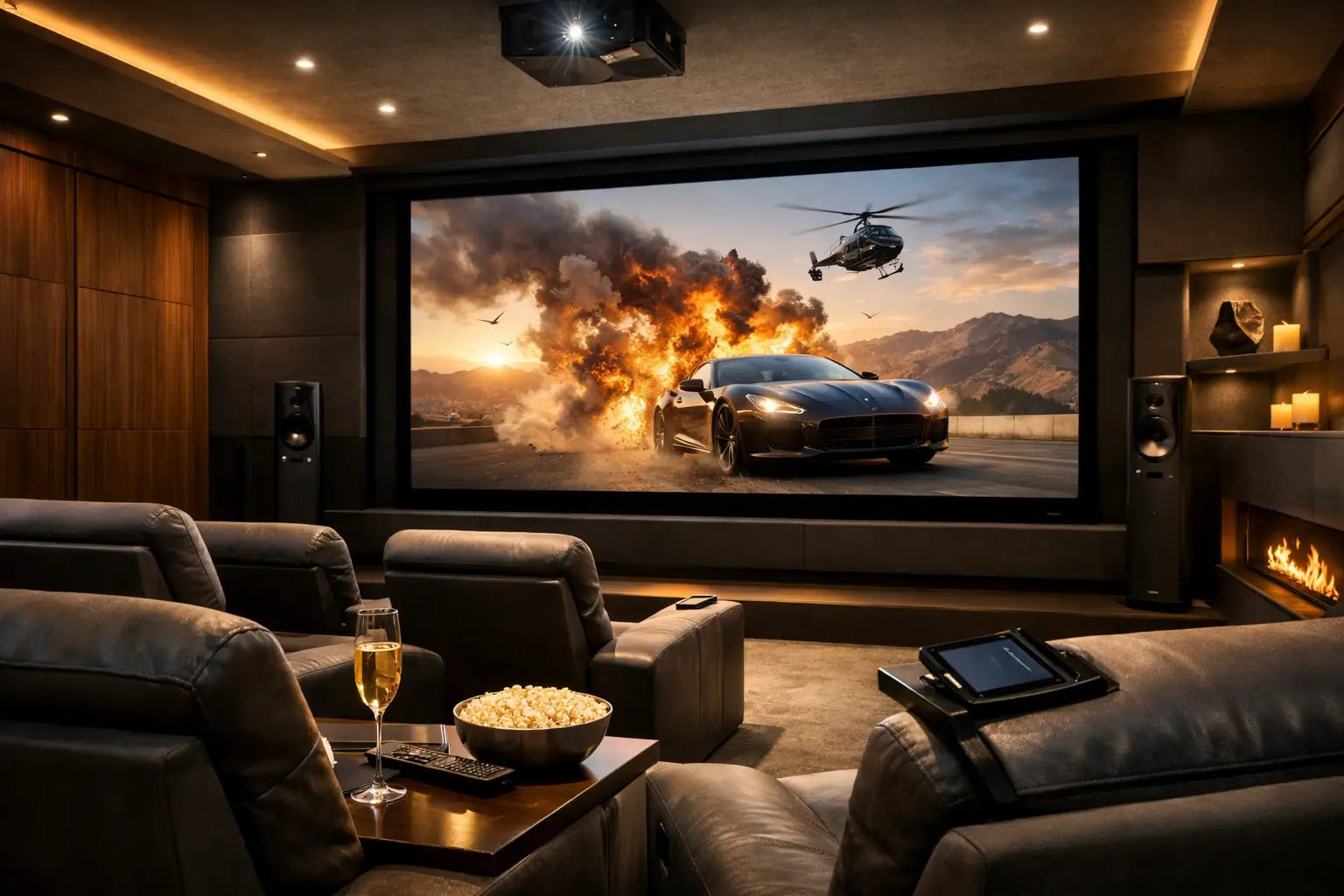
A private theater should not feel like a living room with a large television. It should create the anticipation of a premiere: lights lowering, sound settling into the room, and every detail disappearing behind the experience. The best luxury home cinema features are not simply premium products. They are carefully engineered systems that bring picture, sound, comfort, and control into perfect alignment.
For a villa owner, architect, or interior designer, the goal is a cinema that performs exceptionally without compromising the character of the home. That calls for early planning, exacting installation, and a design language that feels as considered as the rest of the property.
Best Luxury Home Cinema Features That Define the Experience
1. A projection system designed for the room
A luxury theater begins with an image that holds its detail, depth, and color whether the scene is a shadowed drama or a sunlit sports broadcast. A high-performance projector paired with a properly specified screen delivers a scale that even the finest flat-panel display cannot fully replicate.
The right choice depends on room dimensions, viewing distance, ambient light, and the desired screen size. In a fully light-controlled cinema, a premium 4K laser projector and acoustically transparent projection screen can create a truly cinematic presentation. In a multipurpose lounge where daylight is present, an oversized high-brightness display may be the more practical and visually consistent solution.
Screen material matters as much as screen size. A screen selected for the projector's brightness, viewing angles, and contrast performance preserves image quality across every seat. Motorized masking can further refine the presentation by adapting the visible screen area to different film formats.
2. Acoustic engineering before equipment selection
Exceptional sound is not achieved by placing more speakers in a room. It starts with managing how sound behaves inside it. Hard finishes, parallel walls, glass surfaces, and untreated ceilings can create reflections that blur dialogue and overwhelm the soundtrack's detail.
Professional acoustic treatment addresses absorption, diffusion, bass control, and reflection points while preserving the intended interior aesthetic. Fabric wall panels, timber detailing, concealed treatments, and custom ceiling elements can all play a role. The result is a room that sounds controlled and spacious rather than loud.
Soundproofing is a separate consideration and often essential in a premium residence. It limits sound transfer to adjoining bedrooms, living spaces, and neighboring properties. Proper isolation may involve decoupled wall and ceiling construction, acoustic doors, sealed penetrations, and vibration control. These provisions are most effective when designed into the building stage, though they can also be incorporated during a dedicated renovation.
3. Immersive surround sound with precise calibration
A luxury cinema deserves sound that moves naturally around the audience, not speakers that merely make their presence known. Immersive audio formats use carefully positioned surround and overhead channels to place rainfall above, a passing vehicle beside the viewer, or a score throughout the room with convincing realism.
The ideal speaker layout depends on the room. A compact theater may perform beautifully with a 5.1.4 configuration, while a larger space can support more surround channels and multiple subwoofers. Concealed architectural speakers offer a discreet visual finish, while dedicated cinema speakers behind an acoustically transparent screen can provide the scale and impact associated with commercial theaters.
Calibration is where the system becomes coherent. Levels, delays, crossover points, and room correction must be tuned for the actual seating positions, not estimated from a floor plan. Multiple subwoofers, properly located and calibrated, are particularly valuable for achieving even, controlled bass across the seating area.
4. Seating that supports long-form comfort
A beautiful film can lose its appeal quickly in a chair designed only for appearance. Luxury cinema seating should support the body through a full feature film, with correct sightlines to the screen and enough space for guests to move comfortably.
Premium recliners may include motorized recline, adjustable headrests, lumbar support, discreet cup holders, USB-C charging, and ambient lighting. Upholstery can be selected to complement the room, from supple leather to performance fabrics with a more contemporary architectural feel. For families and frequent entertaining, a mix of individual recliners and a rear lounge row can offer both formality and flexibility.
Seat placement also deserves careful attention. The front row should not be uncomfortably close to the screen, and raised platforms should be engineered for clear sightlines rather than added as a decorative afterthought. A well-planned theater makes every seat feel intentional.
5. Intelligent lighting control and scene settings
Lighting is one of the most powerful ways to make a cinema feel refined before the movie even begins. Layered lighting can include dimmable ceiling fixtures, wall sconces, step lights, cove lighting, and subtle illumination around architectural features.
The difference lies in control. A single command can lower blackout shades, dim the room, illuminate the steps at a safe level, power on the AV system, and begin the feature. Separate scenes for entertaining, intermission, sports viewing, gaming, and cleaning allow the room to adapt without asking users to manage several remotes or switches.
Warm, low-glare lighting is generally the preferred choice for a dedicated theater. It protects the viewing experience while maintaining a sense of occasion and comfort. Lighting levels should be planned with the screen in use, not only when the room is photographed.
6. Concealed technology and disciplined design
The most sophisticated cinema rooms feel effortless because the technical infrastructure has been handled with discipline. Speakers, cabling, equipment, ventilation, sensors, and control interfaces should be coordinated with the interior architecture from the outset.
A dedicated equipment rack outside the viewing room keeps heat, fan noise, and visual clutter away from guests. It also gives technicians clear access for service, upgrades, and system management. Ventilation is especially important when the room contains high-output amplifiers, processors, gaming consoles, and media players.
This approach gives designers greater freedom. The room can be dramatic and richly layered, minimalist and contemporary, or inspired by an Art Deco screening room. Technology supports the atmosphere rather than competing with it.
7. A unified control interface
No luxury cinema should require a collection of remotes, unfamiliar apps, and complicated input menus. An integrated control system brings the projector or display, audio processor, sources, lighting, shades, climate, and seating into one intuitive interface.
A wall keypad at the entrance, a dedicated touchscreen, or a personalized mobile control app can all be appropriate. The best arrangement is based on how the household actually uses the room. Some clients want a simple “Watch Movie” button; others want the ability to adjust advanced settings without entering an equipment closet.
Reliable control requires professional programming and thoughtful system design. It should work consistently for family members, guests, and household staff, with clear feedback when a command has been activated.
8. Climate control that stays quiet
A cinema room becomes less inviting when it is too warm, too cold, or interrupted by the sound of air moving through vents. HVAC design must account for the heat generated by people and AV equipment while keeping airflow low-noise and unobtrusive.
Independent temperature control is often a worthwhile investment for a dedicated theater. It allows the room to maintain comfort without affecting the rest of the home. Quiet diffusers, properly sized ductwork, and coordination with acoustic treatments help prevent the HVAC system from undermining the room's performance.
9. Flexible entertainment beyond movies
The strongest cinema rooms earn their place in the home because they serve more than one purpose. They can host a major sporting event, a family gaming night, a concert film, or a private presentation. High-refresh-rate gaming capability, multiple source connections, and high-quality streaming integration make the space more versatile without diluting its cinematic focus.
For some households, a professional karaoke system or multi-room audio connection adds another layer of enjoyment. The key is not to add every available feature. It is to select capabilities that match the lifestyle of the people using the room.
10. Future-ready infrastructure
Premium technology should be designed to evolve. Conduits, accessible cable pathways, generous equipment-rack capacity, network connectivity, and spare speaker wiring make future upgrades far simpler and cleaner.
This is particularly relevant for new villas and major renovations. Installing the right infrastructure before finishes are completed protects the design investment and avoids disruptive work later. A theater may begin with one projector, source, and speaker configuration, then expand as new formats and household needs emerge.
A truly exceptional cinema is not defined by a specification sheet. It is defined by the feeling of complete immersion, where every detail works together and nothing asks for attention. With bespoke design, acoustic precision, and intelligent integration, I-Trust Systems can help turn that standard into a room your family and guests will choose to return to, long after the credits end.
Share:
Smart Home Automation Guide for Luxury Living
Premium Home Automation for Elevated Living