

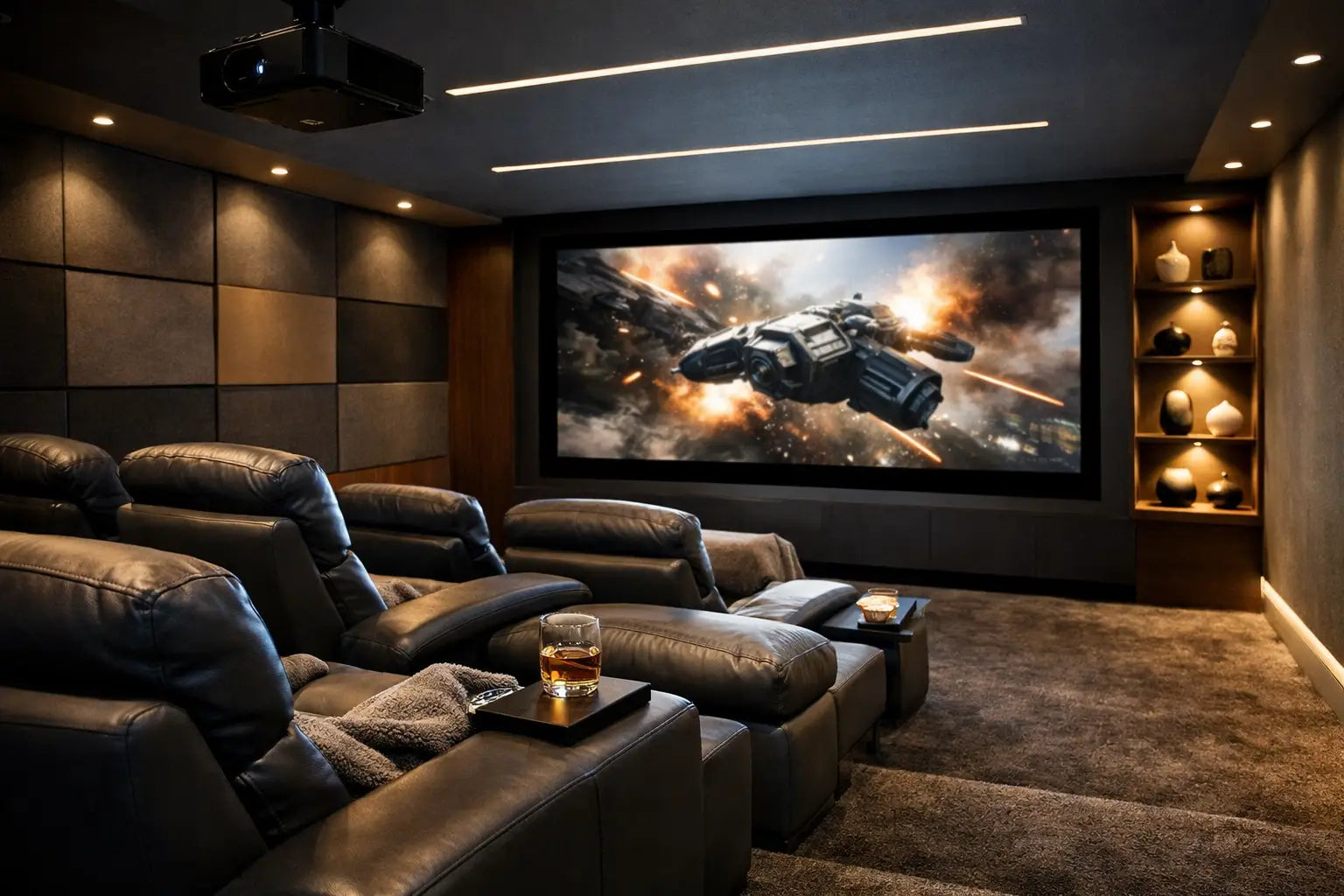
A truly memorable cinema room is rarely defined by screen size alone. The projects that feel extraordinary from the first scene are shaped by proportion, acoustics, lighting, seating comfort, and control - all working together with quiet precision. That is the difference between adding AV equipment to a room and investing in luxury home cinema design.
For discerning homeowners, villa developers, and design professionals, the brief is usually larger than movie night. The room must feel architecturally resolved, perform at a high technical standard, and reflect the wider language of the property. It should impress guests, satisfy serious viewers, and remain effortless to use. None of that happens by accident.
What defines luxury home cinema design
At the premium end of the market, cinema design is less about individual products and more about system thinking. Every decision affects another one. Screen size influences viewing distance. Seating layout affects sightlines and speaker placement. Surface finishes shape the acoustic response. Lighting scenes can either preserve contrast or wash out the image. Even HVAC planning matters, because a room that looks immaculate but sounds like an air handler is a compromised space.
Luxury, in this context, means control and cohesion. The room should feel composed, not crowded by technology. Speakers may be fully visible and beautifully integrated, or they may disappear behind acoustically transparent finishes. Equipment may sit in a dedicated rack outside the room to reduce heat and noise. Controls should be intuitive enough that one touch starts the experience without requiring a lesson.
There is also a question of character. Some clients want the intimacy of a dark, cocooned screening room. Others prefer a brighter, multi-use media lounge with statement finishes and open social seating. Both can be successful. The right solution depends on how the room will actually be used.
The room itself is the first piece of equipment
Many underperforming cinemas begin with a simple mistake: the architecture is treated as a backdrop rather than a performance factor. In reality, room dimensions, ceiling height, construction method, and neighboring spaces determine what is possible and what will require careful mitigation.
A dedicated room usually offers the best result because sound isolation, speaker positioning, and light control can be handled properly from the start. Basements are often attractive for this reason, though they bring their own considerations around ventilation, moisture, and access. Upper-floor cinemas can work beautifully in large homes, but structural transmission and adjacent bedrooms demand more attention.
Proportion matters more than many clients expect. A room that is too wide and shallow can limit screen size and weaken immersion. One that is too narrow may constrain seating and speaker separation. Ceiling height becomes especially important when risers, atmospheric speakers, and detailed lighting are part of the design. Good planning avoids expensive corrections later.
Dedicated cinema or luxury media room?
This is one of the most important early decisions. A dedicated cinema room prioritizes performance - controlled light, controlled acoustics, optimized seating, and minimal compromise. A luxury media room accepts a broader brief. It may need to support sports, gaming, casual TV, conversation, or family gatherings in a more open setting.
Neither option is inherently better. It depends on the property and the client. If film performance is the priority, a dedicated room usually justifies itself. If flexibility matters more, the design must be even more disciplined to preserve quality while accommodating multiple functions.
Sound is where premium cinemas separate themselves
Clients often evaluate a cinema visually at first, but they remember it sonically. Clean dialogue, convincing dynamics, controlled bass, and accurate immersion are what make a room feel expensive in the most immediate way.
That is why acoustic treatment should never be treated as an afterthought. In a luxury room, acoustic elements are integrated into the design language rather than added as visible correction. Wall paneling, stretched fabric systems, timber detailing, and ceiling features can all be engineered to absorb, diffuse, or balance sound while contributing to the interior aesthetic.
Sound isolation is equally important. A cinema should not disturb the rest of the house, and exterior noise should not disturb the cinema. This often involves layered wall construction, isolated ceilings, acoustic doors, and careful detailing around penetrations and mechanical systems. It is one of the least glamorous parts of the build, yet one of the most valuable.
Low-frequency performance deserves special attention. Deep bass is part of the cinematic experience, but uncontrolled bass quickly becomes fatiguing. Proper speaker placement, subwoofer strategy, room treatment, and calibration all matter. This is where engineering-led execution has a clear advantage over a product-led approach.
Image quality is about balance, not just brightness
A premium cinema image comes from the relationship between projector, screen, ambient light control, and viewing geometry. Clients sometimes arrive focused on resolution alone, but a spectacular result depends on contrast, black levels, motion handling, color accuracy, and correct screen selection.
Screen choice should be driven by room conditions and design intent. In some spaces, a large fixed-frame screen delivers the most authentic cinema feel. In others, especially where visual minimalism is preferred, a concealed screen may be the better architectural fit. Acoustically transparent screens can also be transformative, allowing the front speakers to sit behind the image for a more natural and cinematic soundstage.
Projection remains the benchmark for many luxury cinemas because it creates scale and atmosphere that large flat panels still struggle to replicate in dedicated rooms. That said, there are scenarios where premium direct-view displays make sense, particularly in brighter media environments. The right answer depends on usage, not fashion.
Seating, layout, and comfort shape the experience
Even the finest audio and video system can feel underwhelming if the room is uncomfortable. Seating is not just a furniture decision. It affects viewing angles, social dynamics, circulation, and the sense of occasion.
For some clients, a single row of deeply upholstered recliners is ideal. For larger rooms, tiered seating may create better sightlines and a stronger theater atmosphere. Others prefer a mix of formal cinema chairs and relaxed lounge seating at the rear for family use. What matters is that every seat feels intentional.
Spacing should feel generous, not compressed. Cupholders, side tables, charging, concealed storage, and easy access all contribute to perceived luxury. Materials matter as well. Leather, performance fabrics, timber accents, and custom stitching can connect the room to the broader interior palette of the home rather than making it feel like an isolated technical zone.
Lighting and control complete the room
The most elegant cinema spaces are effortless to use. One touch should lower the lights, activate the projector, set the correct audio mode, and prepare the room without clutter or confusion. That level of simplicity requires thoughtful programming and proper system integration behind the scenes.
Lighting deserves particular care. Layered scenes allow the room to transition from arrival mode to trailers, intermission, cleaning, or casual viewing. Step lights, cove lighting, wall accents, and star ceilings can all enhance the atmosphere, but restraint is important. Too many decorative lighting elements can compromise the image or make the room feel theatrical in the wrong way.
Integration with broader smart home systems also adds value. Climate control, shading, security, and multi-room audio can all work in concert with the cinema environment. For clients investing in high-end residential technology, this unified experience is often as important as the cinema itself.
Why bespoke design outperforms packaged solutions
There is no shortage of off-the-shelf cinema packages promising premium results. Some are adequate. Few deliver what a serious project requires. High-end homes are not standardized boxes, and luxury expectations are not met by generic layouts or one-size-fits-all specifications.
Bespoke design begins with the property, the client, and the intended lifestyle. It accounts for architecture, interior design, technical constraints, and operational simplicity. It also avoids a common problem in premium homes: excellent products assembled without a coherent strategy.
This is where a specialist partner matters. A company such as I-Trust Systems approaches the room as a complete environment - combining AV engineering, acoustics, automation, and interior coordination to deliver a result that feels refined from every angle. That integrated approach reduces compromise and protects the quality of the final experience.
The best cinema rooms do not announce their complexity. They simply feel right when the lights dim, the soundtrack begins, and the rest of the world falls away. If you are planning one, start with the room, the performance goals, and the lifestyle you want it to support. The equipment will matter, but the design decisions around it will matter more.
Share:
How to Set Up a Smart Home Automation System
Small Luxury Home Theatre Design Done Right