

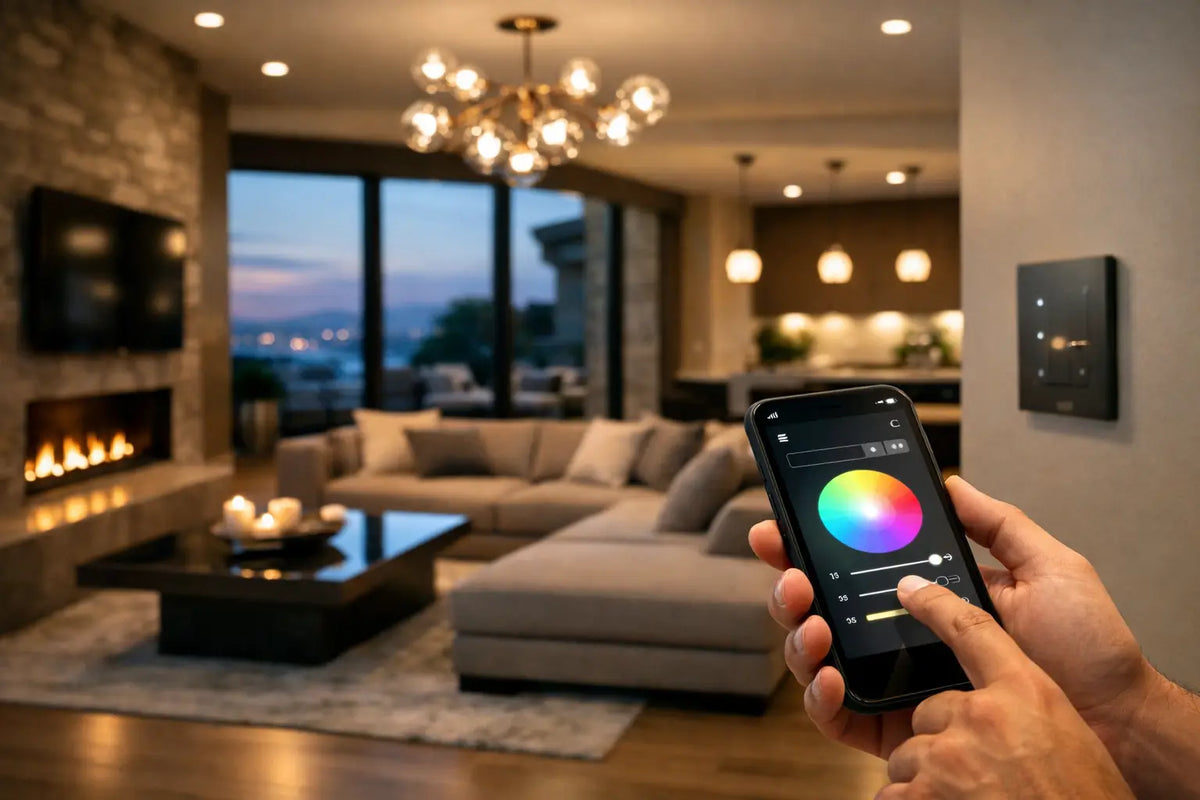
A beautifully finished room can still feel unfinished when its lighting is limited to a wall switch and a single overhead fixture. The question, is smart lighting worth it, becomes far more relevant when a home is designed around architecture, art, entertaining, privacy, and everyday comfort. In a premium residence, lighting is not simply about seeing clearly. It shapes how the space feels from the first morning light to the final evening gathering.
Smart lighting gives homeowners the ability to control brightness, color temperature, scenes, schedules, and selected fixtures from keypads, touchscreens, mobile devices, or discreet sensors. Done properly, it replaces visual clutter and inconsistent lighting with a considered system that responds to how the home is actually used.
What Smart Lighting Changes Beyond a Standard Dimmer
A conventional dimmer adjusts one circuit. A professionally designed smart lighting system coordinates the entire experience. It can bring together ceiling lights, decorative pendants, cove lighting, wall washers, landscape fixtures, and motorized window treatments into scenes designed for particular moments.
One touch can set a formal dining room for dinner, lower the blinds, warm the ambient light, and highlight artwork without requiring anyone to walk around the room adjusting separate switches. In a home cinema, the same system can dim perimeter lighting, illuminate a safe path to seating, and transition the room into a viewing scene as the projector starts.
This is where the difference between connected bulbs and integrated lighting control becomes clear. Individual smart bulbs can be useful in a small apartment or a single room. They are rarely the right long-term answer for a villa, a large custom home, or a commercial environment with layered lighting and demanding design standards. Premium projects benefit from centralized planning, reliable control hardware, carefully selected fixtures, and scenes built around the property rather than around a collection of apps.
Is Smart Lighting Worth It for Your Property?
For many luxury homeowners, the answer is yes, provided the system is specified for the way they live. The value is strongest when smart lighting solves a real design, operational, or lifestyle need rather than being installed as a novelty.
Consider a large home with multiple living areas, guest suites, corridors, landscaped gardens, and entertainment zones. Without a unified approach, each area can become a mix of switches, remotes, dimmers, and incompatible controls. Smart lighting brings order to those spaces. It reduces the number of visible wall controls, establishes consistent scenes across the home, and makes a complex property easier to operate for family members, guests, and staff.
For architects and interior designers, the benefit is equally practical. Lighting control can protect the visual integrity of a carefully designed wall by consolidating multiple circuits into elegant keypads. It also allows the lighting design to be more expressive. Fixtures can be selected for their architectural effect, while the control system manages the technical complexity behind the scenes.
The investment may be less compelling in a small property with simple lighting needs and no plans for wider automation. If the goal is only to turn a single bedside lamp on from a phone, a basic smart plug or bulb may be sufficient. But where lighting must work alongside HVAC, curtains, security, audio, and AV, a professionally integrated platform offers a substantially better experience.
The Everyday Benefits That Justify the Investment
The most valuable smart lighting systems disappear into the rhythm of daily life. They do not demand attention. They provide the right light at the right time, while keeping control close at hand when it matters.
Better atmosphere, at every hour
Light affects how materials, colors, and furnishings are perceived. A space lit with cool, bright light late at night can feel clinical, even when the interiors are exceptional. With tunable white lighting and well-programmed scenes, a home can move from crisp, energizing light in the morning to warmer, more relaxed illumination in the evening.
This is particularly effective in open-plan living areas, kitchens, bedrooms, and hospitality spaces. Rather than relying on one lighting level all day, the environment can reflect the natural transition of the day and the intended mood of the room.
Greater convenience without sacrificing control
Smart lighting allows a homeowner to turn off an entire floor or the full property from one location. Vacation mode can create a lived-in appearance while the property is empty. Motion and occupancy sensors can provide low-level guidance lighting in hallways, dressing rooms, bathrooms, and staircases without harsh illumination or unnecessary switching.
Convenience should never mean loss of control. A well-engineered installation retains intuitive local keypads, so essential functions remain simple for every member of the household. Voice control and mobile apps can be useful additions, but they should not be the only way to operate the home.
More thoughtful energy use
Smart lighting can lower energy consumption through dimming, occupancy sensing, scheduling, and daylight response. Lights can reduce output when daylight is abundant, turn off in unoccupied spaces, and avoid being left on across a large property overnight.
The financial savings depend on the size of the home, fixture types, usage patterns, and local energy costs. Energy efficiency alone may not repay the full cost of a premium installation quickly. Its real value lies in pairing responsible energy use with greater comfort, refined control, and better preservation of the lighting environment.
A stronger security presence
Lighting is an important layer in a broader security strategy. Exterior scenes can illuminate entrances, pathways, gates, and perimeter areas on schedule or in response to selected events. Interior lights can follow realistic routines when the home is unoccupied, rather than simply switching on and off at fixed times.
For properties with integrated surveillance, access control, and automation, lighting can support a more responsive environment. The key is thoughtful programming. Excessively bright or poorly aimed exterior lighting can undermine the elegance of the landscape and create glare, so security lighting should be designed with the same care as the interior scheme.
What Determines Whether the System Feels Premium
The quality of the experience depends less on the word “smart” and more on design and execution. A system with excellent hardware can still feel frustrating if circuits are poorly planned, scenes are generic, or controls are placed without consideration for how people enter and move through a room.
The best results begin early, ideally while the property is being designed or renovated. Electrical plans should account for lighting layers, dimming requirements, fixture loads, driver locations, control panels, keypad positions, and future expansion. Planning early also makes it easier to conceal infrastructure and preserve clean architectural lines.
Reliability deserves particular attention. Wi-Fi-only devices may be acceptable for isolated applications, but a whole-home solution should not depend on a crowded residential wireless network to perform basic functions. Professionally specified systems use appropriate wired and wireless control methods, structured programming, and a clear approach to service and updates.
A premium installation should also avoid forcing the owner to manage technology. Scenes need names that make sense, such as “Welcome,” “Evening,” “Entertain,” or “Goodnight.” Keypads should be easy to understand in low light. The technology should support the home, not turn daily living into a technical exercise.
Smart Lighting Costs and Trade-Offs
Costs vary widely. A few room-level controls can be a measured upgrade, while a whole-property system with custom keypads, centralized panels, architectural fixtures, landscape integration, and automation programming represents a more significant investment. Retrofitting a completed home can also require more labor than incorporating controls during construction.
There are trade-offs beyond price. More capability requires more planning. A homeowner must decide which scenes matter, which areas need sensors, and which lighting circuits should remain independent. The system may also need occasional support as preferences change, rooms are renovated, or new technologies are introduced.
These are not reasons to avoid smart lighting. They are reasons to treat it as part of the property’s infrastructure, much like electrical design, climate control, security, or professional AV. When it is approached as a serious design discipline, it produces a result that remains valuable long after the novelty of app control has faded.
Designing Lighting Around the Way You Live
The most successful lighting control begins with questions, not products. How does the family start and end the day? Which rooms are used for entertaining? Where are art, textured walls, and architectural details meant to be appreciated? Which pathways need discreet nighttime illumination? How should the property behave when it is vacant?
For a villa, that may mean welcoming guests with a composed arrival sequence, softly lighting the landscape and entry, and preparing living spaces before the door opens. For a boardroom, gym, retail space, or auditorium, it may mean reliable scene changes that support presentations, events, workouts, or customer flow without distracting staff or visitors.
I-Trust Systems approaches lighting as one part of a complete intelligent environment, coordinating it with audio, climate, curtains, security, and entertainment systems where appropriate. The goal is not more technology on display. It is a home or commercial space that feels more deliberate, more comfortable, and easier to enjoy.
If you are planning a new build, renovation, or high-performance entertainment space, make lighting control an early conversation. The right system can preserve the calm of the design while giving every room the flexibility to become exactly what the moment requires.
Share:
Office Access Systems That Protect Every Entrance
What Is Lighting Control? A Guide for Better Spaces