

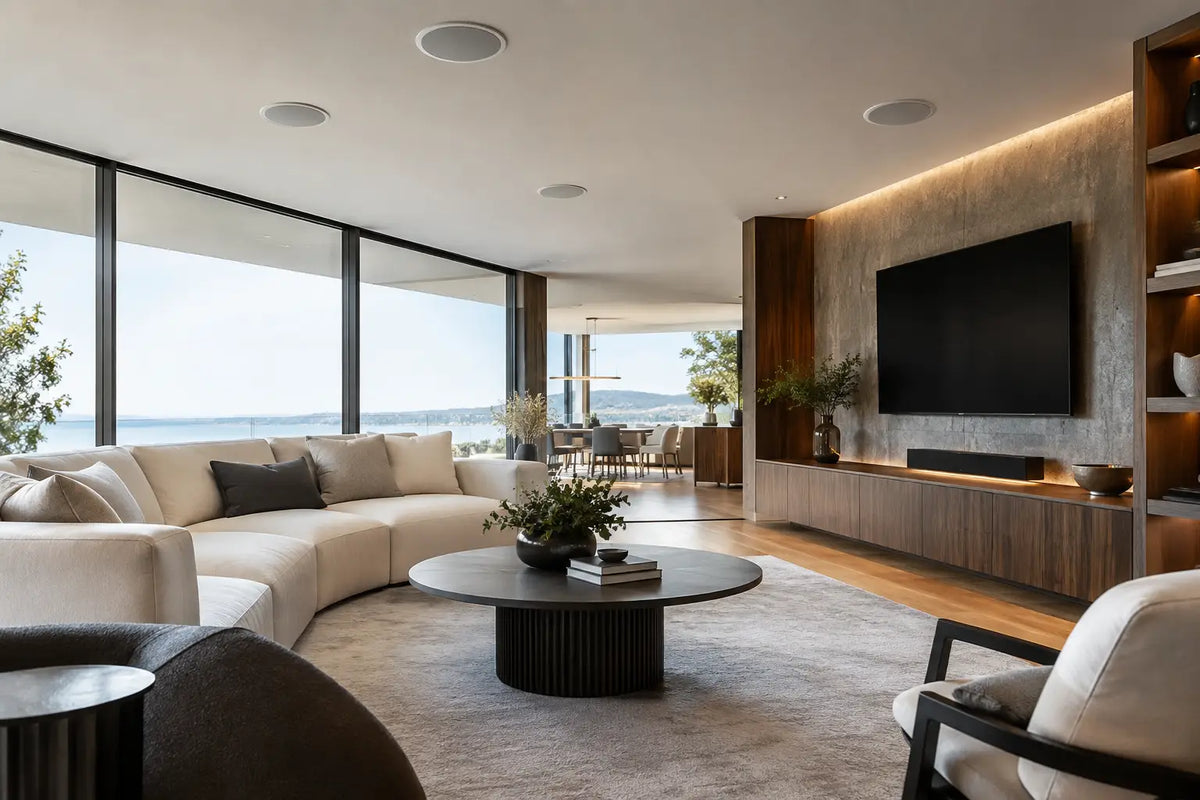
A beautifully finished villa can still feel incomplete when music is limited to one room, controlled by several unrelated apps, or distorted as guests move between spaces. Knowing how to select distributed audio means looking beyond speaker count. The right system should make every area sound intentional, from a quiet morning in the kitchen to a garden gathering, a private cinema evening, or background music across a refined commercial setting.
For luxury residences and high-value commercial projects, distributed audio is an architectural decision as much as an AV decision. It affects ceiling plans, joinery, lighting scenes, network design, acoustics, and how naturally people use a space. A successful design delivers exceptional sound without placing technology at the center of attention.
Start With the Experience, Not the Equipment
Before selecting amplifiers, speakers, or control platforms, define what each space should feel like. A formal living room may need detailed, room-filling music for entertaining. Bedrooms may need soft, independent playback. A gym needs energy and clarity at higher volumes, while a restaurant, mosque, office, or retail environment may require consistent coverage over long operating hours.
The first question is not, “How many speakers do I need?” It is, “How will this space be used?” Consider who will use the system, whether rooms will play independently, and which areas should work together during entertaining. An open kitchen, dining area, and terrace may operate as three separate zones on a typical day, then become one unified entertaining zone when guests arrive.
This early planning prevents a common disappointment: installing speakers in every room without creating a coherent listening experience. More zones do not automatically create more value. Each zone should have a purpose, appropriate control, and sufficient amplification to perform properly.
How to Select Distributed Audio by Zone
A zone is any area that can play its own source, volume level, or content. In a premium home, that may be a bedroom, bathroom, kitchen, terrace, pool area, gym, or cinema lounge. In commercial properties, zones often follow functional areas such as reception, retail floor, meeting rooms, dining sections, corridors, and outdoor spaces.
The number of zones determines much of the system architecture. If every room needs independent music, the system requires more source distribution and amplification channels than a design where selected rooms share playback. Grouping related spaces can be sensible, but only when it reflects real behavior.
For example, a master suite may include the bedroom, dressing room, and bathroom. These can be grouped for convenience, provided independent volume control remains available where appropriate. By contrast, a study should usually remain separate from a nearby family room, since the listening needs are different.
Future use matters as much as current use. If a property is under construction or renovation, prewire for areas that may become a gym, rooftop lounge, guest suite, or outdoor kitchen later. Installing quality cabling during construction is far less disruptive than opening finished ceilings and walls after handover.
Match Speaker Type to the Architecture
Distributed audio should complement the interior, not compete with it. In-ceiling speakers are often ideal for kitchens, corridors, dressing rooms, bedrooms, and open-plan living areas where visual discretion is essential. With carefully selected grilles and placement, they can disappear into the ceiling while producing balanced sound.
In-wall speakers suit spaces where ceiling geometry is complex or where a lower soundstage is preferred. They can work especially well in media rooms, formal lounges, and projects with detailed ceiling features that should remain untouched. Surface-mounted speakers may be the stronger choice for garages, commercial environments, covered terraces, and areas where service access matters.
Outdoor audio requires its own approach. Garden and pool speakers must be rated for moisture, heat, dust, and ultraviolet exposure. More importantly, they should be positioned to direct sound toward listeners rather than neighboring properties. Landscape speakers and buried subwoofers can create remarkably even coverage at modest volume, which is often more elegant than using a few loud wall-mounted speakers.
Speaker size and quantity should follow room dimensions, ceiling height, finishes, and desired listening level. A large marble-finished living area, for instance, may need more than standard ceiling speakers because hard surfaces reflect sound. A smaller, heavily furnished lounge may need fewer speakers but more careful tuning.
Do Not Underestimate Amplification and Power
Speakers are only one half of the equation. Amplification determines control, headroom, and how composed the system sounds when the volume rises. An underpowered design can play music, but it may become harsh, compressed, or uneven during entertaining.
Choose amplification based on the speaker load, room size, expected listening levels, and whether multiple speakers share a channel. Professional design accounts for impedance, cable length, thermal performance, and the ability to deliver clean power over time. This is particularly important in large villas, hospitality venues, fitness facilities, and public spaces where the system may operate for many hours each day.
The trade-off is straightforward: consolidating equipment can reduce rack space and simplify installation, while more dedicated amplification channels offer finer control and stronger performance. Neither option is automatically right. The better choice depends on the level of independence required across the property.
Choose Control That Feels Natural
A distributed audio system should not require instruction every time someone wants to play music. The most refined systems offer intuitive control from elegant wall keypads, touch panels, mobile devices, voice control where desired, and a central smart home interface.
For a villa, the strongest experience often comes from integrating audio with lighting, shading, climate, and security. A single “Entertain” scene might bring music to the living room, terrace, and garden while setting lighting to the right level. A “Goodnight” scene can lower audio, turn off selected zones, close shades, and secure the home.
Commercial projects benefit from control that is simple enough for daily staff use but protected against accidental changes. Reception teams may need access to volume and source selection, while advanced configuration stays with the facility manager or integrator. This balance protects the intended guest experience without making routine operation difficult.
Consider Sources, Streaming, and the Network
Music streaming is expected, but a premium installation should not depend on a single consumer device or unreliable wireless signal. Determine which sources matter: streaming services, local music libraries, television audio, turntables, microphones, paging, or a dedicated media server. Then ensure those sources can reach the zones where they are needed.
The network is central to modern audio performance. A professionally planned wired and wireless network supports reliable streaming, fast control response, and stable communication among audio components. In large properties, access point placement, network segmentation, and equipment rack ventilation deserve the same attention as the speakers themselves.
For commercial installations, content licensing and operational requirements also need early consideration. Background music in a retail environment is not simply a residential playlist played at a higher volume. The system should support approved music services, scheduled playback, paging if required, and dependable daily operation.
Design for Acoustics, Not Just Coverage
Even excellent equipment can disappoint in a poorly considered acoustic environment. Glass walls, stone floors, high ceilings, and expansive open plans are visually striking, but they can create excessive reflection and reduce speech clarity. In these settings, acoustic treatment may be as valuable as additional speakers.
The goal is not to make a home feel like a recording studio. It is to manage echo and improve clarity with materials that belong in the interior: acoustic wall panels, fabric finishes, rugs, curtains, upholstered furniture, timber details, or bespoke treatments integrated into the design language.
Placement also matters. Avoid locating speakers directly above primary seating whenever possible, and plan stereo pairs with symmetry when focused listening is important. For background music, even coverage is usually more valuable than a dramatic left-right image. A specialist should tune the approach room by room rather than applying one rule across the entire property.
A Practical Specification Brief for Your Project
Before approving a distributed audio proposal, make sure it clearly addresses these distinct decisions:
- The number of zones, their intended use, and which zones can be grouped.
- Speaker types, locations, finishes, and outdoor environmental ratings.
- Amplification capacity, equipment rack location, cooling, and service access.
- Control methods for owners, guests, staff, and property management.
- Network requirements, source options, acoustic considerations, and future expansion.
I-Trust Systems approaches distributed audio as part of a complete intelligent environment, aligning sound performance with architecture, automation, security, and the way a property is lived in. The result is not simply music in multiple rooms. It is a space that responds beautifully to quiet routines, family life, entertaining, and commercial operation.
The best time to make these decisions is while plans can still change. Give the audio system a place in the design conversation early, and it will reward the finished space with sound that feels effortless, considered, and entirely at home.
Share:
Best Office Background Music Systems for Work
Auditorium Sound Upgrade for Every Audience Seat