

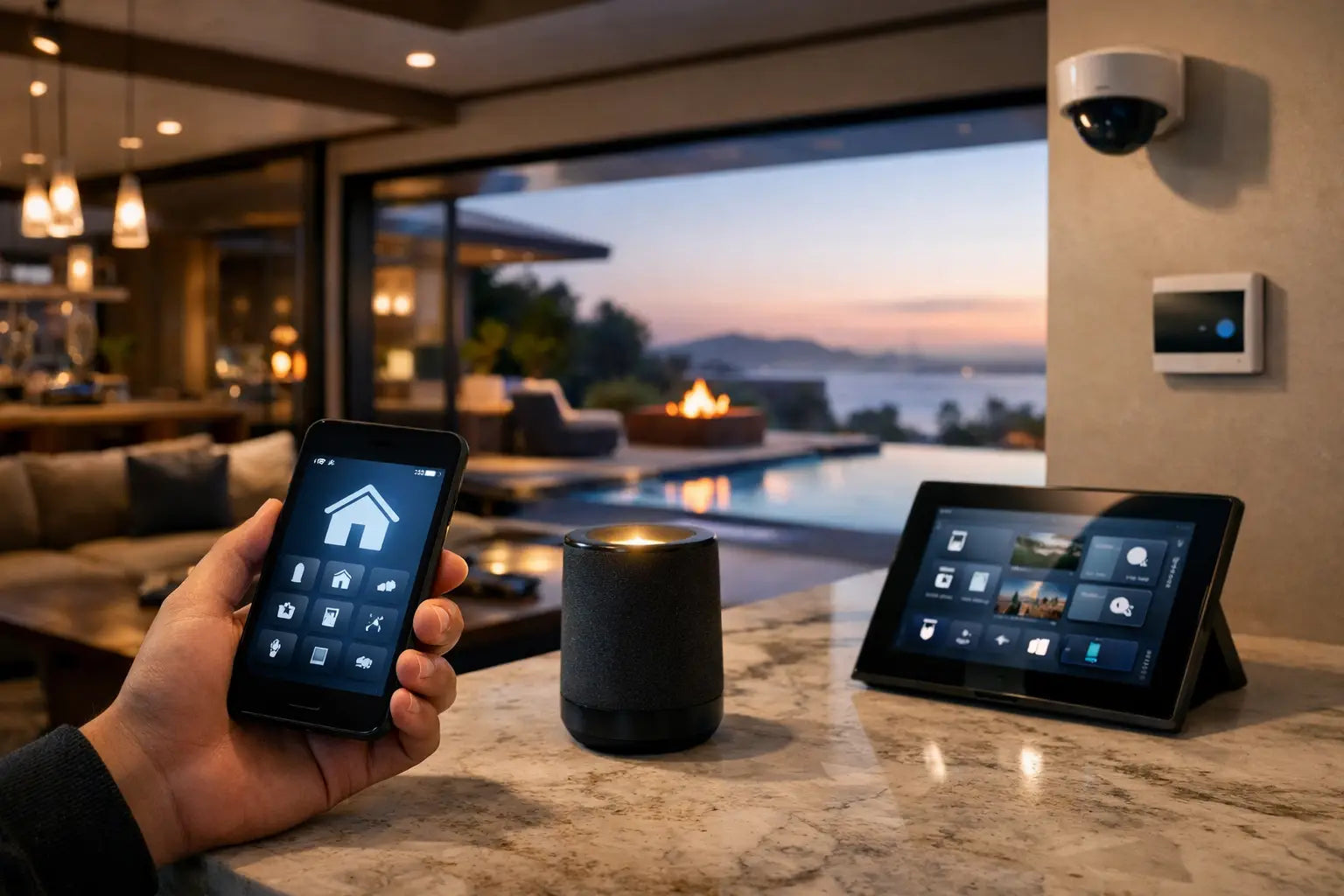
A beautiful home can still feel frustrating when its technology works in pieces. One app handles lighting, another manages cameras, a third controls audio, and none of it feels worthy of the space around it. That is usually the moment the search for the best smart home automation system becomes less about gadgets and more about creating a home that responds with intelligence, consistency, and discretion.
For premium residences, the right system is not simply the one with the most devices or the flashiest interface. It is the one that unifies lighting, climate, shading, security, entertainment, and access into a single, refined experience. It should feel effortless for the homeowner, elegant for the designer, and reliable for the people trusted to build and maintain the property.
What makes the best smart home automation system?
The answer depends on the level of home, the complexity of the project, and the expectations of the client. In a compact apartment, a few wireless devices and voice control may be enough. In a villa with multiple floors, outdoor areas, a cinema room, staff access, and layered security, that approach quickly starts to show its limits.
The best smart home automation system for a luxury property does five things exceptionally well. First, it centralizes control, so daily life does not depend on switching between disconnected apps. Second, it remains stable under constant use. Third, it supports bespoke design, which means keypads, sensors, speakers, screens, and touch panels can complement the architecture rather than compete with it. Fourth, it scales gracefully as the property evolves. Fifth, it is professionally engineered, not merely assembled.
This distinction matters. Consumer smart home products are designed to be purchased one device at a time. Integrated automation systems are designed to perform as a complete environment. That difference affects everything from responsiveness and reliability to cable planning and long-term serviceability.
The systems that usually define the conversation
When clients ask about the best smart home automation system, they are often comparing two broad categories. The first is consumer-first ecosystems such as Google Home, Amazon Alexa, Apple Home, and Samsung SmartThings. These are familiar, flexible, and relatively accessible. They can work well for simpler homes or as a starting point for users who want voice control and basic automation without major infrastructure.
The second category is professional control platforms such as Control4, Crestron, Savant, and KNX-based solutions. These are built for deeper integration, more advanced programming, and higher design standards. They are typically specified, installed, and configured by specialists rather than bought off a shelf and connected over a weekend.
That does not make one category universally better than the other. It means the right choice depends on what the property demands.
Consumer ecosystems: convenient, but not always complete
Consumer platforms have improved dramatically. They can handle lighting scenes, thermostat adjustments, camera feeds, and voice commands with reasonable ease. For many households, that is enough. They also tend to be less expensive upfront and offer wide device compatibility.
The trade-off is that convenience can come with inconsistency. Different brands may interpret commands differently, firmware updates can affect performance, and the user experience often reflects a collection of products rather than a single design vision. In higher-end homes, this can create friction. A room may look immaculate, yet the technology behind it feels improvised.
There is also the issue of infrastructure. Wireless devices are useful, but they are not always the ideal answer for large properties with thick walls, extended outdoor zones, and mission-critical systems such as access control, surveillance, and whole-home AV.
Professional platforms: engineered for the home as a whole
If the brief includes intelligent lighting control, automated shades, AC integration, distributed audio, home cinema, intercom, gate access, security, and energy management, professional platforms become far more compelling. They are designed to consolidate these functions into one coordinated system with predictable behavior.
That is where the concept of the best smart home automation system shifts. It is no longer about buying a hub. It is about creating a technology architecture for the property. In that context, reliability, programming depth, interface design, rack organization, acoustic planning, and aftercare all carry real value.
A well-designed system can trigger a complete arrival scene at sunset, lower shades in glare-prone areas, adjust temperature by zone, arm perimeter security at night, and route audio throughout indoor and outdoor spaces without the homeowner thinking about the mechanics. That is the level of refinement discerning clients expect.
How to evaluate the best smart home automation system for your project
The right evaluation starts with the property, not the product. A penthouse, a family villa, a private cinema, and a mixed-use commercial space all ask different things from an automation platform.
Start with lifestyle, not device count
Many people begin by listing products they want to control. A more intelligent approach is to define the experience first. How should the home behave in the morning? What should happen when the owners travel? How should guests use media areas without confusion? What level of access should staff have? How should exterior lighting, climate, and surveillance respond after hours?
Once these use cases are clear, system design becomes more precise. The best smart home automation system is the one that supports those routines elegantly and consistently.
Consider wired versus wireless infrastructure
In luxury residential construction and major renovations, wired infrastructure still offers significant advantages. It improves reliability, reduces dependence on battery-powered accessories, and allows deeper integration between subsystems. Wireless devices can be extremely useful, especially in retrofit projects, but they should be chosen carefully rather than treated as a default answer.
This is one of the most common points where cost and quality diverge. A lower-cost wireless setup may appear attractive early on, then reveal limitations once the property expands, the network becomes crowded, or more advanced automation is required.
Look beyond control to coordination
True automation is not just remote control on a phone. It is coordination between systems. Lighting should interact with occupancy and daylight. Climate should respond to scheduling and room use. Security should communicate with access events. Cinema mode should dim lights, close shades, power AV equipment, and set the room for performance.
If a platform cannot coordinate these layers effectively, it may still be useful, but it is probably not the best smart home automation system for a high-value project.
Design matters more than many buyers expect
In a premium home, technology should respect the interior palette. Wall controls, speaker placement, touch panels, motorized shading, and even equipment racks affect the visual and spatial quality of the property. The strongest systems are the ones that disappear where they should and present themselves beautifully where they must.
This is why integration should never be treated as a late-stage add-on. It works best when aligned with architecture, joinery, lighting design, HVAC planning, and acoustic strategy from the outset.
Why luxury homes demand more than DIY automation
A luxury property is rarely defined by square footage alone. It is defined by expectations. Owners expect systems to work instantly, quietly, and consistently. They expect elegant control from the bedroom, cinema, terrace, gym, majlis, and entrance gate. They expect technology to support entertaining, privacy, comfort, and security without becoming visually intrusive.
DIY platforms can satisfy parts of that vision, but they often struggle to deliver it as a whole. The issue is not just the equipment. It is the absence of coordinated engineering, programming logic, equipment layout, network design, and integration expertise.
That is where a specialist partner changes the outcome. A firm such as I-Trust Systems approaches automation as part of a complete living environment, where control, AV, security, acoustics, and aesthetics are designed to perform together. For high-end residences and technically ambitious spaces, that level of execution often matters more than the brand name on the app.
So which system is best?
For smaller homes or entry-level projects, a mainstream ecosystem may be perfectly suitable. It offers flexibility, familiar interfaces, and a manageable investment. If the goal is a few smart lights, a thermostat, video doorbell, and voice commands, there is little reason to overcomplicate it.
For villas, large residences, bespoke cinemas, and projects where design cohesion and system stability are non-negotiable, professionally integrated platforms are usually the stronger choice. They offer better control depth, cleaner user experiences, stronger subsystem coordination, and a more polished result across the property.
The best smart home automation system, then, is not a universal winner. It is the system that fits the scale of the home, the sophistication of the brief, and the standard of living the client expects. In premium spaces, the winning choice is usually the one that feels least like technology and most like effortless living.
Choose the system that can grow with the property, respect the architecture, and perform quietly in the background. When that happens, automation stops being a feature and starts becoming part of the home’s character.
Share:
9 Benefits of Smart Home Automation
How to Choose Smart Home Automation Companies