

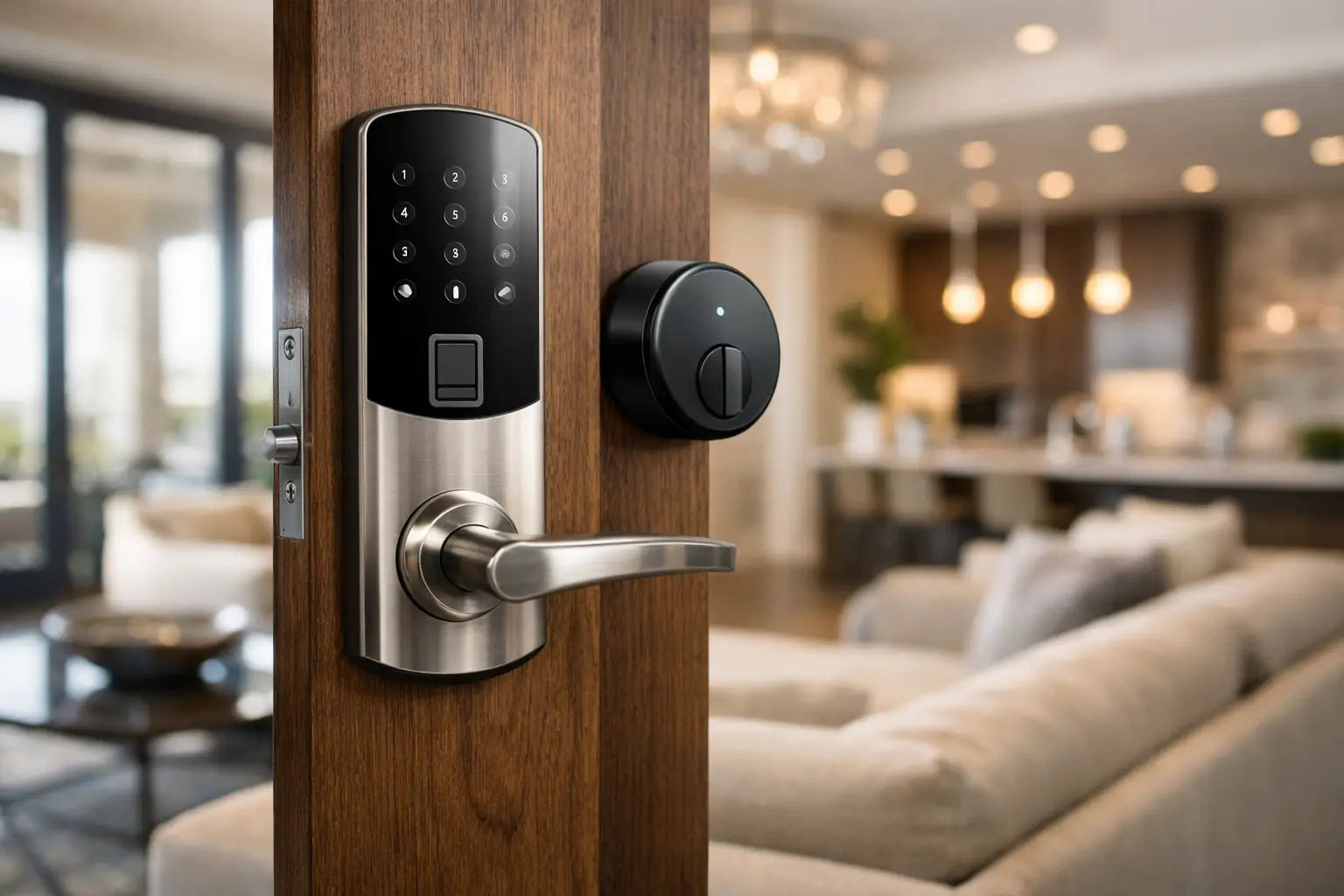
A front door is more than an entrance in a luxury residence. It is the first point of privacy, arrival, and protection for the people inside. Smart locks give that threshold a more intelligent role, allowing homeowners to manage access with the same level of control they expect from lighting, climate, audio, and security systems.
The right solution is not simply a lock with an app. In a refined home, it should complement the architecture, support the household's routines, and operate dependably whether the owner is at home, traveling, or welcoming guests. That requires more than selecting an attractive device from a catalog. It requires careful consideration of access needs, door construction, network design, and the larger security strategy.
Why Smart Locks Are Becoming a Luxury Essential
Traditional keys are familiar, but they offer limited visibility. A key can be copied, misplaced, or passed from one person to another without a clear record of who has access. Smart locks introduce a more considered approach. Homeowners can use PIN codes, mobile credentials, cards, fingerprints, or integrated entry panels, depending on the system and the desired experience.
For a villa owner, that may mean giving a house manager scheduled access without issuing a permanent key. For a family, it may mean assigning individual credentials to each member and receiving a notification when children arrive home. For a second residence, it can mean authorizing a trusted guest or service provider for a defined period, then removing access when it is no longer needed.
The value lies in control without adding friction to daily life. A well-planned system makes arrival feel effortless while keeping access decisions deliberate. It also reduces the visual clutter of key boxes, spare keys, and mismatched access hardware that can undermine an otherwise carefully designed entryway.
Smart Locks Should Be Part of a Complete Security Plan
A smart lock is an important layer of entry security, but it is not a complete security system by itself. Its performance depends on the quality of the door, frame, strike plate, cylinder, hinges, and installation. A premium electronic lock fitted to a weak door assembly cannot compensate for structural shortcomings.
The strongest projects assess the entry as one coordinated system. The lock should be specified alongside the door hardware, intercom or video door station, perimeter cameras, alarm system, gate access, and internal automation platform. This creates a clear, consistent sequence: a visitor arrives at the gate, requests entry through the appropriate panel, and access can be granted, monitored, or denied from the home or remotely.
For properties with multiple entrances, this coordinated approach becomes especially valuable. A main entrance may require a refined biometric or keypad solution, while service doors, staff areas, garages, and private offices may need different credential rules. Treating every opening the same often creates inconvenience or weakens security. Treating each opening according to its purpose creates a more controlled environment.
Access Should Reflect Real Life
The best access plan starts with the people who use the property. Owners, children, household staff, drivers, cleaners, contractors, tenants, and guests all require different levels of access. A premium system should accommodate those distinctions without forcing the homeowner to manage a complicated process every day.
Consider whether access needs to be permanent, temporary, recurring, or limited to certain hours. A landscaper may need entry only on weekday mornings. A short-term guest may require access for a weekend. A family member may need unrestricted entry but not permission to change system settings. These details determine whether a lock should operate independently or be integrated into a broader access-control platform.
What to Look for When Selecting Smart Locks
Design matters, particularly at a prominent front door. The exterior finish, handle style, keyway treatment, and reader placement should feel intentional against the door material and surrounding architecture. A visible keypad may suit one home; another may call for a discreet reader, concealed electronic hardware, or a more minimal profile.
Beyond appearance, four considerations shape whether a smart lock will perform well over time:
- Credential options: Choose methods that suit the household, such as keypad codes, fingerprints, RFID cards, mobile access, or a mechanical override where appropriate.
- Integration capability: Confirm compatibility with the automation, intercom, alarm, and camera systems planned for the property. Standalone operation can be suitable for smaller applications, but integrated control is often preferable in larger residences.
- Power and backup: Battery-operated locks are common and practical, yet the design should include low-battery alerts, emergency power provision, and a considered mechanical access plan.
- Door compatibility: Door thickness, handing, locking points, mortise dimensions, fire-rating requirements, and weather exposure all affect the correct product choice.
Wireless Convenience Requires Network Discipline
Many smart locks rely on Wi-Fi, Bluetooth, Zigbee, Z-Wave, Thread, or a dedicated access-control network. Each approach has advantages, but wireless performance should never be left to chance. Thick walls, metal door cores, stone cladding, long driveways, and detached guest houses can all affect signal quality.
A professionally designed network gives connected devices stable coverage, appropriate segmentation, and dependable remote operation. It also helps prevent a common frustration: a lock that works perfectly when standing at the door but becomes inconsistent when managed through the wider home system.
Cybersecurity deserves the same attention as physical hardware. Strong passwords, secure account management, regular firmware updates, properly configured user permissions, and reputable products all matter. Remote access is powerful, but it should be administered with discipline. Homeowners should know who can control the system and how access can be removed immediately if a phone, card, or credential is lost.
Integration Creates a Better Arrival Experience
The most compelling smart lock installations do not feel like isolated gadgets. They support a complete arrival scene. When an authorized resident enters, selected pathway lighting may activate, the air conditioning can return to an occupied setting, and the entry camera can record the event as part of the security log. When the household leaves, a departure command can confirm that designated doors are secured while lighting and climate settings adjust accordingly.
This level of integration should be used thoughtfully. Not every event needs to trigger multiple actions, and excessive automation can become distracting. The goal is an environment that responds with quiet intelligence, not one that constantly announces itself.
For commercial properties, the benefits can be equally significant. Executive offices, gyms, clinics, showrooms, schools, and hospitality venues often need time-based access for employees, vendors, and visitors. An integrated system can simplify administration while maintaining clear records and controlled entry points. The appropriate solution depends on occupancy, compliance requirements, operating hours, and the cost of an access failure.
Installation Quality Protects the Investment
Premium access hardware deserves precise installation. Alignment between the lock, latch, strike, and door frame affects both security and day-to-day operation. Poor alignment can cause excessive motor strain, unreliable locking, premature battery drain, and an entry experience that feels anything but refined.
Installation should also account for door movement, expansion from heat, exterior exposure, and future maintenance. In high-end projects, coordination with the door manufacturer, joinery team, electrician, low-voltage contractor, and interior designer is often necessary. Small decisions, such as the placement of a reader or the routing of concealed cabling, have a major effect on the finished appearance.
At I-Trust Systems, smart access can be planned as part of a larger environment that brings together security, automation, AV, and architectural detail. This approach gives homeowners and project teams one clear path from design intent through installation and long-term performance.
A smart lock earns its place in a luxury home when it feels considered from the first touch. Choose the system around the people, property, and security expectations it must serve, then give the installation the engineering attention the entrance deserves.
مشاركة:
How to Integrate Access Control Into Luxury Spaces
Why Choose Centralized Home Control for a Villa?