

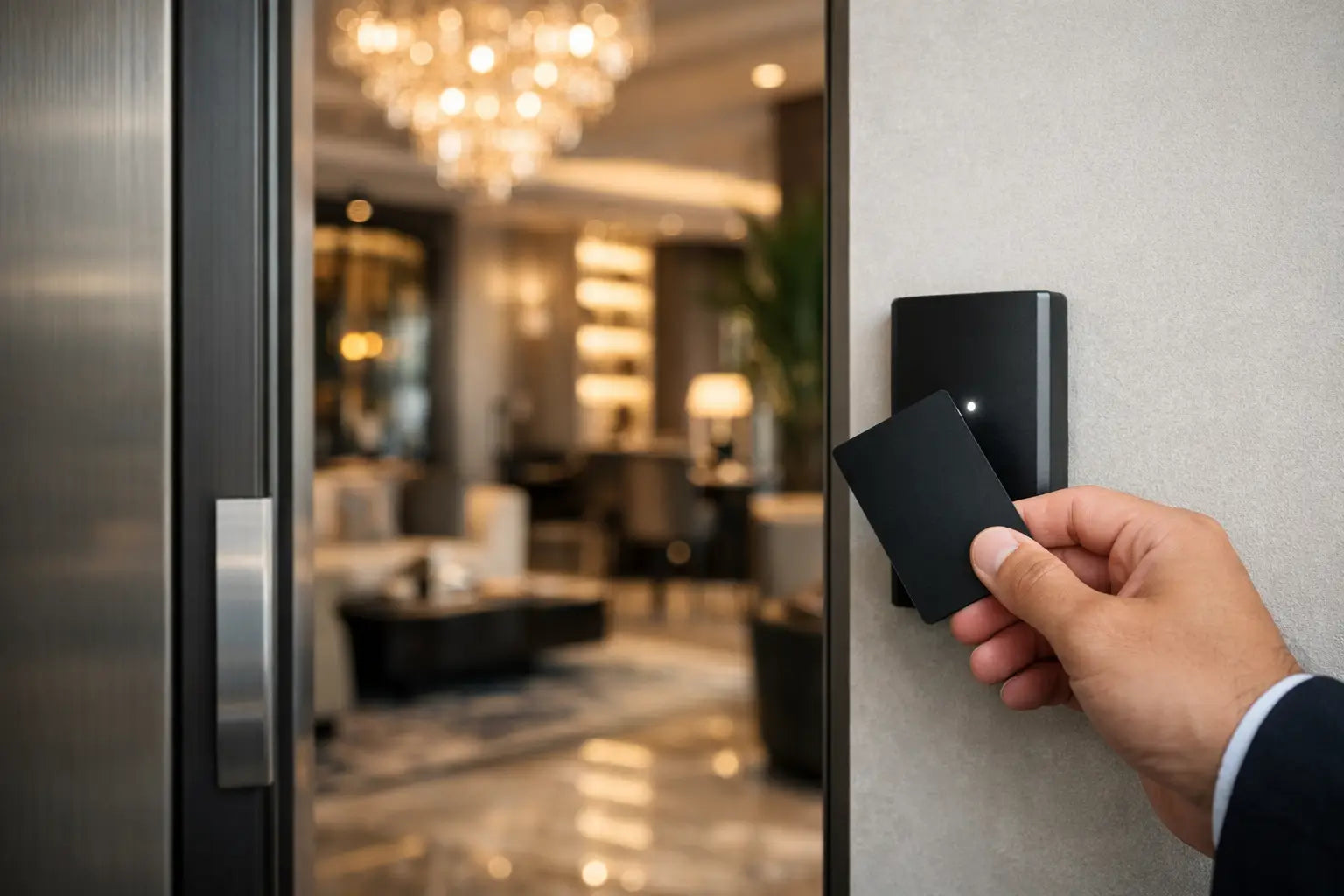
A luxury property should not greet its owner with a search for keys, a call to the gatehouse, or an exposed keypad interrupting an otherwise refined entrance. To integrate access control properly is to make entry feel natural while ensuring every door, gate, and restricted area responds with intelligence, discretion, and certainty.
For villas, premium residences, offices, hospitality venues, and high-traffic commercial properties, access control is more than a locking solution. It is the point where security, architecture, daily routines, and privacy meet. When it is designed as part of a wider smart environment, it can protect the property without making the property feel guarded.
Integrate Access Control as Part of the Whole Design
A standalone door lock can solve a narrow problem. It can secure one door, log an event, or accept a code. But premium spaces rarely operate as a collection of isolated doors. A villa may have a perimeter gate, main entrance, service entry, garage, pool access, staff quarters, a private office, and a cinema room containing valuable equipment. Each zone calls for a different level of access and a different experience.
The strongest approach is to integrate access control with the systems already shaping the building: gate automation, video surveillance, intercoms, lighting control, HVAC, curtains, alarms, and centralized automation. The result is a coordinated response rather than a series of disconnected actions.
For example, verified entry at a front gate can trigger a carefully defined arrival sequence. Exterior lighting can illuminate the driveway, selected interior lights can come on, and the main entrance can prepare for the homeowner's arrival. A visitor, by contrast, may be limited to a video intercom interaction and access to the reception area only. The distinction is not merely technical. It preserves the privacy and rhythm of the home.
Start With How People Actually Move Through the Property
The best access-control design begins with behavior, not hardware. Before selecting readers, locks, or credentials, map who enters the property, where they enter, and what should happen next. Homeowners, children, household staff, guests, drivers, contractors, delivery personnel, and security teams should not all receive the same access experience.
Consider the arrival path from the street to the main entrance. At a large residence, a guest might first interact with an external intercom at the vehicle gate, then proceed through a pedestrian gate, and finally reach the front door. Each point should be purposeful. Too many authentication steps create friction; too few may compromise security. The appropriate balance depends on the property's location, staffing model, risk profile, and the level of privacy expected by the owner.
A thoughtful design also separates everyday circulation from back-of-house movement. Service doors, utility rooms, equipment racks, storage areas, and private wings can remain secure without forcing staff through inconvenient routes. In a commercial setting, this zoning becomes equally valuable for stockrooms, executive suites, IT rooms, staff areas, and public entrances.
Define Access by Zone, Time, and Role
Access permissions should be specific enough to be useful but simple enough to manage. A housekeeper may require entry to designated areas during scheduled hours. A landscape team may receive access to external gates without access to the residence. A temporary contractor can be issued time-limited credentials that expire automatically when work is complete.
This approach reduces the risk of physical keys being copied, lost, or retained after a service relationship ends. It also gives owners and property managers a clear view of who entered, when they entered, and which access point was used. For properties with multiple occupants or rotating staff, that visibility is a practical advantage, not an unnecessary complication.
Choose Credentials That Match the Environment
There is no single credential that suits every entrance. Keypads offer familiarity and can work well for staff or secondary doors, but shared codes need active management. Cards and fobs are efficient for offices, gyms, schools, and larger facilities, although they can be misplaced. Mobile credentials offer convenience and can be remotely issued or removed, making them especially useful for guests and temporary access.
Biometric access can add a high level of certainty in sensitive zones, such as executive offices, server rooms, private storage, or selected residential areas. Yet it should be specified carefully. Some clients prefer biometrics for their speed and security; others prefer a more private or understated experience. A well-designed system accommodates those preferences rather than imposing technology for its own sake.
The entrance itself matters as much as the credential. A sculptural front door may call for a discreet reader integrated into the surrounding detail. A heritage-inspired property may need technology concealed within custom metalwork or stonework. For exterior gates, hardware must withstand heat, dust, moisture, and sustained daily use. Premium design is not achieved by selecting expensive devices alone. It comes from making performance, reliability, and finish work together.
Connect Entry to Security and Home Automation
When access events communicate with the rest of the system, the property becomes more responsive. At minimum, entry should work in concert with video intercom and surveillance. An owner should be able to see who is requesting entry, communicate clearly, and grant or deny access from an appropriate control interface.
Create Arrival Scenes With Restraint
An approved homeowner credential can initiate an arrival scene that feels considered rather than theatrical. The gate opens, pathway lighting adjusts to a welcoming level, the garage is available if required, and selected comfort settings return to the preferred mode. At night, the system can bring on exterior and entrance lighting without illuminating the entire home.
For guests, access can be more controlled. A temporary mobile invitation may operate only during an event window and only at the designated entrance. This is particularly valuable for villas used for entertaining, second homes, or properties where owners want to welcome guests without distributing permanent keys or codes.
Make Departure More Certain
Departure is often where integrated control proves its value. A single action can verify that designated doors are secure, selected lights are off, curtains are adjusted, and the alarm is armed in the appropriate areas. Access control does not replace a complete security strategy, but it can provide a dependable foundation for one.
The system should also account for exceptions. Someone may remain in a guest wing while the main residence is secured. A late-arriving family member may need a different access path than household staff. These scenarios are why bespoke programming matters. Generic settings may work in a small apartment; a substantial property benefits from automation designed around real life.
Build the Infrastructure Before Finishes Are Finalized
Access control is easiest to execute beautifully when it is planned early. Door frames, lock preparation, reader locations, gate operators, network pathways, power supplies, emergency release requirements, and equipment-room capacity all need coordination with the architect, interior designer, door supplier, and electrical contractor.
Retrofitting remains possible, but it usually introduces compromises. Surface-mounted hardware may affect the visual finish. Wireless devices may be appropriate in selected applications, yet battery maintenance and signal conditions must be considered. Hardwired solutions generally offer greater long-term reliability for key perimeter and high-use access points, especially when paired with properly designed backup power and secure network infrastructure.
This is also the time to address life safety. Access-controlled doors must comply with applicable egress requirements, fire alarm interfaces, and emergency-release standards. Security should never obstruct safe exit. An engineering-led integration partner will coordinate these requirements before installation, not attempt to resolve them after the project is complete.
Apply the Same Discipline to Commercial Spaces
Commercial access control has different pressures: higher user volumes, operating schedules, staff turnover, public-facing entrances, and the need for reliable reporting. A gym may need member access at all hours while restricting back-office and equipment areas. A retail environment may require controlled stockroom entry. An auditorium, mosque, or school may need simple public circulation alongside tightly managed staff and technical rooms.
The principle remains the same: access should support the purpose of the space. A system that is overly complex will frustrate staff and create workarounds. A system that is too basic can leave sensitive areas exposed. The right solution reflects the building's operations, its occupancy, and the experience expected by visitors.
For developers and designers, integrating this discipline early also protects the visual integrity of the project. Readers, cameras, intercoms, door hardware, and control panels can be selected as part of a unified material palette rather than added as visible afterthoughts.
Design for Change, Not Just Opening Day
A property changes over time. Families grow, staff roles shift, businesses expand, and new areas are added. Access control should be able to evolve without requiring a complete replacement. That means allowing capacity for additional doors and users, using a platform suited to the project's scale, and documenting the system clearly for future service and expansion.
It also means establishing sensible management practices. Credentials should be reviewed when staff or tenants change. Event logs should be used responsibly. Remote administration should be secured with appropriate permissions. Convenience is valuable, but it should never create an easy route into the system itself.
I-Trust Systems approaches access control as a designed experience: one that protects the perimeter, respects the architecture, and connects naturally with the way a premium property is lived in. The most successful system is rarely the most visible one. It is the one that makes every authorized arrival feel effortless while quietly ensuring that every other door remains exactly where it should be: under control.
مشاركة:
Residential Camera Guide for Secure Luxury Homes
Smart Locks That Belong in a Luxury Home