

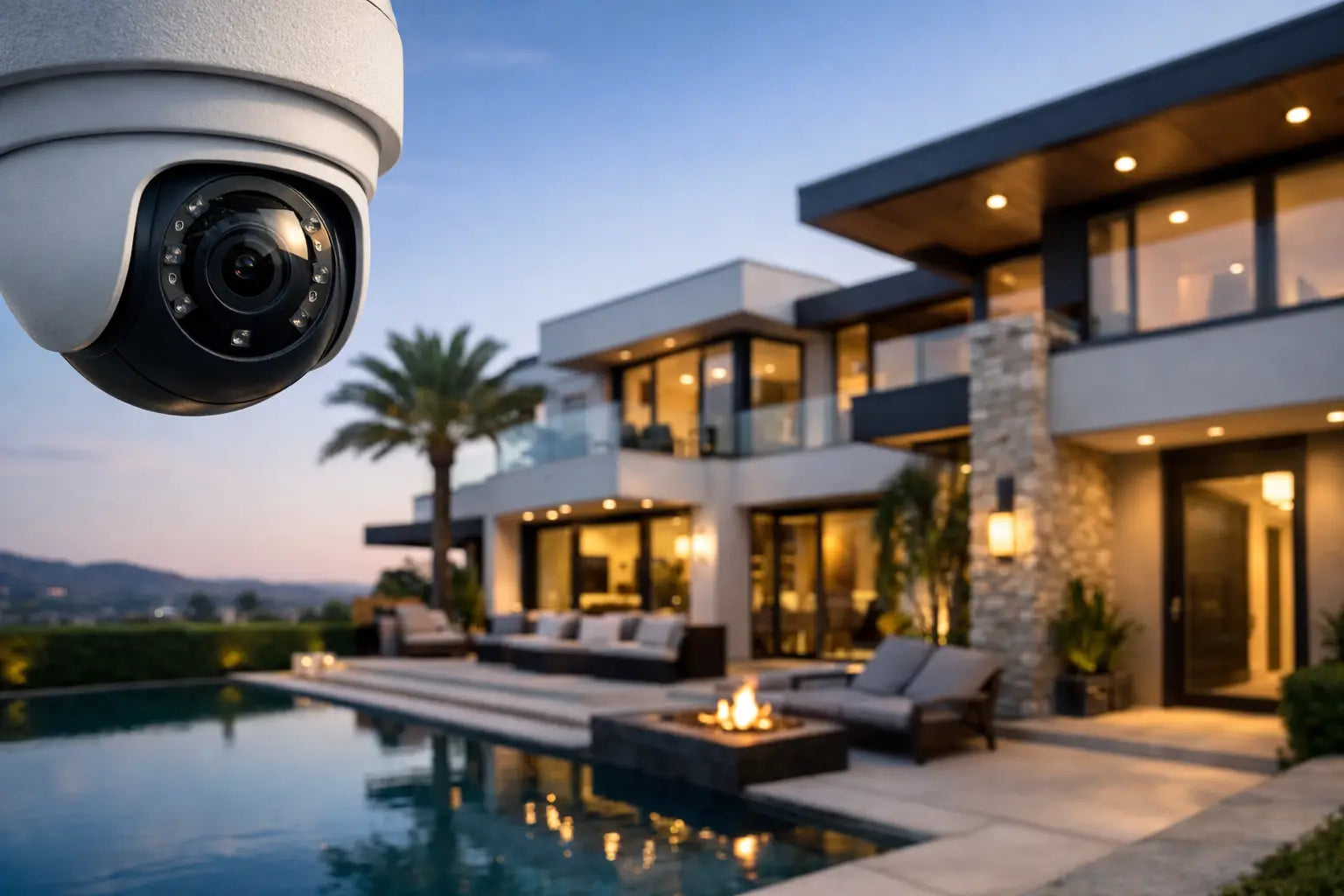
A well-designed camera system should protect a residence without making it feel like a fortress. This residential camera guide is built for homeowners who expect security to complement architecture, landscape design, and daily life - not compete with them. The right solution provides clear evidence when needed, intelligent awareness when away, and a composed visual presence throughout the property.
For a luxury home, choosing cameras is rarely about selecting the highest megapixel number on a product box. It is about understanding how people enter the property, where valuables are exposed, how light changes throughout the day, and how security should connect with gates, access control, lighting, alarms, and smart home automation.
Start With the Property, Not the Camera
Every effective surveillance design begins with a site assessment. A compact urban residence, a waterfront estate, and a multi-level villa have very different risk profiles. Entrances may be obvious, but side passages, service gates, garden boundaries, rooftop access, pool areas, and detached garages often require closer consideration.
The goal is layered awareness rather than indiscriminate coverage. Exterior cameras should establish who approached, where they came from, and where they went. Interior cameras, when appropriate, can protect select high-value areas without turning private living spaces into constantly observed zones.
A professional plan also accounts for sightlines. A camera positioned too high may capture the top of a visitor’s head instead of a useful facial image. One placed too low may be vulnerable to tampering. Landscaping, decorative columns, deep overhangs, reflective glass, and changing sunlight can all affect image quality. These details are precisely why camera placement deserves engineering attention before installation begins.
Residential Camera Guide: Choose Coverage by Purpose
Different camera types serve different roles. A refined system uses each one intentionally rather than placing identical devices at every corner.
A video doorbell or dedicated entrance camera provides a close, face-level view of visitors, deliveries, and service personnel. It is particularly valuable when paired with an intercom and controlled gate or door release. The homeowner can verify a visitor from a wall keypad, mobile device, or central touch panel before granting access.
Turret or dome cameras are often suited to covered entries, hallways, garages, and exterior soffits. Their compact form can blend comfortably into modern architecture, and their protected design makes them a practical choice for many fixed viewpoints. Bullet cameras can be more visible, which may be useful where a clear deterrent is desired, such as a perimeter gate or a remote edge of the property.
Pan-tilt-zoom cameras offer flexible viewing across larger spaces, including expansive driveways, gardens, and shared access roads. Their value lies in active observation and detail at distance. They are not a replacement for fixed cameras, however. A fixed camera records a dedicated scene continuously, while a PTZ camera can only face one direction at a time.
For a discreet finish, cameras can be selected in colors and mounting styles that align with the exterior palette. The objective is not to hide security completely. It is to integrate it with the same care given to lighting fixtures, speakers, and architectural hardware.
Image Quality Is About More Than Resolution
High resolution matters, particularly at gates, entrances, and driveways where facial identification or license plate recognition may be required. Yet resolution alone does not guarantee useful footage. Lens selection, sensor quality, frame rate, dynamic range, and low-light performance all influence what a camera can actually capture.
A wide-angle lens covers more area but makes distant subjects appear smaller. A tighter lens captures more detail at a particular point but sees less of the surrounding scene. The correct choice depends on the question that location needs to answer. At a front entrance, the priority may be a recognizable face. At a garden perimeter, it may be movement and direction of travel.
Night performance deserves equal attention. Luxury properties often feature carefully designed exterior lighting, but cameras still encounter dark corners, strong pools of light, headlights, and shadows cast by trees. Cameras with strong low-light sensors and wide dynamic range can preserve detail when a subject moves between bright and dark areas. Infrared illumination can be highly effective, although it may produce a more monochrome image after dark and can be affected by nearby walls, glass, or foliage.
Avoid specifying cameras by resolution alone. A properly selected 4K camera in the right location may outperform a higher-resolution unit positioned poorly or aimed through difficult lighting.
Design a System That Records When It Matters
Footage is only valuable if it is available when an event occurs. That makes recording strategy as important as camera selection. Continuous recording offers the most complete record of activity, while motion-based recording can reduce storage use. In premium homes, a hybrid approach is often the strongest option: continuous recording at critical entry points, with intelligent event recording and alerts across less sensitive areas.
Modern analytics can distinguish between people, vehicles, and general movement. This helps reduce needless notifications caused by rain, tree branches, pets, or passing shadows. The technology should be configured carefully. Overly sensitive alerts make homeowners ignore notifications; overly restrictive settings can miss meaningful events.
Storage should be sized around the number of cameras, image quality, recording schedule, and desired retention period. A system recording multiple high-resolution streams around the clock needs considerably more capacity than one recording only selected events. Local network video recording provides control and dependable on-site access, while secure remote backup can add protection if recording equipment is damaged or removed.
For larger estates, it is wise to place recording hardware in a secured, cooled, and serviceable equipment location. This also supports clean cable management and easier future expansion.
Make Privacy Part of the Design
Security should enhance confidence, not create discomfort. Indoor cameras require particular restraint. They may be appropriate in a wine room, art storage area, secondary residence, or certain staff-access spaces, but bedrooms, bathrooms, and intimate family areas should remain entirely private.
Exterior cameras should be aimed to cover the homeowner’s property and access routes, not neighboring living areas. Privacy masking can block portions of an image that should never be recorded, such as a neighboring window or private courtyard. It is also sensible to establish clear household permissions for who can view live feeds, receive alerts, export recordings, and manage system settings.
Cybersecurity is part of privacy as well. Cameras should be installed on a professionally managed network with strong credentials, current firmware, secure remote access, and appropriate separation from guest devices. A camera system is not simply a collection of lenses. It is a connected part of the home’s digital infrastructure.
Integrate Cameras With the Rest of the Home
A camera system becomes more valuable when it works with the property’s other systems. When a vehicle reaches the gate, a homeowner may receive a video prompt and choose to open access from a touch panel. When an exterior camera detects a person after hours, landscape lights can illuminate a selected pathway while an alert is sent to authorized users. When the alarm is armed, cameras can shift to a heightened notification profile.
Integration should be purposeful, not theatrical. A sudden movement near a pool does not always require every light in the home to activate. The best automation logic is calm, predictable, and tailored to how the residents use the property.
Centralized control also improves the daily experience. Rather than opening separate apps for cameras, gates, lighting, climate, and audio, homeowners can access key functions from a unified interface. For architects and interior designers, this reduces visible clutter from redundant keypads, displays, and consumer-grade devices.
Prioritize Wired Reliability Where Possible
Wireless cameras can be useful for temporary coverage, difficult retrofit locations, or secondary viewpoints. They are not always the preferred foundation for a large, high-performance residential security system. Wireless performance can be affected by building materials, distance, network congestion, battery maintenance, and changing environmental conditions.
Where construction access allows, wired cameras with Power over Ethernet provide reliable communication and power through a single structured cable. This supports cleaner installation, central power management, and consistent recording. In a new build or major renovation, planning camera cabling early is one of the most valuable security decisions a project team can make.
It is equally important to allow room for growth. A property may later add a guest house, perimeter gate, garage expansion, or new outdoor entertaining area. Thoughtful infrastructure avoids expensive compromises when security needs evolve.
Commissioning Defines the Finished Experience
Installation is not complete when the cameras turn on. Each camera should be focused, framed, tested in daytime and darkness, labeled clearly, and verified for remote access and recording. Analytics should be tuned based on actual conditions at the property, not left at generic factory settings.
The homeowner should also receive a clear handover: how to view footage, respond to an alert, share access appropriately, and request service when needed. At I-Trust Systems, this level of commissioning is what turns individual security products into a considered residential system.
The most elegant security solution is one you rarely have to think about. It simply provides the right view, at the right time, while preserving the beauty, privacy, and effortless control that define an exceptional home.
مشاركة:
How to Choose Access Control for Luxury Properties
How to Integrate Access Control Into Luxury Spaces