

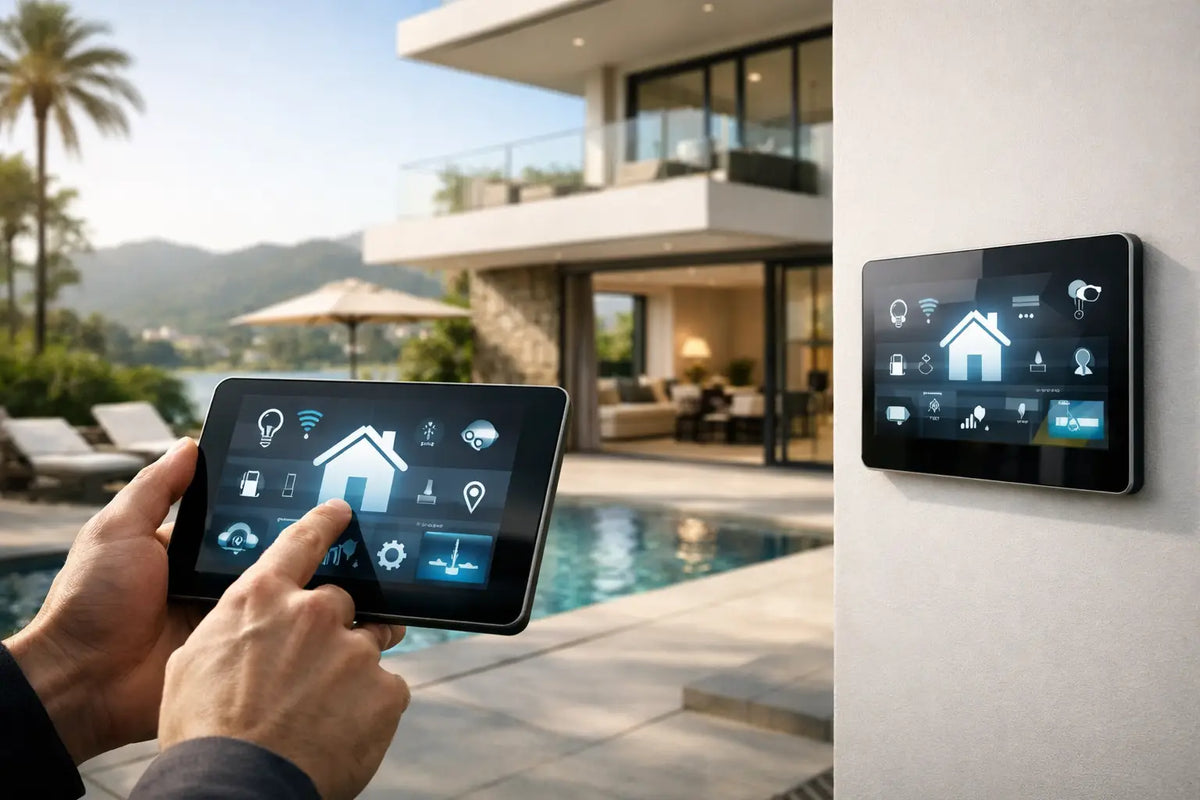
A beautifully designed villa can still feel compromised when lighting lives in one app, air conditioning in another, security on a separate panel, and entertainment behind a cabinet full of remotes. The question of why choose centralized home control is really a question of how you want your home to feel: considered, responsive, and effortlessly prepared for the way you live.
Centralized control brings the major systems of a residence into one intelligently designed environment. Rather than adding disconnected smart devices over time, it creates a coordinated experience for lighting, climate, shades, audio, video, security, access, and selected appliances. The result is not more technology competing for attention. It is technology that recedes into the background while the home performs with greater precision.
Why Choose Centralized Home Control Instead of Separate Apps?
Individual smart products can be useful, particularly in a smaller residence or as a limited upgrade. A smart thermostat, a voice-controlled speaker, or motorized shades may each solve a specific need. The difficulty begins when these systems must work together. Separate apps create separate decisions, separate passwords, separate installers, and often separate points of failure.
A centralized system is engineered as a single ecosystem. A wall keypad can adjust lighting, lower shades, select music, and set the ideal temperature without asking the homeowner to open multiple applications. A refined touchscreen can present only the controls needed in that room, while mobile access gives owners visibility when they are away. The experience is simpler because the engineering behind it is more deliberate.
For high-value properties, this distinction matters. A villa is not merely a collection of rooms. It is an environment with distinct moments: a bright morning kitchen, a formal dinner, an intimate cinema evening, a secure departure, or a weekend gathering that extends from interior living spaces to the garden. Centralized home control gives those moments a consistent logic.
Control That Feels Natural in Every Room
The best control system does not demand that every guest learn a new interface. It gives each space an appropriate level of control. In a bedroom, that may mean a bedside keypad with options for reading, relaxation, and sleep. In a living room, it may mean a simple selection for entertaining, with the lights, shades, and audio responding together. In a home cinema, the system can prepare the room before the first scene begins.
This approach also preserves interior design. Instead of covering premium wall finishes with mismatched switches and standalone controllers, controls can be selected and placed as part of the architectural plan. Finishes, engravings, keypad layouts, and touchscreen locations can be coordinated with the interior palette rather than treated as an afterthought.
Scenes Replace Repetitive Adjustments
The real value of centralization lies in scenes. A scene combines several actions into one intentional command. A Good Morning setting might raise bedroom shades gradually, bring climate control to a comfortable level, and illuminate circulation areas with soft light. An Entertain setting can establish the preferred lighting level, play music in selected zones, and adjust the outdoor living area for guests.
These scenes should be personal, not generic. Families use their homes differently, and a system should reflect that. Some owners want lights to respond to sunset. Others prefer complete manual control with a few carefully designed modes. The objective is not automation for its own sake. It is to remove routine friction while retaining the right level of choice.
A Centralized Home Control System Is an Investment in Integration
Centralization is often mistaken for a premium remote control. In reality, it is an integration strategy. It begins with infrastructure: the wiring, network design, equipment location, power planning, and control architecture that allow systems to communicate reliably. This planning is particularly valuable during construction or major renovation, when technology can be incorporated without compromising ceilings, joinery, acoustic finishes, or sightlines.
Lighting control, for example, is more than dimming fixtures from a phone. A properly designed system considers fixture types, dimming compatibility, circuit loads, keypads, daylight, and how each room is used. Climate integration can coordinate AC control with occupancy, shading, and preferred schedules. Motorized curtains and shades can protect interiors from harsh sun while reducing heat gain and preserving the view when desired.
A central controller gives these systems a shared language. Instead of operating in isolation, they respond to the same intent. When the house is placed in Away mode, selected lights can switch off, shades can move to a preferred position, climate can reduce unnecessary consumption, and security can be armed according to the homeowner's requirements.
Security Becomes Part of Daily Living
Security is most effective when it is easy to use consistently. Centralized home control can bring access control, cameras, gate communication, alarm functions, and selected monitoring alerts into the same environment used for the rest of the home. From a single interface, an owner may verify that doors are secured, view an entrance camera, grant access to a trusted visitor, or receive a meaningful alert while traveling.
This is especially valuable for large homes with multiple entry points, staff access, guest areas, outdoor buildings, or remotely managed properties. The goal is not to place more screens in front of the homeowner. It is to give the right information at the right moment.
Privacy should be considered carefully. Camera positions, access permissions, recording policies, and remote user accounts should be planned with the same attention given to physical security. A premium installation respects both protection and discretion.
Entertainment Performs Better When the Home Understands It
In a luxury residence, entertainment should feel cinematic without becoming complicated. Centralized control can bring together a dedicated theater, living room television, multi-room audio, outdoor speakers, and media sources under one intuitive operating experience. Selecting a movie can trigger the projector, screen, surround sound, lighting, and shades in the proper sequence.
The same principle applies to distributed audio. Music can follow the family from the kitchen to the terrace, remain separate in different zones, or be muted automatically when a doorbell or security event needs attention. When audio, video, acoustics, and control are designed together, performance is more consistent and the room remains visually composed.
For cinema rooms and multipurpose entertainment spaces, centralization should be paired with professional AV engineering and acoustic treatment. Control cannot compensate for poor speaker placement, improper room proportions, excessive reverberation, or an underspecified network. It can, however, make a well-designed system genuinely enjoyable to use every day.
Better Control Can Also Support Property Value
A centralized system adds value when it is thoughtfully documented, professionally installed, and intuitive for future occupants. It demonstrates that the property has been designed as a complete environment rather than assembled from consumer devices. For developers, this can be a meaningful differentiator in premium residences, hospitality spaces, and high-spec commercial projects.
It also helps protect the visual quality of the property over time. Centralized infrastructure reduces the temptation to add more plug-in hubs, visible cables, and disconnected control devices as needs evolve. With the right architecture, future upgrades can be approached strategically rather than through repeated patchwork installations.
That said, property value should not be the only reason to invest. The most immediate return is experiential. Owners notice the difference when arriving home after travel, hosting guests, preparing a cinema room, or managing the house from another location. It is a form of convenience that becomes more valuable because it is reliable.
When Centralized Home Control May Not Be the Right Choice
Centralized control is not automatically necessary for every property. A compact apartment with limited systems may be better served by a focused solution for lighting, climate, or entertainment. Likewise, a homeowner who wants only one isolated function may not need the infrastructure of a whole-home platform.
The investment is most compelling when several systems need to work together, when the property is large or architecturally complex, or when aesthetics and reliability are priorities. Budget, construction stage, network quality, and the owner's appetite for customization all influence the right scope. Retrofitting is possible, but it may require more creative planning than a project designed during construction.
The key is to avoid both extremes: installing disconnected devices without a plan, or specifying technology beyond what the household will genuinely use. A well-designed system should feel appropriate to the property and the people who live in it.
Start With the Lifestyle, Then Engineer the System
The strongest projects begin with questions that go beyond equipment. How does the household arrive and leave? Which rooms are used at different times of day? Are there children, elderly family members, staff, frequent guests, or multiple owners? Does the property need formal entertaining modes, garden control, a private cinema, enhanced perimeter security, or remote management?
From there, the design can establish zones, scenes, keypads, equipment locations, and network requirements. Architects and interior designers should be involved early so that technology supports the architecture rather than competing with it. This is where an experienced integration partner such as I-Trust Systems brings particular value: aligning automation, AV, security, acoustics, and installation under one coordinated design process.
A home should not make its owner think about which app controls which room. Choose centralized control when you want the technology to serve the architecture, anticipate the rhythm of the household, and make every space feel intentionally yours.
مشاركة:
Smart Locks That Belong in a Luxury Home
Acoustic Foam for Refined, Better-Sounding Rooms