

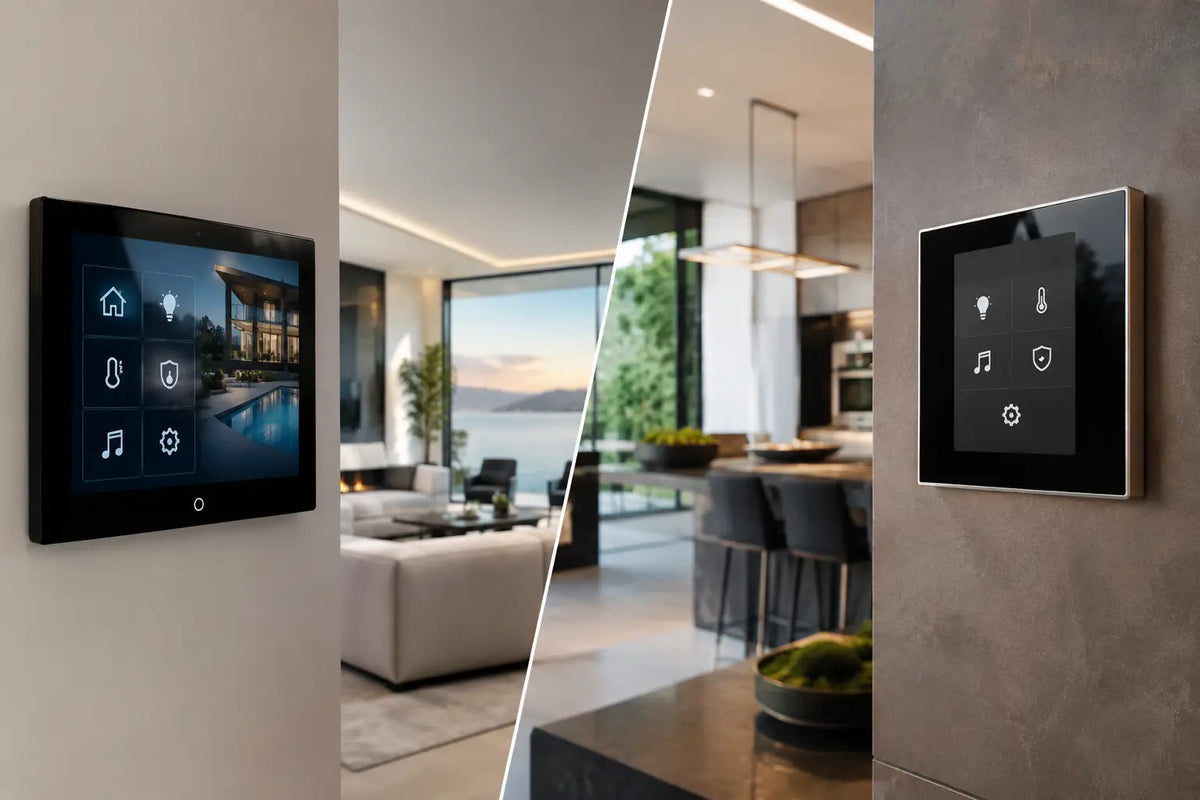
A villa can have beautiful lighting fixtures, discreet speakers, motorized shades, precision climate control, and a cinema worthy of a private screening room - yet still feel frustrating if every system operates on its own app, remote, or wall control. The decision between KNX vs Control4 automation determines how those experiences come together, how the property evolves over time, and how confidently it performs when the house is full.
For premium residences, the right answer is rarely about choosing the system with the longest feature list. It is about selecting an architecture that respects the design, supports the way the space is used, and gives owners a refined, intuitive relationship with the technology around them.
KNX vs Control4 Automation: The Core Difference
KNX is an open, internationally recognized building automation standard. It is engineered primarily for integrated control of lighting, shading, HVAC, sensors, energy functions, and building services. Rather than relying on a single central processor for every essential action, KNX commonly uses distributed devices across a dedicated bus. A lighting keypad, actuator, thermostat, and sensor can communicate within the system according to the programmed logic.
Control4 is a smart home platform built around elegant user interfaces, automation controllers, touchscreens, keypads, remotes, and a broad ecosystem of residential products. It is particularly accomplished at bringing entertainment, multi-room audio, video distribution, lighting, climate, security, and connected devices into one familiar experience.
That distinction matters. KNX often begins with the building infrastructure and its long-term operation. Control4 often begins with the homeowner experience - how a room feels when one button sets the lighting, starts the music, lowers the shades, and prepares the display. Both can deliver exceptional results. They simply approach the project from different directions.
Where KNX Excels
Built for the fabric of the building
KNX is especially compelling when automation is being planned during new construction or a major renovation. Its wired approach allows lighting circuits, blind motors, HVAC zones, occupancy sensors, weather stations, and other building functions to be designed as one coordinated system before finishes are installed.
For a large villa, this can mean a consistent control strategy across dozens of rooms, guest suites, outdoor terraces, service spaces, and landscape lighting. The system can manage practical routines without drawing attention to itself: lights that respond appropriately to occupancy, shading that protects interiors from harsh afternoon sun, and climate settings that reflect actual room conditions rather than a single thermostat setting.
Its distributed design is another advantage for critical functions. If one interface or visualization device requires service, core lighting and climate behavior can remain operational through the devices and logic installed within the building. For owners who see their residence as a long-term asset, that engineering philosophy carries real weight.
Freedom to specify specialist equipment
Because KNX is a standard rather than a single consumer brand, it offers broad choice among manufacturers. This gives architects, designers, and consultants greater flexibility when selecting keypads, sensors, thermostats, actuators, and interfaces that suit the interior concept.
A minimalist stone-and-bronze interior may call for understated metal keypads. A contemporary family home may need clear scene controls that guests can understand immediately. A hospitality project may require durable room controls that can withstand continuous use. KNX can accommodate these decisions without forcing the entire project into one visual language.
The trade-off is that design, programming, and commissioning must be handled with discipline. An open ecosystem rewards experienced engineering. It also requires a well-documented system, carefully selected components, and a clear responsibility for long-term support.
Where Control4 Excels
A polished daily experience
Control4 has earned its place in luxury residences because it makes sophisticated technology feel approachable. Its interfaces are designed for real life: a handheld remote that controls the cinema, an in-wall keypad that recalls a dinner scene, a touchscreen that provides a clear view of cameras and access points, or a mobile app that manages the property while the owner is away.
For clients who place entertainment at the center of the brief, Control4 is often a natural fit. It can unify high-performance audio, televisions, projectors, AV receivers, streaming services, distributed video, motorized shades, lighting, and climate into simple routines. The objective is not to display technical complexity. It is to remove it from the moment.
Consider a cinema room. “Movie Night” can bring the projector online, lower the screen, set the lighting to a low level, close blackout shades, select the correct audio source, and present straightforward transport controls. The owner sees one action. Behind that action is a carefully engineered sequence.
Strong value for phased projects
Control4 can also be an attractive choice for existing homes or projects completed in stages. A homeowner might begin with a cinema, multi-room audio, security cameras, and common-area lighting, then expand into shading, gate access, outdoor entertainment, and additional zones later.
This does not mean Control4 is only for smaller projects. It is used in substantial residences with extensive equipment racks and multiple living environments. However, it can be particularly efficient where a complete building-control infrastructure was not specified early in construction, or where the priority is to centralize a varied collection of systems into one sophisticated control layer.
Its consideration is platform dependence. Control4 offers a cohesive ecosystem, but the project remains closely tied to its approved products, drivers, dealer programming environment, and hardware roadmap. That can be reassuring for clients who want a well-defined solution, while others may prefer the wider vendor independence of KNX.
The Best Choice Depends on the Project Brief
A new-build estate with extensive lighting, motorized curtains, HVAC zones, architectural shading, landscape areas, and energy-management ambitions will often benefit from KNX as its foundational automation layer. It is particularly suited to projects where the building itself must operate intelligently for decades, whether or not a touchscreen is being used.
A luxury apartment, entertainment-led villa, or renovation may favor Control4 when intuitive AV control, distributed music, cinema integration, security visibility, and a consistent user interface are the primary goals. It can make a technically dense home feel remarkably calm to operate.
Many of the strongest projects do not treat the choice as an either-or decision. KNX can manage core building functions while Control4 provides the elegant interface for entertainment and selected daily controls. In this arrangement, lighting, shading, and climate retain the resilience of a dedicated building platform, while the owner gains an exceptional front end for the spaces they enjoy most.
This hybrid approach demands careful integration. It should be designed from the beginning, with defined responsibilities between systems, reliable gateways, naming conventions, network planning, and clear fallback behavior. A hybrid system is not automatically superior. It is superior only when it solves a genuine project requirement without creating unnecessary complexity.
Design Comes Before Devices
The most expensive mistake in home automation is choosing a platform before defining how the property should live. Technology should follow the architectural and lifestyle brief, not dictate it.
Start with the moments that matter. How should the entrance welcome residents after dark? Which rooms need one-touch privacy? Does the principal suite require independent lighting, climate, shading, and audio scenes? Is the outdoor area a quiet garden one evening and a large entertainment venue the next? Will the cinema be used by children, guests, or a dedicated media enthusiast? Answers to these questions shape the control strategy more effectively than comparing specifications alone.
The same is true for commercial environments. A mosque, school, gym, retail space, office, or auditorium has different demands for scheduling, access, audio zoning, user permissions, emergency operation, and maintenance. KNX may be well suited to broad building functions, while Control4 can add value where presentation, hospitality, and simple AV operation matter most.
Cost, Longevity, and Support
Neither KNX nor Control4 should be evaluated only by initial equipment cost. A premium automation system includes design coordination, electrical planning, panel construction, network architecture, programming, installation, commissioning, documentation, and aftercare. The visible keypad or touchscreen is only one part of the investment.
KNX may require greater coordination early in a project, particularly when wiring, control panels, and specialist devices are being planned across a large property. That early discipline can pay back through scalability, serviceability, and the ability to select from multiple manufacturers over the life of the building.
Control4 may offer a more direct route to an elevated control experience, especially when integrating AV and connected residential systems. Its value is strongest when the system is designed around the owner’s habits rather than installed as a collection of impressive products.
In both cases, documentation is a luxury feature. As-built drawings, labeled panels, device schedules, scene descriptions, network records, and a clear service plan protect the investment long after the final handover.
Choose the Experience You Want to Live With
The best automation system is not the one that makes the most noise in a proposal. It is the one that disappears into the architecture, responds predictably, and makes each room more enjoyable to inhabit.
For projects that demand building-level control, enduring flexibility, and precise coordination across complex spaces, KNX deserves serious consideration. For homes centered on effortless entertainment, elegant interfaces, and unified everyday control, Control4 remains a compelling choice. For many exceptional properties, the right answer is a considered combination, engineered as one experience.
At I-Trust Systems, the conversation begins with the property, the design intent, and the lifestyle expected within it. When those are understood first, the technology becomes more than automation - it becomes a home that feels considered in every detail.
مشاركة:
Smart Home Privacy Without Sacrificing Luxury
Commercial Background Music Guide for Premium Spaces