

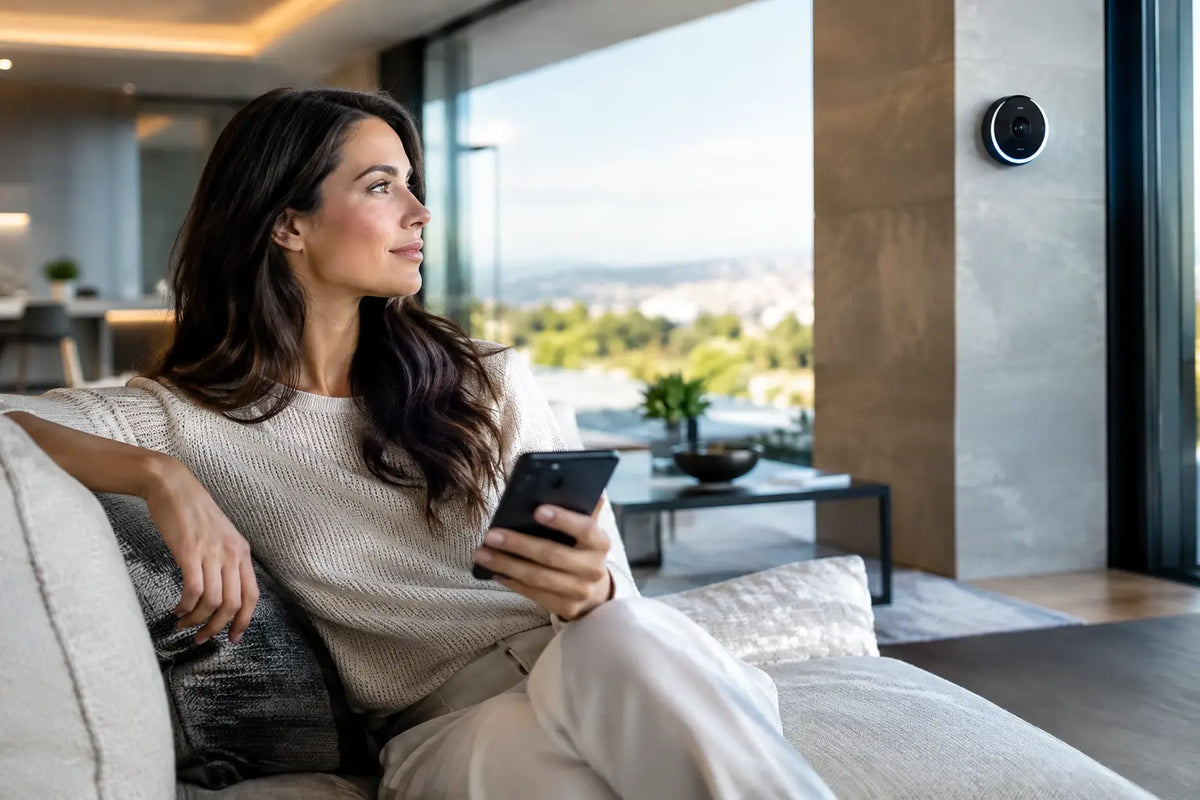
A residence can recognize your arrival, adjust the climate, lower the shades, and prepare the cinema before you step through the door. That level of refinement is the promise of intelligent living. Smart home privacy is what ensures the experience remains personal, controlled, and worthy of the home it serves.
For luxury homeowners, privacy is not an afterthought added once the technology is installed. It is a design principle. The same attention given to concealed speakers, elegant keypads, acoustic performance, and cinematic lighting should extend to how devices collect information, communicate with one another, and allow access from outside the property.
Smart Home Privacy Starts With System Design
A connected home is not one product. It is an ecosystem of lighting controls, HVAC equipment, motorized window treatments, cameras, door locks, audio zones, network hardware, voice assistants, entertainment sources, and mobile applications. Each component can create convenience. Each also creates a potential point of access that should be considered before installation.
The strongest privacy decisions are made during planning, particularly in new construction and major renovation projects. Rather than adding disconnected devices room by room, a professionally designed system establishes a clear architecture for the entire property. It identifies which systems need internet access, which should communicate only on the local network, and who has authority to manage them.
This matters because convenience and exposure often rise together. A camera that can be viewed from anywhere is useful when a property is vacant, but it must be configured with secure remote access. A voice-controlled system can make entertaining effortless, but homeowners should decide when microphones are active and whether voice control is appropriate in private areas. There is no single setting that fits every household. Privacy should reflect how the home is lived in.
Local Control Creates a More Private Experience
Many consumer devices depend heavily on cloud services. Commands travel from the home to a remote server and back again before an action occurs. That model can be useful for remote access and software updates, but it also means the experience may depend on an outside platform, an internet connection, and the provider's data practices.
Where practical, local control offers a more private and responsive alternative. Lighting scenes, climate schedules, shading presets, and whole-home audio can often operate within the residence itself. The result is faster performance, less dependence on external services, and greater confidence that routine activity remains within the home's own network.
This does not mean every cloud-connected feature should be avoided. Remote alerts, secure off-site monitoring, and app-based access can be valuable, especially for second homes and large estates. The goal is to use these features deliberately, not by default.
Secure Networks Are the Foundation
Premium technology can only perform as well as the network beneath it. A luxury home may contain dozens or even hundreds of connected endpoints, from televisions and access panels to pool equipment and surveillance cameras. Treating all of them as if they belong on one open network is an unnecessary risk.
A properly engineered network separates devices into appropriate zones. Personal computers and phones should not share unrestricted access with cameras, guest devices, or smart appliances. Segmentation limits what can happen if one device is compromised, while still allowing approved controls to function as intended.
Strong Wi-Fi passwords matter, but they are only one part of the picture. Professional network design also considers firewall configuration, encrypted wireless access, secure remote connections, reliable equipment placement, and ongoing firmware management. In a larger residence, coverage and security must be engineered together. A weak signal often encourages workarounds that weaken protection, such as adding unmanaged extenders or connecting devices to a guest network for convenience.
Guest access deserves its own design conversation. Visitors, contractors, and household staff may need internet access without gaining visibility into private devices, shared storage, security controls, or family media systems. A dedicated guest network preserves hospitality without sacrificing boundaries.
Cameras and Doorbells Require Clear Boundaries
Security cameras are among the most valuable tools in a connected residence, and among the most sensitive. Their placement should be purposeful. Exterior entry points, gates, garages, driveways, and perimeter areas are natural priorities. Indoor cameras require a higher standard of consideration because they can affect the comfort and privacy of family members, guests, and staff.
Before installation, decide who can view each camera, when recordings are retained, and whether footage is stored locally, in the cloud, or through a hybrid approach. Local recording can provide greater ownership and continuity, while cloud storage may offer convenience and off-site redundancy. The right choice depends on the property's risk profile, retention needs, and the level of remote access required.
Avoid sharing camera logins among multiple people. Every authorized user should have an individual account and only the permissions they need. A property manager may need access to exterior cameras and gate controls, for example, without access to private interior spaces or the family's main automation settings.
Access Should Be Personal, Not Permanent
The most elegant smart home systems simplify access without making it casual. A homeowner may want full control of every scene, security setting, and entertainment zone. A child may only need a bedroom keypad and limited app controls. A housekeeper may need access to designated entry doors during scheduled hours. These are different roles, and the system should recognize that.
Individual credentials make it easier to review access, remove it when circumstances change, and avoid the common problem of shared passwords that remain active long after a contractor or guest has left. Multi-factor authentication should be enabled wherever a system supports it, especially for remote access to cameras, alarms, locks, and administrative accounts.
It is equally important to create an ownership record. Homeowners should know which email address controls each major platform, who holds administrator rights, where recovery codes are stored, and what happens if a phone is lost or replaced. These details are rarely glamorous, yet they are essential to long-term confidence in an integrated property.
Privacy Depends on Ongoing Care
A smart home is not static. New devices are introduced, family routines change, software evolves, and service providers update their policies. A privacy-focused home benefits from periodic review, ideally once or twice a year and whenever a major device is added.
During that review, confirm that unused accounts have been removed, passwords and recovery methods are current, firmware updates have been applied, and remote access is still necessary. Review camera permissions, voice assistant settings, mobile app access, and guest network credentials. If the residence has changed ownership or undergone staffing changes, an access audit should be treated as part of the handover process.
For professionally integrated projects, this is where an experienced technology partner adds lasting value. I-Trust Systems approaches automation, AV, security, and network infrastructure as one considered environment rather than a collection of separate purchases. That perspective helps protect both the performance of the system and the privacy of the people who use it.
The Right Questions Before Adding Any Device
Before introducing a new connected product, ask whether it needs continuous internet access, what information it collects, and whether it can operate locally if the internet is unavailable. Consider who needs access, how that access can be revoked, and whether the device will remain supported with security updates over time.
Also consider the aesthetic and operational cost of consumer convenience. A low-cost device with its own application, account, microphone, and cloud service may solve a small problem while creating a fragmented experience. In a refined home, fewer well-integrated systems are often better than a collection of disconnected products competing for attention.
The finest smart homes feel effortless because their technology is quiet, dependable, and discreet. Privacy should feel the same way: present in the architecture, carefully maintained, and never left to chance.
مشاركة:
What Is AV Over IP and Why Does It Matter?
KNX vs Control4 Automation for Luxury Homes