

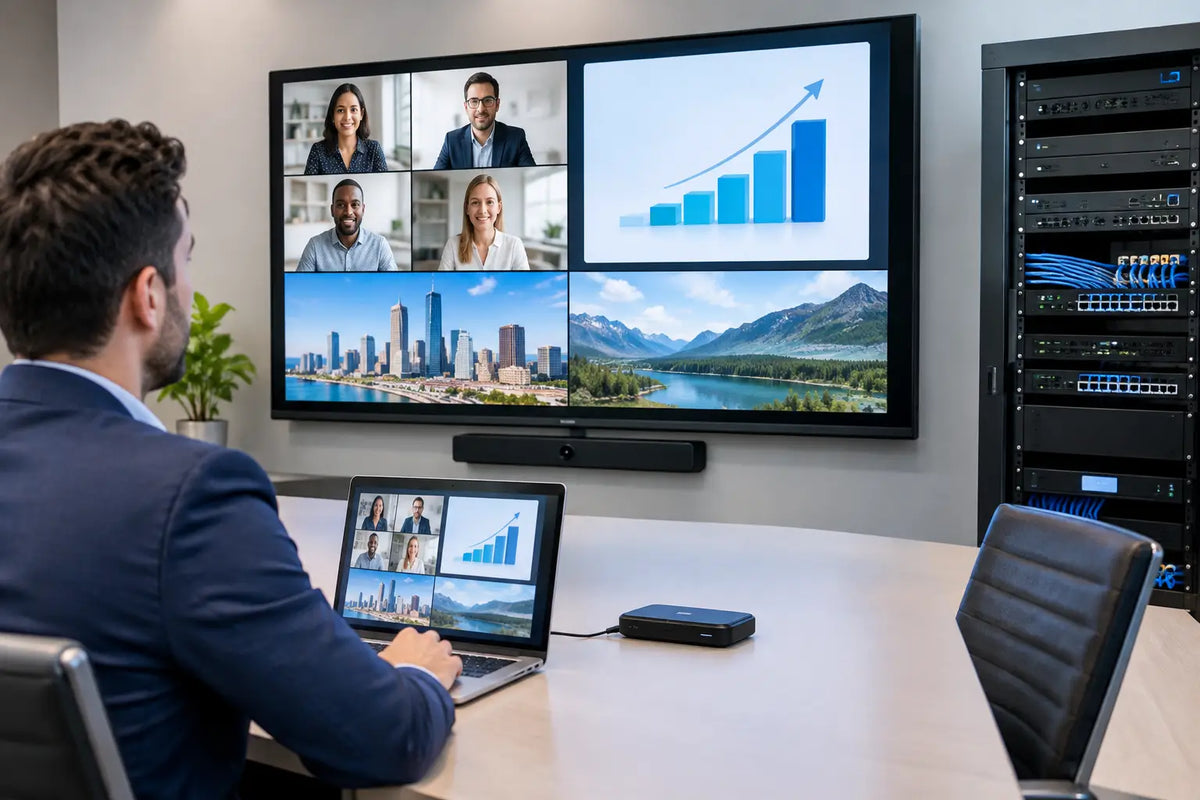
A villa may need a cinema-quality source in the media room, live security camera views at the gate, and curated music across indoor and outdoor entertaining areas. In a commercial setting, a boardroom, gym, retail floor, and digital signage network may need equally precise control. What is AV over IP? It is the technology that distributes audio, video, and often control signals across a standard data network, rather than relying on a separate dedicated cable run for every source and display.
For discerning property owners, architects, and commercial decision-makers, the value is not simply technical. AV over IP makes it possible to design technology around the way a space is used, while keeping displays, speakers, controls, and equipment visually refined. It replaces isolated systems with an intelligent audiovisual foundation that can evolve with the property.
What Is AV Over IP?
AV over IP stands for audio visual over Internet Protocol. Put simply, an AV source such as a media player, cable box, camera, computer, or digital signage player is converted into data packets and sent through an Ethernet network. A receiving device at the destination reconstructs that signal for a television, projector, video wall, speaker system, or other endpoint.
The network does not need to be connected to the public internet for this to work. “IP” refers to the communication method used by network devices. In a properly engineered installation, AV traffic travels through managed network switches, structured cabling, and purpose-selected transmitters and receivers. The result is a flexible system that can carry high-quality content where it is needed.
Traditional AV distribution typically relies on direct point-to-point connections. A source in one location is physically linked to a specific display or zone, often using HDMI extenders, matrix switchers, or dedicated audio cabling. That approach can be excellent for compact, fixed installations. However, it becomes more limiting as the number of rooms, screens, sources, and control requirements increases.
AV over IP shifts the architecture from fixed pathways to a networked environment. A source can be made available to many approved destinations, and a display can be assigned content without requiring a new dedicated connection back to the equipment rack. This distinction is especially meaningful in large residences, luxury developments, hospitality projects, auditoriums, schools, houses of worship, and multi-zone commercial environments.
How AV Over IP Works in a Designed Space
Every AV over IP system begins with endpoints. An encoder, often called a transmitter, accepts a source signal such as HDMI or audio input and places it on the network. A decoder, or receiver, takes the selected stream from the network and delivers it to a display, projector, amplifier, or speaker zone.
Between them is the network itself. Managed switches direct traffic efficiently, while network configuration determines which devices can communicate, how multicast video is handled, and how priority is assigned to time-sensitive audiovisual data. This engineering layer is the reason AV over IP should be planned as part of the wider technology infrastructure, not treated as an accessory after construction is complete.
Control brings the experience together. A wall keypad, touch panel, mobile interface, or automation platform can select a source, adjust volume, recall a presentation mode, or send camera footage to a chosen display. For example, one command could lower motorized shades, activate the projector, set lighting to a cinema scene, and route the preferred streaming source to the screen. In a conference room, the same principle can switch between a guest laptop, video conferencing system, and presentation display without manual patching.
The equipment can remain discreetly housed in a central rack, leaving rooms free of clutter. This is a major advantage where interior architecture matters as much as performance. A finely finished cinema, reception space, or formal living room should not be compromised by exposed devices and improvised cabling.
Why AV Over IP Is Chosen for Premium Projects
The strongest benefit is flexibility. A conventional matrix has a defined number of inputs and outputs. Once all ports are occupied, expanding the system may require a larger chassis, additional hardware, and sometimes disruptive rewiring. With AV over IP, expansion is often more straightforward: add appropriately specified endpoints and confirm that the network has sufficient capacity.
This does not mean every project needs AV over IP. A single theater room with a projector, AV receiver, and a few local sources may be better served by a direct-wired system. The right design depends on scale, desired functions, cable pathways, budget, and how likely the space is to change. AV over IP earns its place when flexibility, multiple destinations, centralized management, or future growth carry real value.
It also supports sophisticated content distribution. A homeowner may want the same sporting event on several displays during an outdoor gathering, then independent programming in the lounge, gym, bedrooms, and pool house. A retailer may need synchronized promotional content across multiple screens. A corporate facility may route one presentation source to selected meeting rooms while maintaining private content in executive spaces.
For video walls and digital signage, synchronization matters. Depending on the platform, AV over IP can deliver coordinated playback across multiple displays, creating a composed visual statement rather than a collection of separate screens. In entertainment venues and auditoriums, it can also help move camera feeds, presentation content, and confidence monitors through a facility with greater freedom than fixed AV pathways allow.
Audio benefits as well. Networked audio can distribute music, microphones, paging, and program sound to carefully defined zones. In a large home, this may mean different listening experiences in the terrace, spa, kitchen, and formal entertaining areas. In a mosque, school, gym, or retail environment, it can provide organized audio routing and zone control while preserving clarity where it matters most.
Image Quality, Latency, and Network Capacity
The phrase “over IP” should not be mistaken for a guarantee that every system delivers the same visual or audible result. Performance depends on the chosen platform and its configuration. Some systems use compression to reduce bandwidth requirements, while others prioritize visually lossless or ultra-low-latency transmission for demanding applications.
Compression is not automatically a compromise. In many signage, residential distribution, and presentation environments, a well-designed compressed system delivers an excellent viewing experience while making effective use of network resources. But a high-performance gaming suite, live event feed, surgical training environment, or premium cinema application may have stricter expectations around latency, color fidelity, frame handling, and HDR support.
Latency is the brief delay between the source and what appears on screen or is heard through speakers. A small delay may be unnoticeable when watching a movie. It can become unacceptable when a camera feed must be monitored in real time, when presenters rely on live confidence monitors, or when audio and video must remain precisely synchronized. The system should be specified for the application, not selected only by its headline resolution.
Bandwidth is equally central. High-resolution video consumes significant network capacity, particularly when multiple streams are active. A network that handles ordinary internet access comfortably may not be designed for several simultaneous 4K video feeds. Proper AV over IP design considers switch throughput, uplink capacity, multicast management, cable category, redundancy requirements, and separation of AV traffic from other critical services where appropriate.
Designing the Network Before the Finish Work
The most successful AV over IP projects are considered early, ideally while architectural plans are still open to refinement. This allows the technology team to coordinate equipment-room locations, cable pathways, display positions, power requirements, cooling, service access, and wireless coverage with the architect and interior designer.
Centralizing equipment can make maintenance and upgrades far more orderly, but the rack itself requires thoughtful planning. It needs ventilation, stable power, network access, labeling, and enough physical space for present equipment and sensible future additions. A beautiful installation is not only what the client sees. It is also the discipline behind the wall, in the rack, and within the documentation.
Security deserves similar attention. AV endpoints are network devices, and any connected system should be commissioned with sensible access controls, current firmware practices, and a clear approach to remote support. For properties that combine surveillance, access control, automation, and AV, coordinated network design becomes a matter of both performance and protection.
Where AV Over IP Makes the Greatest Difference
In luxury residences, AV over IP is often most compelling when the property includes multiple entertainment zones, a dedicated cinema, outdoor living areas, guest spaces, and a centralized technology rack. It enables a home to feel composed rather than over-equipped: content appears where it is wanted, while hardware remains discreet.
In commercial projects, the technology is particularly effective where spaces are regularly reconfigured or content must reach many locations. Offices can support adaptable meeting environments. Malls and retail spaces can manage signage at scale. Fitness facilities can distribute entertainment and class content. Schools, auditoriums, and worship spaces can route presentations and camera feeds with greater operational control.
The decision is not about adding technology for its own sake. It is about selecting an architecture that supports the experience expected from the space. I-Trust Systems approaches AV over IP as part of a complete environment, aligning audiovisual performance with automation, acoustic treatment, security, and the visual language of the interior.
A well-planned AV over IP system should feel almost invisible in daily use. The screen shows the right content, the sound arrives in the right zone, and control feels immediate and intuitive. When the infrastructure has been designed with care, the technology does not compete with the architecture or the occasion. It simply gives the space more possibilities.
Share:
Analog Versus IP Surveillance for Premium Spaces
Smart Home Privacy Without Sacrificing Luxury