

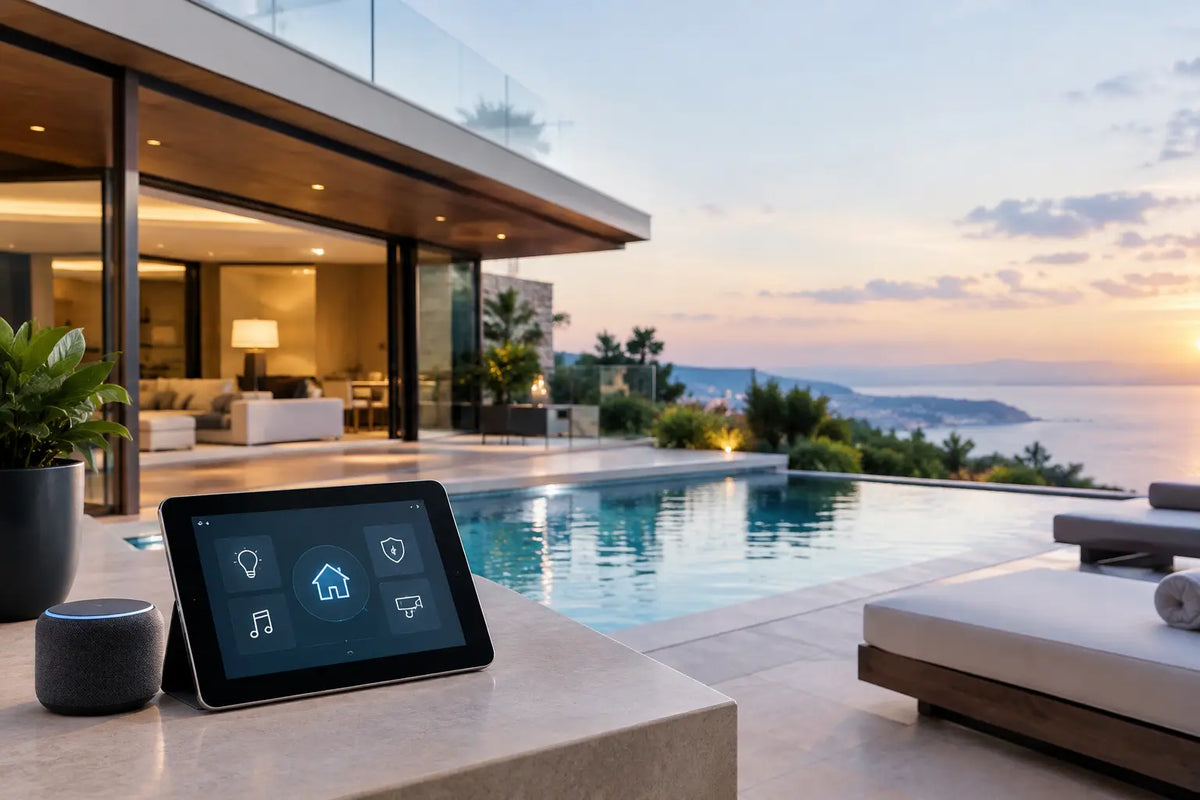
A luxury villa should not require a wall of remotes, separate apps, or constant adjustment to feel comfortable. The best technology is rarely the most visible. It is the system that anticipates the moment: lights settling into the right scene at sunset, climate responding to occupancy, music following you from the lounge to the terrace, and security working quietly in the background. This luxury villa technology guide explains how to plan that experience with the level of engineering and design discipline a premium residence deserves.
Start With the Lifestyle, Not the Device List
A villa technology project is most successful when it begins before decorative finishes, furniture selection, and final electrical decisions. It should start with an honest conversation about how the property will be lived in. A family with children, a frequent host, an owner who uses the residence seasonally, and a developer preparing a show villa will each need a different control strategy.
Consider the transition from arrival to evening. The gate opens, exterior lighting guides the way, the entrance is comfortable, selected areas are illuminated, and the preferred environment is ready without a series of manual instructions. That is not a collection of independent products. It is a designed sequence, built around the owner’s routine.
This approach also protects the interior concept. Premium villas are defined by clean sightlines, natural materials, architectural lighting, and considered proportions. Technology should support those details rather than compete with them through exposed equipment, poorly placed speakers, or rows of mismatched wall controls.
The Luxury Villa Technology Guide to Core Systems
The strongest projects bring several systems together under one carefully planned control architecture. Integration does not mean every feature must be automated. It means the systems that matter work intelligently together and remain easy to use for every member of the household.
Lighting and shading set the atmosphere
Lighting control is often the most immediately felt upgrade in a luxury home. Instead of treating each circuit as an isolated switch, lighting can be organized into scenes for entertaining, dining, reading, cleaning, evening relaxation, and departure. A single keypad can replace a cluttered bank of switches while offering more precise control.
Motorized curtains, blinds, and shades deserve equal consideration. They protect furnishings from harsh sun, improve privacy, and help manage heat gain across large glazed elevations. In a villa with expansive windows, shading is not simply a decorative detail. It is part of the comfort and energy strategy.
The right solution depends on the architecture. A minimalist interior may favor discreet keypads and hidden automation, while a more traditional residence may call for finishes that complement stone, timber, or decorative wall treatments. The objective is not technology for its own sake. It is a home that changes character gracefully throughout the day.
Climate control should feel effortless
Luxury is often a matter of consistency. A beautiful room that is too warm, too cold, or difficult to ventilate never feels fully resolved. Integrated HVAC control allows owners to manage temperature by zone, schedule comfort around occupancy, and monitor conditions from a central interface.
For large villas, zoning is particularly valuable. Bedrooms, formal reception rooms, staff areas, gym spaces, and rarely used guest suites do not need identical settings at all times. Smart scheduling can reduce unnecessary operation while ensuring key spaces are ready when needed.
However, climate automation must be engineered around the actual mechanical system. Retrofitting controls onto incompatible equipment can create unreliable performance and frustration. This is why early coordination among the technology integrator, MEP team, architect, and interior designer is essential.
Security must be layered, discreet, and dependable
A premium security system does more than record footage. It creates a clear view of the property, controls who enters, and gives owners confidence whether they are at home or abroad. The foundation typically includes professionally positioned cameras, access control, video intercom, intrusion detection, gate integration, and smart notifications.
Placement matters as much as the equipment itself. Cameras should cover approaches, perimeter points, entrances, service access, and valuable exterior areas without undermining the visual quality of the façade or landscape. Access control should be convenient for residents and appropriately managed for staff, contractors, and guests.
Privacy also deserves thoughtful planning. Not every room requires the same monitoring approach, and indoor cameras may be unsuitable for many households. A well-designed system balances protection with personal boundaries and provides intuitive access to relevant information rather than constant, unnecessary alerts.
Entertainment That Matches the Architecture
A villa’s entertainment system should feel as considered as its kitchen or master suite. Multi-room audio can provide refined background music in living areas, bedrooms, bathrooms, gardens, and pool zones, with independent volume and source control for each space. The result is a more connected atmosphere, whether the home is hosting an intimate dinner or a large gathering.
Speaker selection and placement are critical. Architectural speakers can disappear into ceilings or walls, but invisibility alone is not a measure of quality. Room dimensions, ceiling height, furniture placement, surface materials, and intended listening level all influence the final result. Outdoors, equipment must be selected for weather resistance and coverage that avoids excessive volume spilling into neighboring properties.
A true home cinema is a dedicated experience
A large television in a dark room is not automatically a home cinema. A cinematic room requires coordinated decisions on projection or display technology, screen size, speaker layout, subwoofer positioning, seating geometry, acoustic treatment, lighting, ventilation noise, and interior finishes.
Acoustic treatment is especially important in villas with marble, glass, high ceilings, and other reflective finishes. Without it, dialogue can lose clarity and bass can become uncontrolled. The answer is not always to add more speakers. It is to manage the room itself through absorption, diffusion, isolation, and calibrated system design.
A dedicated cinema can be bold and theatrical, or it can be understated and architectural. Both approaches can perform exceptionally well when the technical design is established before the finishes are fixed. Retrofitting acoustics after the room is complete is possible, but it often limits the aesthetic and adds cost.
Build the Infrastructure Before the Finishes
The invisible backbone of a connected villa includes structured cabling, network design, equipment racks, electrical planning, and sufficient pathways for future service. This is where many high-end projects either gain long-term flexibility or inherit expensive limitations.
Wireless technology is valuable, but it cannot replace a properly designed wired network for high-performance AV, security cameras, access control, and critical control systems. A professional network should provide reliable coverage across the residence, garden, pool, guest house, and staff areas while separating devices appropriately for security and performance.
Centralized equipment racks keep source devices, amplifiers, network hardware, and control processors organized and serviceable. They also reduce visual clutter in living spaces. The rack location needs ventilation, power protection, access for maintenance, and a plan for heat management. These practical details are not glamorous, but they protect the ownership experience long after installation day.
Avoid Fragmented Smart Home Decisions
It is tempting to buy individual smart products as each need arises: a camera from one brand, lighting from another, a separate climate app, and audio equipment that operates independently. This can work for a small apartment. In a villa, it often creates a confusing collection of interfaces, inconsistent reliability, and no single point of responsibility.
A unified system simplifies daily use, but it should not become restrictive. The best specification leaves room for future expansion, allows for properly supported product choices, and provides clear documentation for the owner. Ask how the system will be serviced, what happens during an internet outage, who can make adjustments, and whether the design can adapt as the household changes.
I-Trust Systems approaches these decisions as part of a complete environment, coordinating automation, AV, security, acoustics, supply, installation, and project execution under one expert team.
Make Technology Feel Personal
The finest villa technology does not announce itself at every opportunity. It gives the homeowner fewer decisions to make, better control when they want it, and a living environment that feels composed from morning through night. Begin with the spaces and moments that matter most, then build the infrastructure to support them properly. When technology is planned with the same care as the architecture, the home feels not merely smarter, but more beautifully lived in.
Share:
Smart Thermostat Controls for Refined Living
Analog Versus IP Surveillance for Premium Spaces