

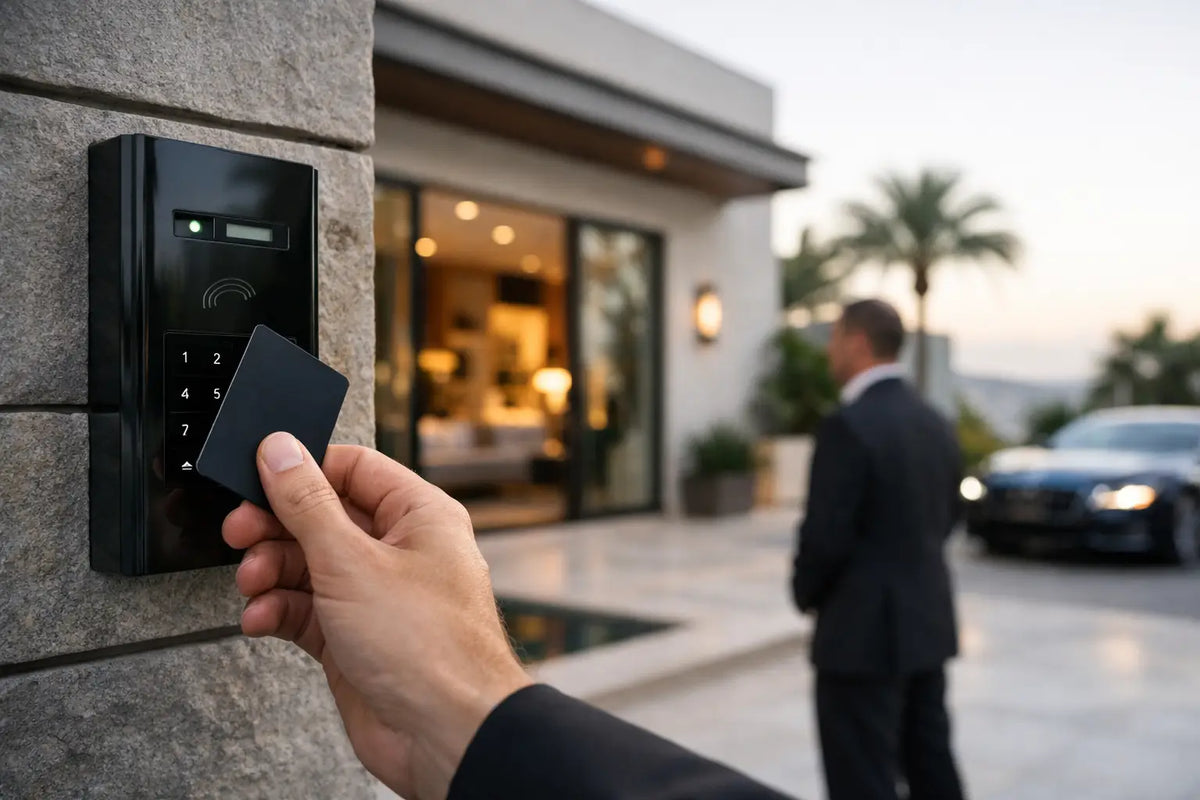
A front gate that relies on a shared key, a lobby door that cannot verify visitors, or a side entrance left outside the security plan can diminish an otherwise exceptional property. Knowing how to choose access control means looking beyond the lock itself. The right system protects people, property, and privacy while preserving the refined arrival experience expected in a luxury residence or high-performance commercial environment.
For a villa, office, gym, school, or hospitality setting, access control should feel intentional. It should grant the right people entry without creating friction for family, staff, guests, tenants, or approved contractors. More importantly, it should work as part of a wider security and automation strategy rather than becoming another isolated device to manage.
Start With the Way People Move Through the Property
The most effective access control design begins with circulation, not equipment. Consider every route a person may use from the perimeter to the most private areas of the building. A luxury villa may need controlled access at the vehicle gate, pedestrian gate, main entrance, service entrance, pool area, staff quarters, wine room, and home office. A commercial site may need different permissions across parking, reception, back-of-house areas, management offices, storage, and technical rooms.
Each opening has a different level of risk and convenience. The main door may need an elegant video intercom and mobile credential for residents, while a delivery entrance may require scheduled access for staff. A server room or records archive may call for a more restrictive credential and a detailed audit trail.
This approach avoids a common mistake: installing premium access hardware at the front door while leaving secondary entrances dependent on keys or informal processes. Security is only as considered as the least controlled route into the property.
How to Choose Access Control by Security Level
Not every door requires the same authentication method. The appropriate choice depends on what sits behind it, who needs entry, and what happens if a credential is lost, copied, or misused.
Traditional keys remain familiar, but they offer little visibility. If a key is duplicated or not returned, there is no reliable record of who entered or when. Keypads improve control by eliminating physical keys, although shared PIN codes can quickly become difficult to manage in a busy household or workplace.
For premium projects, these are the most relevant credential options:
- Mobile credentials allow approved users to enter with a smartphone, often through Bluetooth, NFC, or a secure app.
- Key cards and fobs are practical for staff, tenants, gyms, and multi-user commercial environments.
- PIN codes suit temporary visitors, deliveries, and service personnel when codes can be scheduled or changed easily.
- Biometric authentication uses a fingerprint, face, or palm credential for higher-security spaces where identity verification matters.
- Video intercom access lets residents or reception staff see, speak with, and admit visitors remotely.
Prioritize Credential Management, Not Just the Door Hardware
Elegant readers and premium locks are visible components, but credential management determines how well the system performs after installation. Ask how easily an administrator can add a new user, remove a former employee, revoke a lost phone credential, or create access that expires automatically.
This matters especially for properties with changing personnel. House managers, cleaners, drivers, maintenance teams, contractors, and short-term guests should not require permanent access. A properly designed system can authorize a landscaper only for selected days and hours, give a guest entry during a specific stay, or deactivate access instantly when a working relationship ends.
For commercial decision-makers, the same capability supports clearer operations. Access can be assigned by department, location, role, or shift. Rather than collecting keys when an employee leaves, a manager can remove the credential in seconds. Entry logs can also help investigate an incident, confirm opening and closing activity, or identify patterns that require attention.
Privacy should be part of this conversation. Audit trails are valuable, but data should be limited to what the property genuinely needs and managed responsibly. In residences, discretion is as essential as visibility.
Select Access Control That Complements the Architecture
Access control is often one of the first technologies a visitor encounters. It should feel consistent with the architecture, landscaping, and interior palette rather than appear as an afterthought attached to a finished wall.
A contemporary villa may call for flush-mounted intercom panels, minimalist keypads, concealed electric strikes, and gate stations chosen to complement metalwork or stone. A heritage-inspired residence may need technology integrated with greater sensitivity to traditional details. In a corporate reception area, the reader, visitor station, and door hardware should support the visual language of the space while standing up to daily use.
Finish, placement, lighting, and wiring routes deserve attention early in the design process. A beautiful access panel loses impact when mounted at an awkward height, exposed to glare, or surrounded by visible conduit. For exterior openings, weather resistance, heat tolerance, and nighttime visibility are equally relevant. Premium design is not only about selecting a handsome device. It is about ensuring every component belongs in the environment.
Plan for Integration With Security and Smart Living
A standalone lock can secure a single door. An integrated access control system can shape how the entire property responds to arrival, departure, and unusual activity.
When a resident enters the gate, the system can disarm selected security zones, illuminate the entrance path, raise designated shades, and adjust comfort settings. When the final authorized user leaves, it can secure perimeter doors, arm the alarm, switch off nonessential lighting, and notify the owner if a gate remains open. These actions should be carefully programmed, not applied automatically without considering real household routines.
Integration with surveillance is equally valuable. A video intercom call can display on a wall touch panel or smartphone, while a door event can trigger a nearby camera to record. For larger properties, this creates a more complete view of entry activity without requiring separate apps and disconnected monitoring tools.
Compatibility should be assessed before purchase. Ask whether the access platform works reliably with the chosen automation controller, alarm system, cameras, motorized gates, elevator controls, and network infrastructure. The answer may affect which brands and protocols are appropriate. A system that appears economical at the door can become costly when it requires workarounds to communicate with the rest of the property.
Consider Reliability During Power and Network Disruptions
Convenience should never create dependence on a single point of failure. Every access control design needs a clear answer to a practical question: what happens when the power, internet connection, or central controller is unavailable?
Critical doors may need battery backup, local credential storage, mechanical override options, or fail-safe and fail-secure locking selected for the opening's purpose. These terms matter. A fail-safe lock releases when power is lost, which may be appropriate for safe egress in some applications. A fail-secure lock remains locked without power, which may suit certain protected areas but must still comply with life-safety requirements.
Emergency egress, fire codes, and accessibility requirements should guide the technical design from the beginning. Exterior security is never a reason to compromise a safe exit. In commercial projects, local code compliance and coordinated door hardware are essential. In residences, the same principle applies, particularly around staff areas, pool access, guest wings, and secondary exits.
Choose a System That Can Grow With the Property
A new villa may begin with two residents and a small household team, then later add a guest house, a gym, perimeter gates, or an expanded security presence. A commercial development may open with a single tenant floor and later require multi-tenant permissions, visitor management, or additional buildings.
Choose a platform that can accommodate new doors, users, and zones without replacing the foundation. Scalability does not mean buying unnecessary capacity. It means selecting an architecture that leaves room for sensible expansion, with the right cabling, network planning, power provision, and controller capacity established during construction or renovation.
This is where a design-led integrator adds significant value. Access control touches electrical work, door hardware, networking, automation, security, architectural finishes, and daily operations. Coordinating those disciplines early produces a result that is quieter, cleaner, and more dependable than a late-stage installation.
Ask the Questions That Reveal Long-Term Value
Before approving an access control proposal, ask who will administer it, how credentials are issued and revoked, what functions continue during an outage, and whether the system can integrate with future security and automation plans. Confirm the warranty, service response process, and availability of replacement components. For a luxury property, long-term support is part of the investment, not an optional extra.
Also consider the experience from the user's perspective. Can an elderly family member enter comfortably? Can a guest be admitted without sharing a permanent code? Can staff access only the areas necessary for their role? Can the owner verify a visitor from another location without sacrificing privacy? The strongest system is not the one with the longest feature list. It is the one that fits real behavior with confidence and restraint.
A carefully specified access control system becomes almost invisible in daily life: doors open for the right people, visitors are handled with poise, and the property remains protected without feeling fortified. That balance of security, design, and intelligent control is where I-Trust Systems brings sophisticated spaces to life.
Share:
How Acoustic Wall Panels Help a Room Feel Better
Residential Camera Guide for Secure Luxury Homes