

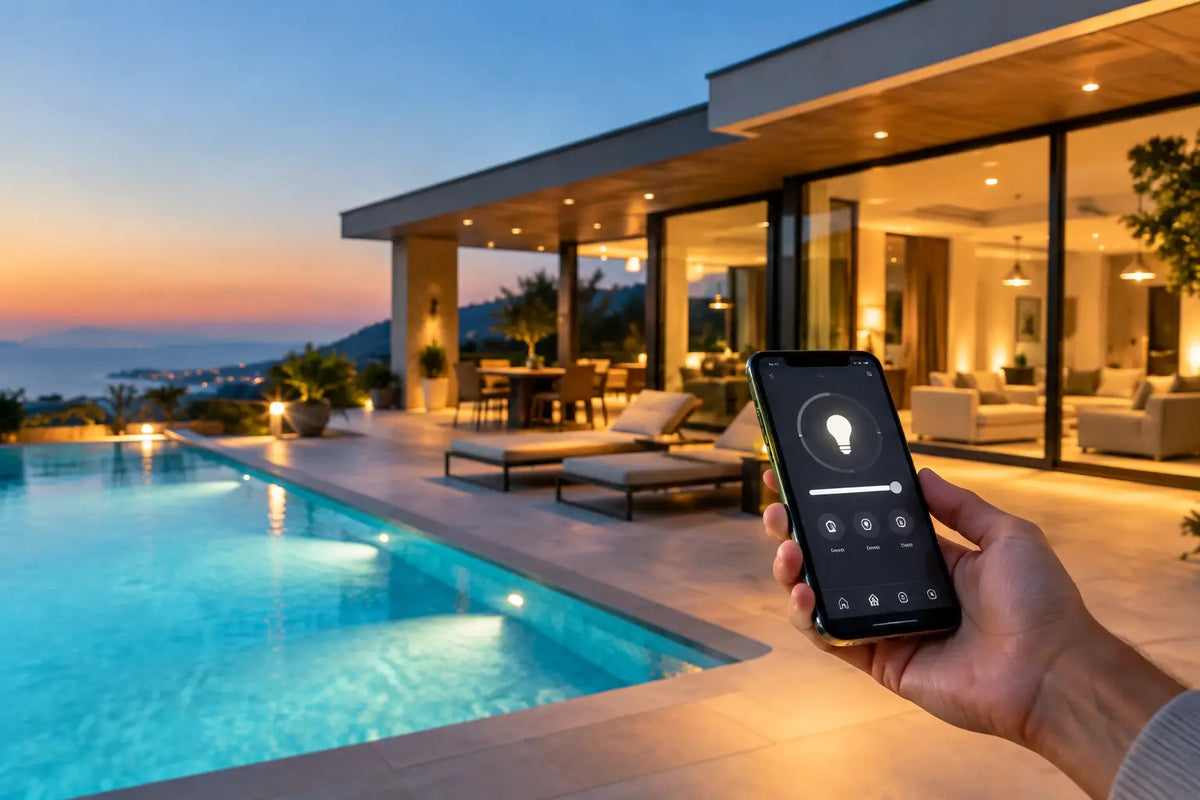
A villa should not greet you with a row of ordinary switches. It should anticipate the hour, the atmosphere, and the way each space is used. Learning how to automate villa lighting begins with a simple shift in perspective: lighting is not a utility to be turned on and off. It is part of the architecture, shaping arrival, relaxation, entertaining, security, and the visual character of every room.
For a premium residence, the goal is not to add more technology. It is to create control that feels effortless, finishes that remain visually clean, and lighting that performs beautifully from bright afternoon through late evening.
How to Automate Villa Lighting With a Clear Plan
The most successful lighting automation projects are planned before ceilings are closed, finishes are selected, or furniture layouts are finalized. Retrofitting is possible, but early design provides more freedom for concealed wiring, keypad locations, lighting circuits, motorized shades, and the integration of architectural details such as coves, niches, stair treads, and landscape features.
Start by mapping how the villa is actually lived in. A formal living room may need a polished welcome setting, a comfortable conversation setting, and a low-level evening setting. The kitchen requires functional task lighting at the counters, while an open-plan dining area benefits from warmer, more controlled illumination. Bedrooms need gentle night pathways, while bathrooms often require a practical daytime level and a softer late-night option.
This is where a lighting plan becomes more than a fixture schedule. It defines layers of light: ambient light for overall visibility, task light for practical activities, accent light for art or architectural texture, and decorative light for character. Automation gives these layers purpose by allowing them to work together rather than compete.
A professional integrator should also coordinate early with the architect, interior designer, electrician, HVAC team, and landscape designer. Lighting control affects power distribution, wall elevations, ceiling details, joinery, exterior zones, and sometimes generator or backup-power strategy. Careful coordination prevents the familiar problem of a beautiful room with too many switches and no intuitive way to use them.
Build Scenes, Not Just Controls
The real value of smart lighting is found in scenes. A scene adjusts several lighting zones at once to support a particular moment, using carefully calibrated brightness and color temperature where the fixtures allow it.
For example, an “Arrival” scene can illuminate the entry, driveway, foyer, and selected living areas as the homeowner approaches. “Dinner” can lower general lighting, emphasize the dining table, and bring artwork or wall finishes into focus. “Movie” can dim the main living space, close automated shades, and coordinate with the AV system. A “Goodnight” command can turn off selected interior zones while leaving pathway and security lighting active.
These scenes should feel specific to the property, not copied from a generic app. A villa overlooking a garden may prioritize terrace and landscape illumination. A residence with a gallery-style art collection may require precise accent-light levels. A family home with multiple floors may need simple, repeatable routines that every household member and guest can understand.
It also pays to think beyond the obvious rooms. Dressing rooms, pantries, corridors, staircases, service areas, garages, pool decks, and outdoor kitchens all benefit from intelligent control. The best systems make these areas more comfortable without asking occupants to think about them.
Choose the Right Control Method for Each Space
A luxury lighting system should offer more than one way to interact. Elegant wall keypads provide immediate, dependable control and preserve the experience when a phone is unavailable. A touch panel can offer a clear overview of the home. Mobile control is useful for adjustments away from the property, while voice control can be helpful in selected spaces such as kitchens or bedrooms.
The key is not to place every possible control option in every room. Too much choice can make a sophisticated system feel complicated. In most villas, engraved keypads with a few meaningful scene buttons are the most intuitive daily interface. Labels such as “Welcome,” “Entertain,” “Relax,” and “Off” are easier to understand than technical zone names.
Centralized lighting control is often preferred for large new-build villas because it can consolidate dimming hardware away from living spaces, reduce wall clutter, and simplify long-term expansion. Wireless solutions can be an excellent choice for renovations, guest houses, or areas where new cabling would disturb valuable finishes. The right approach depends on the scale of the project, construction stage, system requirements, and the owner's expectations for future flexibility.
Dimming compatibility deserves close attention. Not every LED fixture dims equally well, and poor pairing between drivers, dimmers, and fixtures can produce flicker, audible noise, limited dimming range, or inconsistent color. Premium lighting automation is as much about specifying compatible components as it is about selecting a control platform.
Use Sensors With Restraint and Purpose
Occupancy, vacancy, daylight, door, and motion sensors can improve convenience and reduce unnecessary energy use. Their role should be discreet. A hallway can brighten when someone enters, a laundry room can switch off after a period of inactivity, and exterior lighting can respond to sunset or movement near the perimeter.
However, sensors are not appropriate everywhere. In a formal lounge or cinema room, sudden automatic changes can interrupt the experience. In bedrooms, overly sensitive motion detection can become irritating at night. High-end homes should use sensors where they remove friction, while preserving deliberate manual control in spaces where atmosphere matters most.
Daylight response is especially valuable in rooms with large glazing. When the sun provides sufficient illumination, the system can reduce artificial light levels while maintaining the visual balance of the room. Combined with motorized shades, this helps manage glare, privacy, heat gain, and light quality throughout the day.
Connect Lighting to the Rest of the Villa
Lighting becomes more compelling when it works with the wider home environment. A single “Away” command can turn off interior lights, lower shades, adjust AC settings, arm security, and leave selected exterior lights on. A morning routine can raise bedroom shades, bring bathroom lighting up gradually, and prepare shared spaces before the household begins moving through them.
For outdoor entertaining, lighting can coordinate with audio zones, pool features, and terrace shading. For a dedicated cinema, one command can lower lights in stages as the projection system starts, preserving a cinematic transition rather than an abrupt blackout. These details are what make a residence feel considered.
Security integration is another practical advantage. Vacation mode can vary selected interior lights to create an occupied appearance. Gate or perimeter events can activate discreet exterior lighting, while entry lighting can guide residents safely from driveway to front door. The design should support security without making the home feel harshly lit or institutional.
Design for Reliability, Service, and Change
A villa lighting system is a long-term investment, so reliability matters as much as visual impact. Specify a platform with proven support, professional-grade hardware, and a clear path for updates or expansion. The system should continue to provide essential wall-control functions even if internet service is unavailable.
Ask how scenes will be commissioned and documented. Fine-tuning takes place after furniture, artwork, curtains, and final finishes are installed, because each affects how light is perceived. A good commissioning process tests dimming levels, keypad logic, sensor behavior, exterior timing, and integration with other systems. It also gives the homeowner time to live with the settings and request refinements.
Future needs should be considered from the beginning. A child’s bedroom may become a study. A formal room may later become a media space. An unused garden area may become an outdoor lounge. Allowing capacity for additional zones and control points is usually more economical than rebuilding the system later.
I-Trust Systems approaches villa automation as a coordinated design and engineering discipline, bringing lighting, shading, AV, climate, and security into one considered environment. The result is not a collection of smart devices. It is a home that responds with quiet precision.
The finest lighting automation is rarely noticed as technology. You notice the welcoming entry, the artwork that looks exceptional after sunset, the staircase that guides you safely at night, and the room that always feels right when you walk in.
Share:
Can Acoustic Panels Improve Privacy in Your Home?
Centralized Versus Zoned HVAC: Which Fits?