

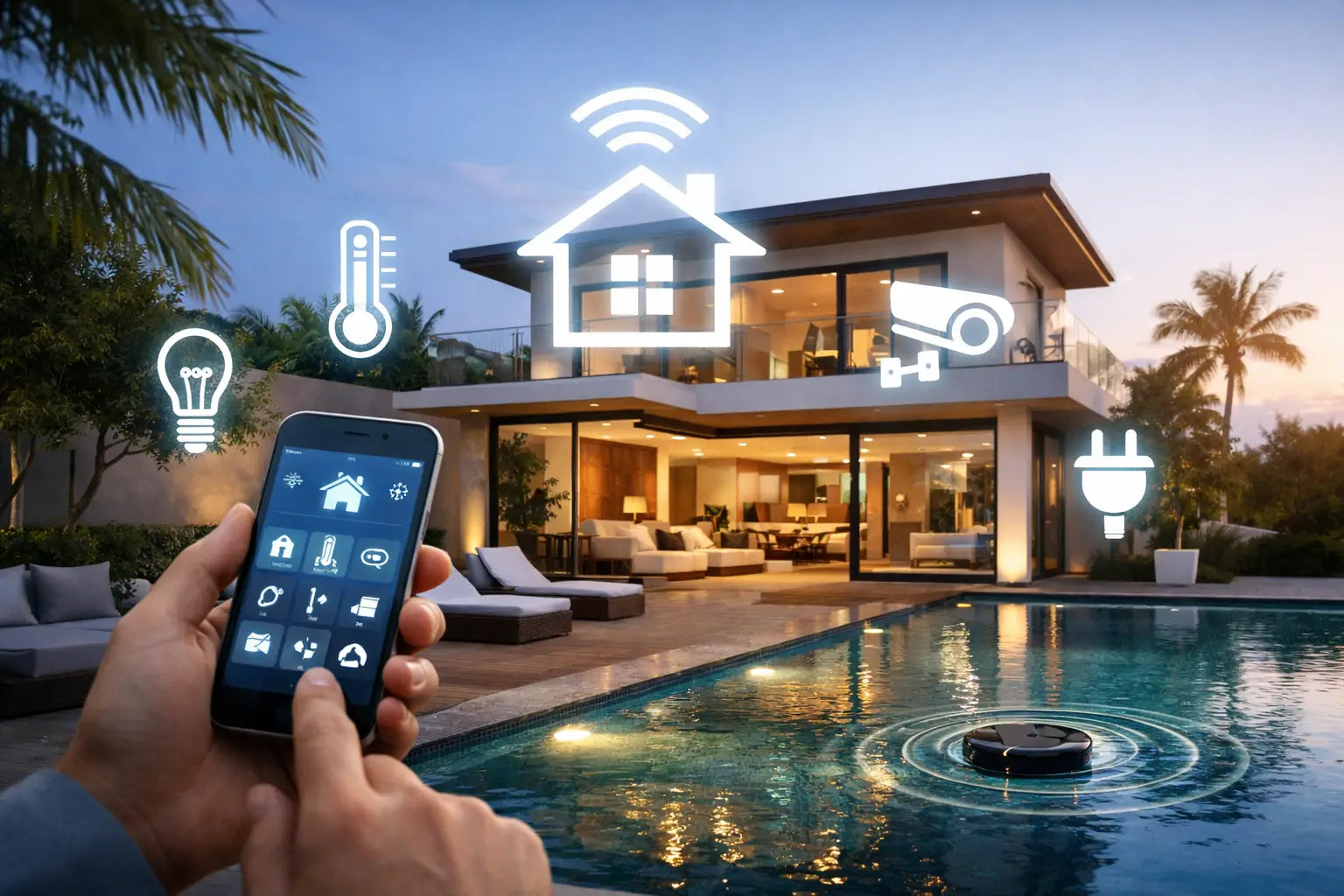
A well-designed villa should not feel like a collection of disconnected apps, remotes, wall switches, and security panels. It should respond as one environment. That is the real answer to how smart villa automation works: it brings lighting, climate, shading, audio, video, security, and access control into a single coordinated system that is engineered around the way the property is lived in.
In a premium residence, automation is not simply about adding gadgets. It is about making the villa quieter to manage, more comfortable to occupy, more secure when empty, and more refined in how every system looks and behaves. When done properly, the technology recedes into the background while the experience becomes unmistakably elevated.
How smart villa automation works in practice
At its core, smart villa automation connects multiple subsystems to a central control platform. Instead of treating lighting, AC, curtains, gate access, CCTV, and entertainment as separate purchases, the system allows them to communicate and respond together.
That central platform may be controlled from elegant wall keypads, touch panels, mobile devices, voice control, or scheduled programming. The interface is only the visible part. Behind it sits the real value: structured wiring, network design, intelligent processors, device integration, and carefully programmed scenes.
A scene is where automation becomes meaningful. One command can lower motorized curtains, dim the lights, adjust the temperature, and start the media system in the cinema room. Another can shut down selected areas of the villa at night, arm the perimeter, and switch pathway lighting to a lower level. These are not isolated actions. They are orchestrated responses designed around lifestyle.
For villa owners and design professionals, this distinction matters. A luxury automation project is not the same as installing a few smart bulbs and a doorbell camera. It requires engineering, coordination with architecture and interiors, and a clear plan for how the property should perform every day.
The systems that typically work together
Lighting control is often the first layer because it affects every room and every hour of the day. Rather than relying on rows of switches, the villa can be programmed with scenes such as Welcome, Dining, Evening, and Away. This reduces wall clutter and gives the home a cleaner visual language while improving usability.
Climate control is another essential layer. Smart thermostats and HVAC integration can regulate temperatures by zone, respond to occupancy, and coordinate with window treatments. In a large villa, that matters because comfort is not uniform. Bedrooms, formal living spaces, guest areas, and entertainment rooms all have different usage patterns.
Curtain and blind automation adds both convenience and environmental control. Morning light can open selected spaces gradually, while west-facing rooms can close automatically during hotter periods to reduce solar gain. This is one of the clearest examples of where luxury and performance meet.
Security and access control are equally important. Cameras, smart locks, gate systems, intercoms, alarm sensors, and perimeter monitoring can be integrated into the same control environment. A villa owner can see who is at the entrance, unlock access remotely, verify camera views, and receive intelligent alerts without juggling multiple platforms.
Entertainment systems complete the experience. Multi-room audio, distributed video, garden speakers, private cinema spaces, and media rooms can all be brought into the same ecosystem. Instead of asking which remote controls which device, the system presents a unified command structure. That sounds simple, but in a large residence it changes the daily experience dramatically.
What makes a villa automation system truly intelligent
Automation becomes intelligent when it goes beyond manual control. The system should respond to time, occupancy, ambient light, temperature, security status, and routines.
For example, exterior lights can follow sunset schedules while adjusting for seasonal changes. Hallway lighting can activate softly during nighttime movement. AC settings can shift when family members leave the property. Curtains can preserve privacy in the evening without needing a daily reminder. The villa starts to anticipate rather than wait for instructions.
That said, intelligence should never feel intrusive. Over-automation is a real issue in luxury homes. If every action triggers another action, the property can become frustrating rather than effortless. Good design is selective. It automates the routines that add comfort and efficiency while leaving room for easy manual control when preferences change.
This is where bespoke programming matters. Two villas of the same size may need very different logic. A family home with children, staff, and frequent guests will operate differently from a seasonal residence used mainly for entertaining. The best systems are tailored, not generic.
The role of infrastructure behind the walls
The visible devices in a smart villa tell only part of the story. The system depends on what sits behind the walls, in the rack room, and across the network.
Reliable automation requires structured cabling, properly designed Wi-Fi coverage, network segmentation, clean power management, and centralized equipment planning. In larger homes, rack-based AV and control hardware keeps the technical backbone organized and easier to maintain. This is one reason professionally integrated systems perform at a different level than piecemeal consumer setups.
It also affects aesthetics. In a refined interior, owners and designers rarely want tech clutter. Hidden speakers, discreet keypads, flush touch panels, concealed wiring paths, and carefully coordinated finishes preserve the architecture rather than compete with it.
The earlier this infrastructure is considered, the better the result. During new construction or major renovation, automation can be integrated with lighting design, ceiling plans, joinery, acoustic treatment, and MEP coordination. Retrofitting is still possible, but options may be more limited depending on wall finishes, cabling access, and existing equipment.
Why one platform matters more than multiple apps
One of the most common mistakes in high-end homes is collecting excellent products that do not behave like a system. A villa may have premium lighting, strong security hardware, quality speakers, and motorized curtains, yet still feel fragmented because every function lives in a different app.
A unified platform solves that problem. It creates one control experience and one logic layer across the property. More importantly, it allows conditional programming. If the villa is set to Away mode, the lighting, AC, curtains, alarms, and gates can all respond accordingly. That kind of coordination is difficult when systems remain isolated.
There is a trade-off here. Single-platform integration requires planning, compatibility checks, and disciplined product selection. It may reduce the temptation to buy random devices based only on retail appeal. But in a luxury villa, consistency usually matters more than novelty.
How smart villa automation works for daily living
The value of automation is often most visible in ordinary moments. A morning routine can bring up soft lighting, open curtains, and set the preferred temperature before anyone reaches for a switch. Entertaining mode can activate exterior lighting, distribute music to indoor and outdoor zones, and simplify guest movement through key areas. Night mode can secure the property while maintaining comfort in occupied rooms.
In larger residences, this convenience scales. Staff can manage service areas without disrupting family spaces. Guest suites can be easy to operate without lengthy explanations. Owners can monitor and control the villa while traveling. Developers can position a property more competitively by offering integrated intelligence as part of the architecture rather than as an afterthought.
There are also performance benefits. Energy management improves when lighting, shading, and HVAC work together. Security improves when access, surveillance, and alerts are coordinated. Entertainment improves when rooms are acoustically considered and AV systems are designed as part of the wider control strategy.
For discerning homeowners, the question is rarely whether the villa should be smart. It is whether the technology has been specified with enough care to feel worthy of the property.
Choosing the right approach
The best automation projects start with a clear brief. What should the villa do effortlessly? Which spaces need the highest level of control? Where should technology be visible, and where should it disappear? What level of remote access, security, and entertainment is expected? These decisions shape the system far more than any single product choice.
This is why experienced integration partners bring value well beyond installation. They coordinate performance, aesthetics, compatibility, and long-term reliability. For premium homes, that is the difference between a house full of technology and a residence that feels intelligently composed. At I-Trust Systems, that distinction sits at the center of every successful project.
A smart villa should feel calm, responsive, and beautifully controlled. When the system is planned with precision, luxury is no longer just what you see. It is what the home does for you, quietly and consistently, every single day.
Share:
Luxury Cinema Room Guide for Elegant Homes
9 Best Villa Automation Features That Matter