

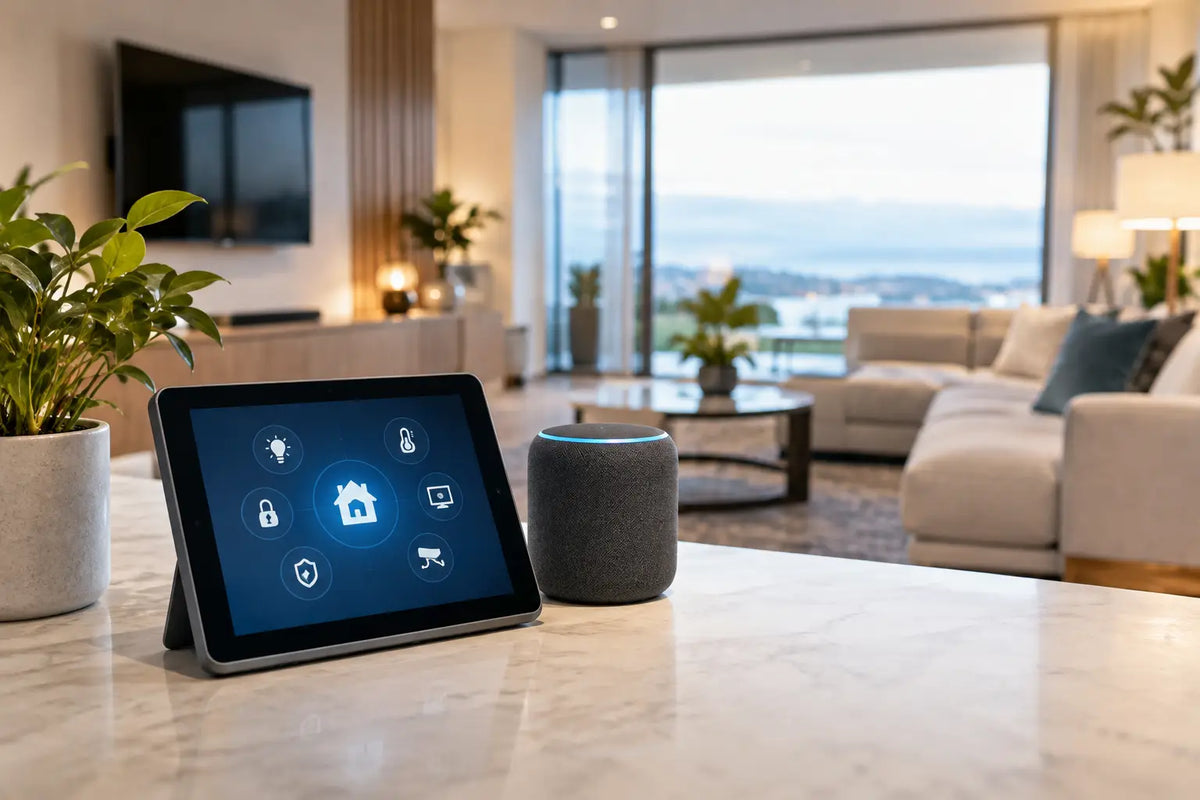
A beautifully designed villa should not require a collection of remotes, wall switches, and disconnected apps to operate at its best. Home automation controllers bring the essential systems of a property into one considered experience, allowing lighting, climate, shading, security, audio, and entertainment to respond as one environment rather than a series of separate purchases.
For discerning homeowners, the controller is not simply a technical component hidden in a rack. It is the intelligence behind a home that welcomes you with the right light, maintains a preferred temperature before you arrive, lowers shades as the afternoon sun moves across the room, and prepares a cinema space at the touch of a button. When specified correctly, it makes advanced technology feel almost invisible.
What Home Automation Controllers Actually Do
A home automation controller is the central processor that coordinates connected devices and systems. It receives commands from keypads, touch panels, mobile devices, voice interfaces, sensors, and programmed schedules. It then communicates with the lighting system, motorized shades, HVAC equipment, door locks, surveillance cameras, AV components, and other compatible technologies.
The distinction matters because a collection of smart products is not necessarily an integrated home. A standalone smart thermostat can manage temperature. A smart speaker can play music. A motorized curtain track can open at a scheduled time. Yet without a properly designed controller, each system remains isolated, with its own app, logic, and limitations.
A professionally integrated controller creates relationships between systems. Pressing “Good Night,” for example, can turn off selected lights, lower bedroom shades, adjust climate settings, arm perimeter security, and switch off distributed audio throughout the residence. The action feels simple because the engineering behind it has already accounted for devices, zones, priorities, and homeowner preferences.
Why a Centralized Control System Changes the Experience
Luxury is often defined by ease. The finest home automation systems remove unnecessary decisions and replace visual clutter with quiet confidence. Rather than installing more technology for its own sake, centralized control gives each room a clear purpose and a consistent interface.
Consider a formal living room used for conversation, entertaining, and occasional film viewing. One interface can create distinct scenes for each use. A reception setting may illuminate artwork and architectural details while keeping the room comfortable for guests. An evening scene may introduce warmer lighting, close the shades, and begin discreet background music. A movie scene can dim lights, activate the display or projector, select the correct source, and adjust motorized shading without requiring guests to understand the equipment.
This approach also protects the design language of the interior. Elegant keypads can replace crowded banks of switches. Flush-mounted touch panels can be selected to complement stone, timber, metal, or painted finishes. Equipment can be organized discreetly in dedicated racks, leaving living spaces focused on architecture, furnishings, and atmosphere.
For larger residences, the benefit extends beyond convenience. Centralized control makes it practical to manage multiple floors, guest suites, outdoor areas, gates, pools, landscape lighting, and entertainment zones without compromising usability. The result is a residence that feels composed, even when its underlying systems are highly sophisticated.
Choosing Home Automation Controllers for Your Property
The right controller depends on the scale of the project, the systems being integrated, and the level of personalization expected. A modest apartment with lighting, climate, and a media room requires a different architecture from a multi-level villa with extensive shading, surveillance, access control, whole-home audio, and dedicated cinema spaces.
The first consideration is scope. Identify the systems that should operate together, rather than choosing individual devices first. Lighting and shades are natural starting points because they have an immediate effect on comfort and ambiance. Climate control, security, gate access, multi-room audio, video distribution, irrigation, pool controls, and energy monitoring may follow depending on the property.
The second is interface design. A controller is only as valuable as the experience it delivers. Homeowners may prefer engraved wall keypads for everyday actions, touch panels in primary rooms, and a mobile interface for remote access. Staff or facility managers may need a simplified control view with permissions tailored to their responsibilities. A successful system does not force every user to navigate the same complex screen.
The third is reliability. Premium automation should operate consistently, including when an internet connection is unavailable. Core functions such as lighting scenes, climate commands, and security-related actions are best designed around a stable local control architecture. Remote access is valuable, but it should complement the system rather than become its single point of operation.
Finally, allow room for the property to evolve. A well-planned control system can accommodate future zones, upgrades, or new entertainment components with minimal disruption. This is particularly valuable during a renovation or new build, when proper cabling, power planning, network design, and equipment-rack space can be incorporated before finishes are complete.
The Role of the Network and Equipment Rack
The controller may be the brain, but it relies on a disciplined technical foundation. A high-performance network is essential for dependable mobile control, streaming, cameras, distributed audio, and connected devices. Poor Wi-Fi coverage or consumer-grade networking equipment can make an otherwise exceptional system feel inconsistent.
The same principle applies to the equipment rack. Organized cabling, labeled connections, appropriate ventilation, surge protection, backup power, and service access are not glamorous details, yet they determine long-term performance. In premium projects, engineering discipline is part of the luxury experience. The homeowner sees a clean interface; the installation team sees an orderly system designed to be maintained properly.
Automation Should Be Personal, Not Overprogrammed
There is a common misconception that an intelligent home must automate every possible action. In practice, the most satisfying systems balance automatic responses with personal control. A residence should anticipate routine needs without feeling intrusive.
Schedules and sensors work especially well for predictable moments. Landscape lighting can follow sunset. Exterior shades can respond to sun exposure. Hallway lighting can provide low-level illumination at night. HVAC can prepare occupied areas before the household returns. These actions support comfort without demanding attention.
Other moments should remain deliberate. Entertaining, hosting family, watching a film, or setting the mood for a private dinner are personal experiences. Here, carefully designed scenes give the homeowner control over the atmosphere while eliminating the technical steps normally required to create it.
Automation also requires thoughtful privacy and security planning. Cameras, access control, intercoms, alerts, and remote monitoring should be designed around the household’s needs and access permissions. A premium system should offer reassurance without making the home feel surveilled or complicated.
Beyond the Residence: Intelligent Control for Commercial Spaces
The same principles apply in high-end commercial environments, though the priorities change. In a gym, controller-based systems can coordinate audio zones, digital displays, lighting schedules, and climate settings across reception, training areas, studios, and changing rooms. In an auditorium or mosque, control can simplify operation of microphones, displays, projection, lighting, and professional sound systems for staff who need reliability without technical complexity.
Retail spaces, schools, offices, and hospitality venues benefit from consistent system behavior across multiple rooms and usage patterns. The essential question is not how many technologies can be connected. It is which experiences must be dependable every day, for every user.
For commercial projects, it is also wise to separate user permissions and prioritize serviceability. Managers may need access to scheduling and daily presets, while technical teams retain control over advanced configuration. This reduces operational errors and keeps the system approachable as staff changes.
The Value of Professional Integration
Home automation controllers cannot be selected in isolation from the rest of the project. Their performance depends on compatibility, wiring, network design, programming, commissioning, and the quality of the physical installation. This is why a bespoke approach delivers a different result from assembling individual smart-home products after construction is complete.
At I-Trust Systems, automation is approached as part of a complete environment. The control experience is considered alongside AV engineering, security, acoustic performance, cinema design, lighting, and interior aesthetics. That perspective matters when a client wants a private cinema to perform as beautifully as it looks, or a villa’s lighting, climate, and entertainment to operate with one natural rhythm.
The most effective time to plan is early, alongside architecture and interior design. It allows technology to support the space rather than compete with it. Start with how the property should feel at different moments of the day, then build the control system around that experience.
Share:
Commercial Background Music Guide for Premium Spaces
Smart Building Trends Shaping Premium Spaces