

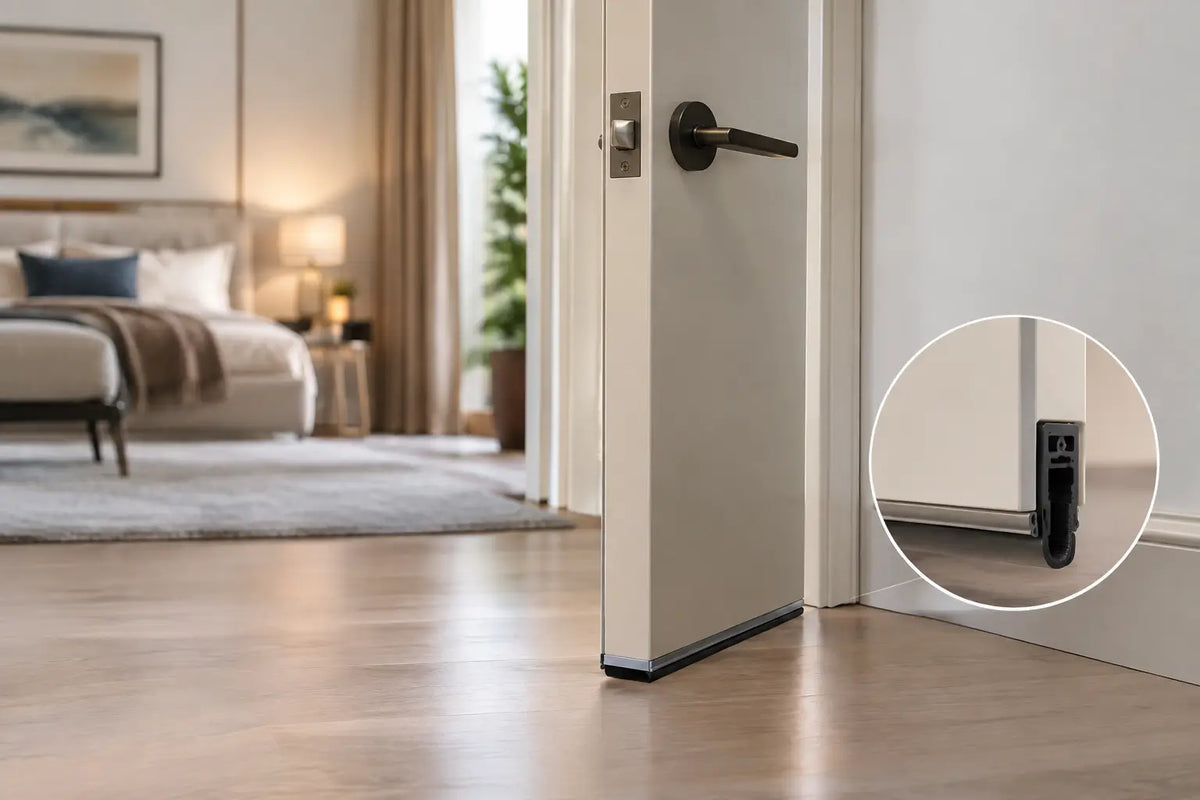
A cinema door can look substantial, feel beautifully finished, and still allow the most disruptive sound to pass around its edges. That narrow gap beneath the door or slight clearance at the jamb can undermine the entire room. Acoustic door seal solutions address this overlooked weak point, preserving the privacy, immersion, and control expected in high-performance residential and commercial interiors.
For villa cinemas, executive offices, recording rooms, private gyms, consultation suites, and worship spaces, sound isolation is never achieved by a single material. It is a system. The door assembly is one of its most critical components because it interrupts an otherwise continuous wall. Treating it with the same engineering discipline as the walls, ceiling, glazing, and HVAC penetrations is what separates a quiet room from one that merely looks acoustically designed.
Why Doors Are the Weak Link in Sound Isolation
Sound behaves like water in one important respect: it finds openings. Even a heavy, solid-core door loses much of its acoustic value when air can move freely through gaps at the head, sides, and threshold. Conversations, television sound, music bass, and reverberant noise do not need a large opening to become audible beyond the room.
This is why a visually impressive door is not automatically an acoustically effective one. Door mass matters, but airtightness matters just as much. A lightweight hollow-core door may need replacement for serious isolation. Yet even a premium solid-core or acoustic-rated door requires correctly specified perimeter seals, a threshold strategy, and precise installation.
The goal is not to make every room silent. A luxury home cinema should contain cinematic impact without disturbing adjacent bedrooms. A boardroom should protect confidential conversation. A wellness room should feel calm despite activity elsewhere in the property. Each objective calls for a tailored level of sound control.
Acoustic Door Seal Solutions That Work Together
An effective acoustic door detail usually combines several components rather than relying on one product. The right selection depends on the door type, floor finish, traffic level, fire requirements, accessibility needs, and target acoustic performance.
Perimeter Compression Seals
Perimeter seals are fitted along the top and vertical sides of the door frame. When the door closes, they compress against the door leaf to restrict air paths around the jamb. High-quality seals should maintain consistent contact without making the door difficult to close or creating an untidy appearance.
For premium interiors, finish matters alongside performance. Seals can be selected and detailed to complement dark timber, painted lacquer, aluminum, bronze-toned hardware, or contemporary concealed-frame doors. The best result feels intentional rather than added as an afterthought.
Automatic Drop Seals
The gap beneath a door is frequently the largest source of sound leakage. An automatic drop seal, also called a drop-down door bottom, lowers a sealing mechanism as the door closes and retracts when it opens. This protects the seal from dragging across stone, timber, carpet, or other finished flooring.
Drop seals are especially well suited to luxury projects because they offer strong acoustic benefits without the visual weight of a permanent threshold. They can be integrated into the bottom of the door leaf for a cleaner appearance. Their performance, however, depends on a level floor and exact adjustment. A poorly fitted drop seal can leave a gap at one side or create excessive pressure that affects door operation.
Acoustic Thresholds and Door Bottoms
Where higher isolation is required, an acoustic threshold may be paired with a door bottom seal. This creates a more controlled contact surface beneath the door, which can be valuable in dedicated cinema rooms, studios, equipment rooms, and commercial spaces with demanding privacy requirements.
There is a trade-off. Raised thresholds may affect accessibility, cleaning, and visual continuity between rooms. In spaces where barrier-free movement is essential, a high-quality automatic drop seal against a carefully detailed floor surface may be the more elegant solution. The right answer is determined during design, not after finishes are installed.
Astragals and Meeting-Stile Seals
Double doors create another potential leakage path at the meeting point between the two leaves. Astragals and specialized meeting-stile seals close this central gap, making them essential for double-leaf cinema entrances, executive suites, multipurpose halls, and hospitality spaces.
These details need careful coordination with locks, handles, panic hardware, and access-control systems. A seal that interferes with latching or leaves an uneven reveal compromises both performance and the user experience. Integration is the difference between a door that performs on paper and one that performs every day.
Start With the Door, Not Just the Seal
Acoustic seals cannot compensate for every limitation in the door itself. A thin, hollow door leaf will remain a weak boundary, even with excellent edge sealing. For spaces requiring meaningful isolation, a solid-core, mineral-core, or purpose-built acoustic door assembly is usually the proper foundation.
Door weight must also be considered. Heavier leaves require suitable hinges, closers, frames, and fixing methods. A door that sags slightly over time can break the compression line of its seals, reducing acoustic performance. Premium projects benefit from hardware specified for the full assembly, not selected independently for appearance alone.
The frame and surrounding wall construction also matter. If sound bypasses the door through poorly sealed frame gaps, lightweight partitions, or unsealed service penetrations, the investment in a high-performance door can be wasted. Acoustic caulking, backing materials, frame anchoring, and wall detailing should form part of one coordinated scope.
Matching the Solution to the Room
A bedroom suite adjacent to a family living area may need a well-sealed solid-core door with discreet perimeter gaskets and an automatic drop seal. The result is a calmer retreat without changing the character of the interior.
A dedicated home cinema requires more rigorous planning. Powerful low-frequency effects, high playback levels, and neighboring quiet spaces often justify an acoustic-rated door, sealed frame, drop seal, and potentially a secondary entry door or sound-lock vestibule. Low frequencies are particularly challenging because they transmit through structure as well as air. Door seals help, but they are only one part of the envelope.
For a boardroom, legal office, or medical consultation room, the focus is usually speech privacy rather than cinema-level containment. A properly sealed door can significantly reduce intelligibility outside the room, although full confidentiality may demand upgrades to partition construction, ceilings, and return-air paths as well.
Commercial gyms, classrooms, mosques, auditoriums, and retail environments introduce other variables: high traffic, frequent opening cycles, fire ratings, access compliance, and maintenance. In these settings, durable hardware and reliable adjustment are as important as laboratory acoustic ratings.
Design Coordination Protects Both Performance and Appearance
The most expensive time to address door leakage is after the project is complete. By then, flooring is installed, wall finishes are approved, custom joinery is complete, and changing a door frame may affect several trades. Early acoustic coordination allows the door swing, threshold condition, floor transition, hardware, and seal type to be resolved before construction reaches the finishing stage.
This is particularly valuable in smart homes. Door contacts, access control, motorized locks, concealed closers, and security systems may all interact with the same opening. A refined result requires these layers to work together without visible compromise. I-Trust Systems approaches acoustic treatment as part of the wider environment, coordinating sound performance with AV design, automation, security, and interior intent.
Common Mistakes That Reduce Acoustic Results
The most frequent mistake is treating a door seal as a cosmetic strip rather than a calibrated component. Self-adhesive foam products may offer a short-term improvement in minor applications, but they can compress permanently, detach in heat, interfere with closing, and rarely provide the consistency expected in premium projects.
Another issue is ignoring the bottom gap. Perimeter seals cannot solve leakage beneath the door, especially where floor levels vary. Finally, teams sometimes specify high-performance seals without checking door alignment. If the leaf is warped, the frame is out of square, or the hinges are incorrectly adjusted, even the best seal will fail to maintain contact.
Professional installation should include testing the closing action, inspecting the compression line, confirming latch engagement, and revisiting adjustment after the building settles and the HVAC system is operating. Details this small deserve that level of care.
A quiet room is not defined by how little equipment it contains. It is defined by how completely every element supports the intended experience. When a door closes with a precise, reassuring seal, the space beyond it can finally perform as designed.
Share:
Biometric Versus Card Access for Luxury Spaces
Acoustic Wall Treatment for Refined Interiors