

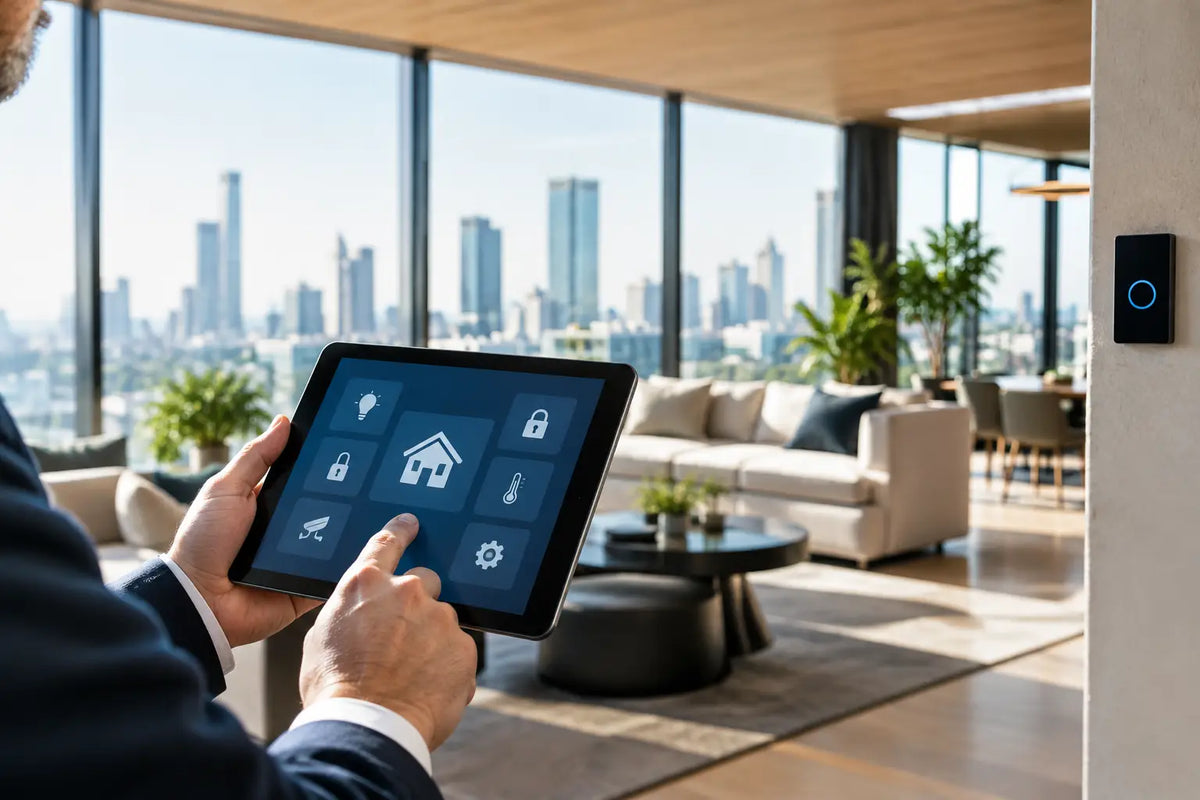
A villa should not feel like a collection of unrelated switches, remotes, speakers, cameras, and thermostats. It should respond as one considered environment. The most influential smart building trends are moving premium properties beyond novelty automation toward intelligently engineered spaces where comfort, security, entertainment, and design work in harmony.
For homeowners, architects, developers, and commercial decision-makers, the real opportunity is not simply adding more connected devices. It is designing a technology foundation that supports the way a space is used, looks refined from every angle, and remains dependable long after handover.
Smart Building Trends Are Becoming More Integrated
For years, automation was often installed in separate layers. Lighting control sat apart from climate management. Security cameras had their own application. Multi-room audio was managed elsewhere. The result was more technology, but not necessarily a better experience.
Premium projects are now taking a different approach: one integrated control strategy across the entire property. A single interface can coordinate lighting scenes, motorized curtains, air conditioning, access control, surveillance, audio, and video. The benefit is not just convenience. It is consistency.
A homeowner can select an “Evening” scene that lowers selected shades, adjusts lighting warmth, sets the preferred temperature, and prepares the living area for music or television. In a commercial setting, a gym can automate opening and closing scenes, background music zones, climate schedules, and display systems without placing that responsibility on staff.
Integration does require thoughtful planning. Not every room needs every feature, and too many controls can create confusion rather than luxury. The best systems make complex engineering feel simple because the experience has been designed around the occupants, not around a catalog of devices.
Lighting Is Becoming an Architectural Material
Smart lighting is no longer limited to turning fixtures on and off from a phone. It is becoming part of the architectural language of a property. Carefully planned lighting control can emphasize texture, art, joinery, landscaping, and circulation while giving occupants precise command over brightness, color temperature, and mood.
Tunable white lighting is particularly relevant in premium residences, offices, hospitality venues, and wellness spaces. Cooler, brighter light can support focus during active hours, while warmer tones help create a more relaxed atmosphere in the evening. The goal is not to make every room colorful. In sophisticated interiors, restraint usually produces the strongest result.
Lighting scenes also reduce the visual clutter of wall switches. A clean keypad, discreet touch panel, or elegant control interface can replace banks of conventional switches while preserving direct, intuitive operation. Physical controls still matter. A mobile app is useful, but no homeowner should need to reach for a phone to dim the dining room or close the curtains.
Energy Management Is Becoming More Personal
Energy efficiency is increasingly part of the premium conversation, particularly in large villas and commercial buildings with high cooling demands. Smart climate control, occupancy awareness, automated shading, and scheduling can reduce unnecessary energy use while maintaining the comfort expected in high-value spaces.
The key distinction is between automation that simply follows a timer and automation that responds to real conditions. Motorized shades can reduce solar gain during the hottest part of the day. Climate zones can be managed according to how rooms are occupied. Exterior lighting can respond to daylight levels and operating hours.
However, energy management should never compromise the living experience. A system that switches off cooling too aggressively or changes lighting at inconvenient moments will quickly be overridden. Good programming balances efficiency with comfort, allowing the property to anticipate needs without becoming intrusive.
For developers, this approach can also strengthen the long-term value proposition of a project. Buyers increasingly expect connected climate, shading, and lighting infrastructure in premium residences, especially when it is integrated discreetly into the design rather than added after construction.
Security Is Shifting From Alerts to Awareness
Security remains one of the most practical smart building trends, but premium clients are looking for more than a stream of notifications. They want confidence that their property is protected without feeling constantly monitored by technology.
A well-designed security ecosystem may combine controlled entry, video intercoms, perimeter cameras, smart locks, intrusion detection, gate integration, and remote monitoring. When these elements communicate through a unified control system, the experience becomes more useful. A resident can verify a visitor, open a gate, view a camera, and activate a welcome lighting scene from one place.
Privacy must be part of the design conversation from the beginning. Camera placement, user permissions, network security, and remote access protocols should be carefully specified. In family homes, schools, worship spaces, and hospitality environments, security technology must be capable without becoming visually dominant or operationally complicated.
Reliability also matters more than an impressive feature list. Security systems should retain essential functions during internet outages and power interruptions where appropriate. Premium integration is as much about dependable infrastructure as it is about elegant interfaces.
Entertainment Spaces Are Being Designed for Immersion
The demand for dedicated cinema rooms, media lounges, gaming environments, and distributed audio continues to grow. Yet the standard for these spaces has changed. A large screen and loud speakers do not automatically create a cinematic experience.
The most successful home cinemas begin with acoustic design. Room proportions, speaker placement, sound isolation, absorption, diffusion, seating positions, projector selection, screen material, and lighting must be considered as one system. A beautiful room that produces uncontrolled reflections or sound leakage will not deliver the performance its finishes suggest.
Outside the cinema, multi-room audio is becoming more intentional. Different zones can support different uses: relaxed music in a living room, higher-energy sound in a gym, discreet background audio in a garden, or clear speech reinforcement in an auditorium. The system should provide enough flexibility for the property without burdening users with complicated source selection.
Commercial clients are applying the same principle. Retail, fitness, education, and worship environments benefit from professional AV systems that are engineered for intelligibility, coverage, reliability, and easy day-to-day management. The right solution depends on the room, the audience, and the intended atmosphere - not just the size of the speaker.
Design Coordination Is Now a Technology Requirement
Technology has the greatest impact when it is considered early. Once ceilings are closed, finishes are installed, and furniture layouts are fixed, options become narrower and costs can rise quickly. Early coordination allows the automation, AV, security, network, and acoustic requirements to support the architecture instead of competing with it.
For architects and interior designers, this means involving an integration specialist during concept development. Equipment can be concealed where appropriate, speaker locations can align with ceiling geometry, rack spaces can be properly ventilated, and control keypads can complement the interior palette. The objective is not to hide every device at all costs. It is to make every visible element feel intentional.
This coordination is especially valuable in large residences and mixed-use commercial projects, where separate contractors can otherwise create fragmented systems. I-Trust Systems approaches these projects as connected environments, aligning engineering performance with the details that define a premium finished space.
The Network Is the Foundation Few People See
Every intelligent building depends on a capable network. Lighting processors, access systems, control panels, cameras, streaming devices, wireless access points, and smart appliances all rely on stable connectivity. A weak or poorly planned network can make even high-end technology feel unreliable.
A professional network design considers coverage, wired connections, equipment location, cybersecurity, guest access, future capacity, and serviceability. In a villa, this may mean dependable Wi-Fi from the cinema room to the garden. In a commercial building, it may mean separating critical building systems from public or guest networks.
This is one area where selecting products individually can be misleading. The quality of the complete system is determined by how well its components are designed, installed, programmed, and supported together.
Choosing Trends That Will Last
Not every new feature deserves a place in a premium project. Voice control can be useful in certain rooms, but it may not suit every household. AI-driven automation can improve recommendations and system responses, but it should never remove meaningful user control. Touch panels can provide an elevated experience, while elegant keypads remain essential for immediate, familiar operation.
The strongest smart building strategy is built around daily routines, architectural intent, and future flexibility. Select platforms that can grow with the property, specify infrastructure that supports upgrades, and prioritize proven performance over temporary novelty.
A truly intelligent space does not demand attention. It quietly makes arrival easier, rooms more comfortable, entertainment more immersive, and operations more efficient - leaving the architecture, the atmosphere, and the people within it at the center of the experience.
مشاركة:
Home Automation Controllers for Refined Living
Can Acoustic Panels Improve Privacy in Your Home?