

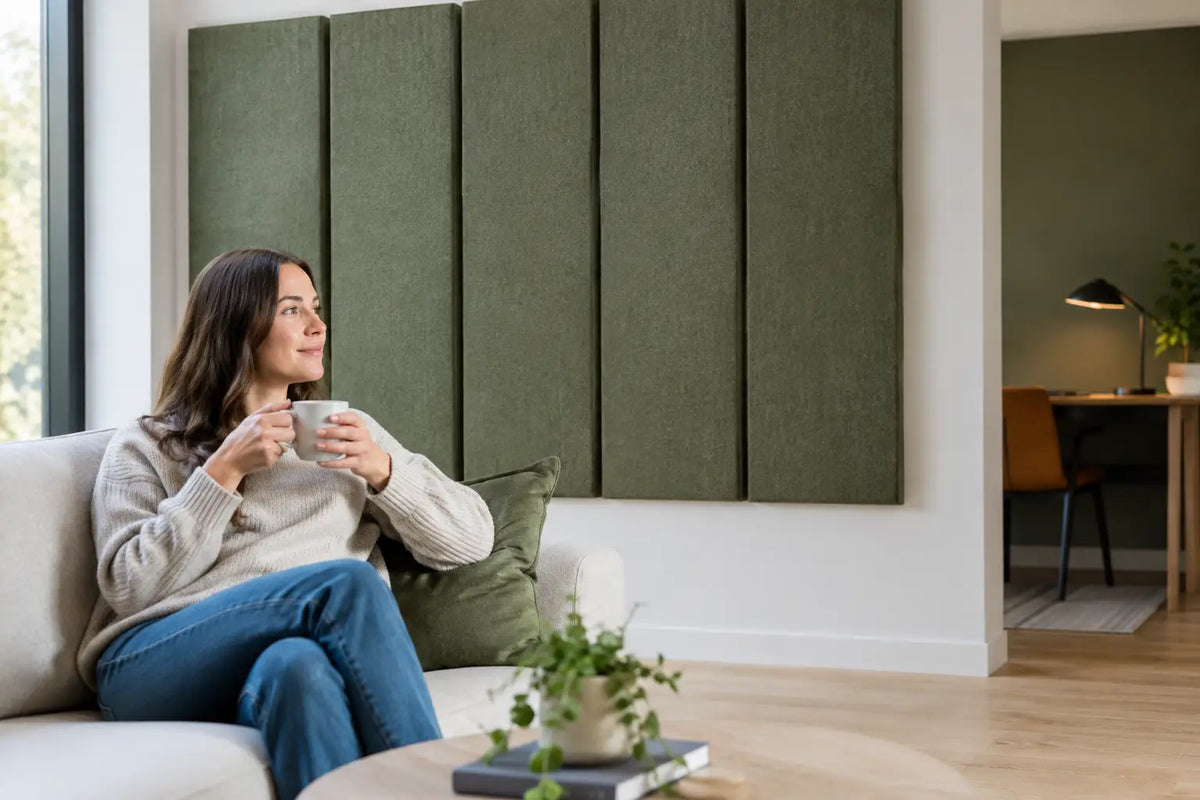
A private room should feel private the moment the door closes. Yet in many villas, open-plan residences, executive offices, and media rooms, conversations remain surprisingly easy to hear. So, can acoustic panels improve privacy? Yes, but only when their role is understood correctly. Panels can make speech less intelligible and reduce the sense that sound is carrying through a space. They cannot, by themselves, stop sound from passing through a lightweight wall, an open doorway, or an unsealed ceiling.
For discerning homeowners and project teams, the distinction matters. Privacy is not achieved by placing decorative panels at random. It comes from a considered acoustic strategy that combines absorption, construction detailing, and refined integration with the architecture.
Can Acoustic Panels Improve Privacy? The Short Answer
Acoustic panels improve acoustic privacy within a room by absorbing reflected sound. When someone speaks in a hard-surfaced room, their voice does not travel only in a straight line. It reflects from glass, stone, tile, plaster, timber, and ceilings. Those reflections keep speech alive in the room, making words clearer and louder over distance.
A well-designed acoustic treatment scheme reduces those reflections. The result is less reverberation, lower perceived noise, and conversations that become harder to understand from across the room or just outside an adjacent open area. This is particularly valuable in home offices, meeting rooms, private gyms, prayer spaces, classrooms, restaurants, and multipurpose entertainment rooms.
However, acoustic panels are not the same as soundproofing. They improve the quality of sound inside a room. Soundproofing reduces the amount of sound that crosses from one room to another. Premium projects often need both.
Absorption and Soundproofing Solve Different Problems
The most common mistake in privacy planning is expecting wall panels to compensate for poor room separation. A beautiful fabric-wrapped panel, timber slat feature, or architectural ceiling baffle can absorb a significant amount of reflected mid- and high-frequency sound. It cannot seal the gap beneath a door or add meaningful mass to a thin partition.
Think of the difference this way: absorption manages the energy already inside a room. Soundproofing controls the path sound takes as it tries to leave the room.
If a private conversation is audible through a closed wall, the weak points may include the wall construction, door core, perimeter seals, HVAC grilles, recessed electrical boxes, ceiling voids, or glazing. In these cases, additional absorption may make the room more comfortable, but it will not deliver the privacy expected from a boardroom, bedroom suite, consultation room, or cinema.
A complete privacy solution may include denser wall assemblies, acoustic insulation within partitions, high-performance doors, automatic door bottoms, sealed frames, acoustic glazing, and carefully designed ventilation routes. Panels are then introduced to control echo and improve the room’s character rather than being asked to perform a job they were never designed to do.
Where Panels Make the Biggest Difference
Acoustic panels are exceptionally effective where privacy is affected by open layouts or excessive reverberation. In a large living area with marble floors, expansive glazing, and high ceilings, family conversations can carry farther than expected. Strategic absorption softens the room, making it easier to speak at a comfortable level and reducing the spill of intelligible speech into neighboring zones.
In a luxury home office, panels can reduce the distracting reflection of a video call and help prevent the room from broadcasting every word into a hallway or adjacent lounge. They are also highly valuable in executive meeting rooms, where speech clarity for participants should be balanced with discretion beyond the room.
For home theaters and media rooms, treatment serves a dual purpose. It sharpens dialogue, controls unwanted reflections, and supports the immersive performance expected from premium AV systems. At the same time, it can reduce internal sound buildup, which makes the room more pleasant at both reference listening levels and everyday viewing volumes.
Commercial environments benefit in equally practical ways. In a fitness studio, treatment can reduce the relentless buildup of music, coaching, and equipment noise. In schools and worship spaces, it can improve speech definition without creating a harsh acoustic environment. In hospitality and retail, it helps preserve energy and atmosphere while allowing guests to speak without feeling exposed.
Privacy Depends on Speech Intelligibility, Not Silence
Absolute silence is rarely the goal. A well-designed residence or workplace should still feel alive, welcoming, and connected. The real objective is often to make speech less intelligible to people who are not meant to hear it.
This is why a room with controlled reverberation can feel more private even if a sound meter shows only a modest change in overall volume. When reflections are reduced, the sharp consonants that make words understandable do not continue bouncing around the space. You may still hear that people are talking, but the content of the conversation becomes less clear.
For sensitive spaces, a degree of controlled background sound can also help. Quiet HVAC airflow, a discreet water feature in an exterior zone, or professionally designed sound masking may reduce the contrast that makes speech stand out. This approach must be handled carefully. The goal is not to introduce noise, but to create an environment where privacy feels natural rather than forced.
Placement Matters More Than Decorative Coverage
Acoustic treatment should follow the room’s surfaces, volume, use, and aesthetic direction. A few panels mounted in the wrong place may look intentional while achieving very little. The best locations are typically the hard reflective surfaces that allow speech and music to continue circulating through the room.
In many interiors, the ceiling is one of the most valuable treatment areas, especially where walls are defined by glazing, artwork, millwork, or stone. Ceiling panels, suspended elements, and integrated acoustic finishes can deliver meaningful absorption without compromising the visual language of the space.
Wall treatment should be placed with sightlines, furnishings, and room use in mind. A media room may require a more technical distribution of absorption and diffusion. A formal lounge may call for discreet fabric panels integrated into wall moldings or custom timber features with acoustically transparent backing. In an office, panels can become part of a tailored design composition while quietly improving speech comfort.
Material selection also matters. Fabric finishes, perforated timber, PET felt, micro-perforated architectural surfaces, and bespoke upholstered panels each create a different visual and acoustic outcome. The right solution should support the interior, not appear as an afterthought.
The Trade-Off: A Room Can Become Too Absorbent
More acoustic treatment is not always better. An over-treated room can feel unnaturally dull, particularly in living spaces designed for entertaining. Voices may feel close and dry, while music loses some of its natural openness. The aim is balance.
A cinema room can accept a higher level of absorption because control and precision are central to the experience. A dining area, villa majlis, or reception lounge may need a more measured approach that reduces harshness while retaining warmth and liveliness. This is where acoustic engineering and interior design need to work as one discipline.
Low-frequency sound presents another limitation. Standard thin panels are effective for much of the speech range, but deep bass from subwoofers, mechanical equipment, or amplified music needs more specialized treatment. Bass traps, isolated construction, and system calibration may be required when privacy concerns include powerful home cinema or multi-room audio systems.
Designing Privacy Into the Project From the Start
The most refined results come when acoustics are considered alongside lighting, HVAC, electrical planning, security, and AV design. Once ceilings are complete and bespoke finishes are installed, privacy improvements can become more restricted and more visible than necessary.
For new builds and major renovations, identify the rooms that need discretion early: bedrooms, executive offices, cinema rooms, meeting areas, treatment rooms, prayer rooms, and entertainment zones. Then consider both the internal acoustic character of each room and the paths sound may take into neighboring spaces.
At I-Trust Systems, this integrated approach allows acoustic treatment to complement high-performance audio, intelligent control, and the architectural finish of the project. The outcome is not simply a quieter room. It is a space that performs with greater comfort, discretion, and composure.
When privacy is a priority, begin with the experience you want people to have when they enter the room. From there, the right combination of acoustic panels, sound isolation, and thoughtful design can make discretion feel effortless.
مشاركة:
Smart Building Trends Shaping Premium Spaces