

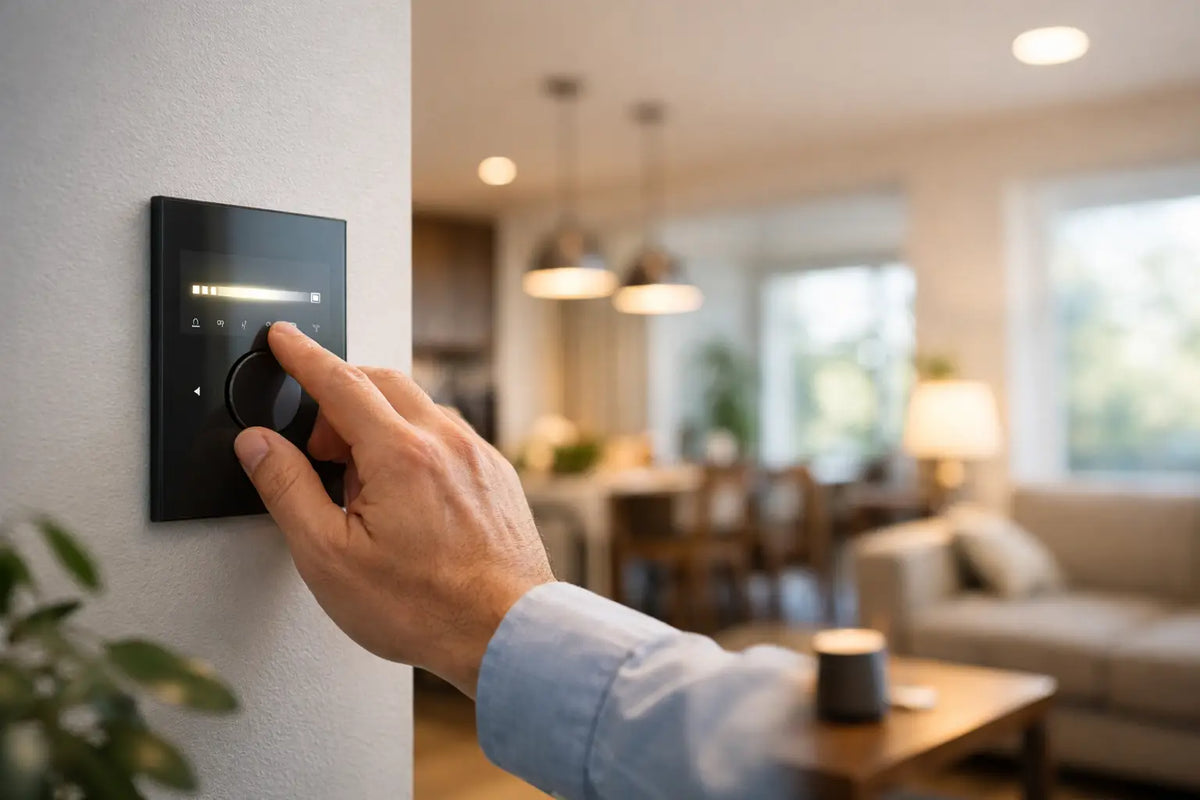
A beautifully designed room can still feel incomplete when every light is controlled by a row of conventional switches. The question, “what is lighting control,” is really a question about how a space should feel and perform from morning through late evening. It is the ability to manage light intelligently - by room, zone, scene, schedule, occupancy, or daylight level - rather than treating every fixture as an isolated circuit.
For a luxury residence, it means arriving home to a composed welcome scene, entertaining under warm layered light, and ending the day with one command that settles the entire home. In a commercial setting, it supports visual comfort, operational consistency, energy efficiency, and an environment that reflects the quality of the brand.
What Is Lighting Control?
Lighting control is a system that adjusts electric lighting through keypads, touch panels, mobile devices, voice control, sensors, timers, or automation programming. It can turn lights on and off, but its real value lies in precise dimming, scene creation, and coordinated operation across multiple fixtures and spaces.
A conventional switch offers a binary choice: on or off. A lighting control system creates a more considered response. It may dim recessed ceiling lights to 40 percent, raise artwork lighting to 70 percent, close motorized shades, and activate accent lighting around a feature wall - all as part of a single “Evening” scene.
This distinction matters because professional lighting design is layered. Ambient light provides general illumination, task lighting supports activities such as cooking or reading, and accent lighting brings depth to architecture, art, textures, and landscape features. Control brings these layers together without filling a refined interior with unnecessary wall controls.
Lighting Control Is More Than Smart Bulbs
Smart bulbs can be useful in a small apartment or a single-room retrofit, but they are not always the right foundation for a high-value property. They rely on constant power, can create inconsistent dimming across fixture types, and often place control at the bulb rather than at the electrical and design level of the home.
A professionally integrated system is designed around the project. It can control architectural fixtures, decorative pendants, LED strips, outdoor lighting, landscape lighting, and specialty loads from a unified interface. The system is planned with the electrical infrastructure, interior design, and automation strategy in mind.
This approach also preserves the visual discipline of the space. Instead of multiple branded apps and clusters of switches, a property can use elegant engraved keypads, discreet touchscreens, and carefully programmed scenes. The technology remains present when needed and quiet when it is not.
How Lighting Control Works in a Home or Business
At its core, a lighting control system sends commands to dimmers, relays, drivers, or connected fixtures. Those commands may be triggered manually by a keypad, automatically by a sensor, or through an integrated automation platform that coordinates lighting with shades, climate, security, and AV.
In a residence, a “Good Morning” command might gently raise bedroom lighting, illuminate the hallway at a low level, open selected shades, and bring the kitchen to a practical daytime setting. A “Movie” scene can dim the cinema entry lights, guide guests with step lighting, close blackout shades, and protect the screen image from distracting reflections.
In offices, retail environments, gyms, schools, mosques, and hospitality venues, control strategies tend to be more operational. Timed schedules can reduce reliance on staff routines. Occupancy sensors can lower lighting in unoccupied areas. Daylight sensors can reduce artificial light near windows while maintaining a balanced appearance throughout the room.
The best programming is rarely dramatic for its own sake. It should feel intuitive. A client should not need to think about which circuits belong to which fixture group. They should simply select the atmosphere or function they want.
The Value of Scenes and Zoned Lighting
Scenes are pre-set combinations of lighting levels designed around a moment, activity, or mood. They are one of the strongest reasons to specify a dedicated control system, particularly in large villas and multi-purpose commercial spaces.
Consider a formal living room. During the day, the space may need soft ambient light that complements natural daylight. For a dinner party, pendant lighting over the table may become the focal point while perimeter lights fade back. Later, only cove lighting and art illumination may remain, allowing the room to feel relaxed without becoming dark or flat.
Zoning makes this possible. Rather than controlling an entire floor as one lighting group, a system divides it into meaningful areas: the dining table, lounge seating, circulation paths, display niches, kitchen worktops, and exterior terrace. Each zone can respond differently, giving the designer much greater control over depth and visual hierarchy.
The number of zones should be intentional. Too few can make a large room feel blunt and overlit. Too many can make programming, budgeting, and daily use needlessly complicated. The right balance depends on the architecture, the fixture schedule, the purpose of the room, and how the client lives in it.
Dimming Quality Defines the Experience
Not all dimming is equal. A system may be technically functional yet still produce flicker, audible buzzing, poor low-end performance, or uneven behavior between fixtures. In premium interiors, these flaws are immediately noticeable.
Dimming performance depends on compatibility between the control system, dimming module, LED driver, fixture, and lamp. Some loads use phase dimming, while others require 0-10V, DALI, DMX, or digital protocols. Decorative fixtures, imported luminaires, tunable-white LEDs, and long linear LED runs often require particular attention during design and commissioning.
This is why lighting control should be considered early, not added once construction is nearly complete. An engineering-led review of the lighting schedule can identify compatibility risks before fixtures are ordered and ceilings are closed. Mockups are especially valuable for spaces where atmosphere is central, such as a cinema, double-height entrance, majlis, restaurant, or luxury retail environment.
Control, Daylight, and Energy Performance
Energy savings are a practical benefit, but they should not be the only reason to choose lighting control. A well-designed system uses only the light required for the task and time of day, which can reduce waste while making rooms more comfortable.
Daylight harvesting is one example. Sensors detect available natural light and gently adjust nearby fixtures to maintain a chosen illumination level. In a glazed office or villa living area, this can prevent the common problem of lights running at full output beside bright windows.
Scheduling provides another layer of discipline. Exterior lighting can activate at sunset, shared spaces can move to after-hours levels, and landscape scenes can be timed to enhance the property without operating unnecessarily all night. Occupancy and vacancy sensing can be valuable in closets, bathrooms, corridors, meeting rooms, back-of-house areas, and other spaces where lights are often left on.
Still, automated settings need careful calibration. An overly aggressive sensor can frustrate occupants, while a poorly programmed daylight response can make a room appear to fluctuate. Comfort, visual stability, and the character of the space should guide the design.
Integrating Lighting With the Rest of the Property
Lighting becomes more powerful when it is part of a wider intelligent environment. A single “Away” command can turn off selected lights, lower shades, adjust AC settings, mute entertainment zones, and prepare the security system. A nighttime pathway can activate softly when motion is detected, without waking the household with full-brightness lighting.
For a dedicated home cinema, integration is particularly valuable. The viewing experience depends on controlled darkness, low-glare circulation light, screen-ready shades, and a consistent response from the AV system. One command can transform the room from a social lounge into a focused cinematic environment.
The same principle applies to commercial projects. In a showroom, lighting can reinforce product displays and support opening or closing routines. In an auditorium, scenes can coordinate house lights, stage lighting, projection, and AV operation. In a premium gym, different zones can carry distinct energy levels without requiring staff to manage every circuit manually.
I-Trust Systems approaches these projects as coordinated environments, where lighting, automation, AV, acoustics, and security are planned to support one architectural and operational vision.
When Is Lighting Control Worth the Investment?
Lighting control is particularly worthwhile when a project includes multiple lighting layers, large open-plan rooms, extensive glazing, motorized shades, landscape lighting, entertainment areas, or several floors. It is also compelling when design continuity matters and the client wants fewer visible controls with more capability behind them.
For a smaller renovation, a targeted solution may be more appropriate. Key areas such as the entry, living room, kitchen, primary suite, outdoor entertaining zone, and cinema can be designed for intelligent control, with provisions left for future expansion. The right answer is not always to automate every possible circuit. It is to invest where daily comfort, aesthetics, and usability will be felt most.
A successful system also requires a clear handover. Homeowners and staff should understand the essential scenes, manual overrides, and support process. Technology should elevate the experience of the space, not introduce another layer of complexity.
Light has the rare ability to change a room without changing a single piece of furniture. When it is controlled with precision, it can make architecture feel warmer, art more intentional, evenings more relaxed, and every arrival more considered.
مشاركة:
Is Smart Lighting Worth It in a Luxury Home?
Villa Security Camera Placement That Looks Refined