

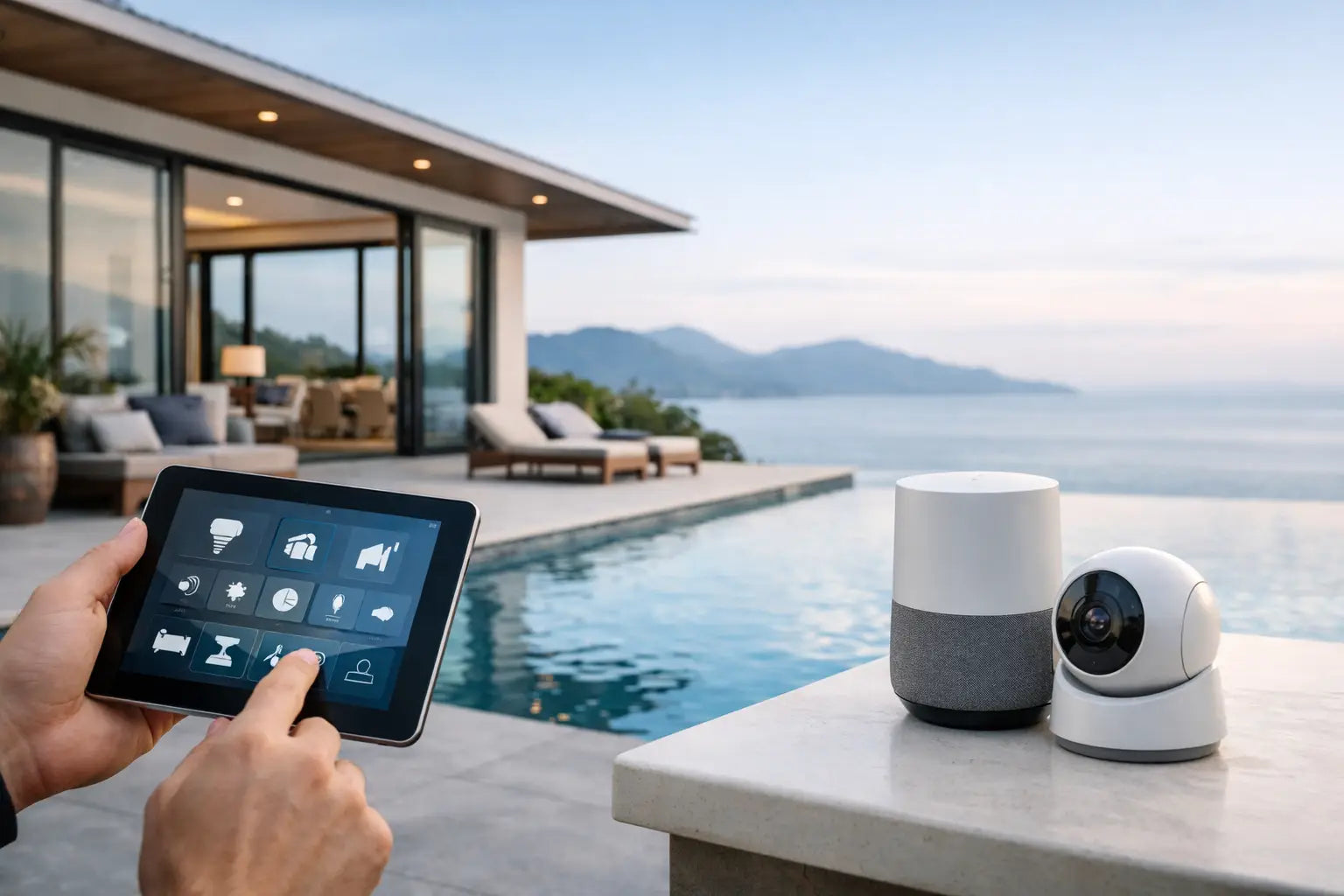
A luxury villa should not require a wall of switches, separate remote controls, and multiple apps just to create the right atmosphere. The most successful villa automation project example begins with a simpler ambition: every important system should respond naturally to the way the household lives, entertains, rests, and travels.
For a contemporary five-bedroom villa, that may mean lights that welcome the family home after sunset, air conditioning that adjusts room by room, curtains that protect interiors during the hottest hours, and security that is visible when needed but never intrusive. It can also mean a cinema that performs like a private screening room, while the garden, pool terrace, and living areas share music without competing with one another.
This is not a collection of gadgets. It is an engineered environment in which technology, architecture, interiors, and daily routines are considered as one.
The Villa Brief: Comfort Without Visual Clutter
Consider a newly built, three-level villa with formal reception rooms, open-plan family living, five bedroom suites, a private home cinema, gym, garden terrace, pool, and staff areas. The owners want a refined home that is easy to operate for family members, guests, and household staff. They also want a level of security appropriate to a valuable property, without compromising the clean lines of the interior design.
The challenge is familiar in premium residences. Lighting, HVAC, motorized shades, gate access, cameras, audio, television, and cinema equipment are often purchased separately and installed at different stages. The result can be technically capable but frustrating to use. A guest may know how to turn on a television but not the correct sequence for the shades, AV receiver, and room lighting. A homeowner may have excellent security cameras but no convenient way to view them from the bedside or at the front door.
A well-planned villa automation project brings those decisions into a single control strategy. The aim is not to automate every action. It is to make the most common actions effortless and give the owner clear control when personal preference matters.
A Villa Automation Project Example, Room by Room
Arrival, access, and the first impression
At the gate, secure access control verifies residents and approved visitors through an intercom, keypad, mobile credential, or integrated gate system. Cameras cover entry points, driveway movement, and perimeter zones, with carefully selected viewing angles rather than excessive hardware on every facade.
When the owners arrive after dark, an Arrival scene can open the gate, illuminate the driveway and entry path, disarm selected interior zones, and activate warm lighting in the foyer, main living area, and kitchen. If the home has been vacant, the system can restore comfortable temperatures before the family enters.
The experience is deliberately composed. Exterior lighting should provide safety and architectural presence, not flood the property with harsh brightness. Inside, the foyer lighting can highlight artwork, stone, or a sculptural staircase while preserving the calm of the home.
Lighting designed around moods, not switches
Lighting control is often the foundation of a luxury automation system because it affects every room, every day. Instead of a crowded bank of dimmers, elegant keypads offer scenes that reflect how the room is actually used.
In the formal living room, Entertain might set layered ambient lighting, illuminate display shelving, lower sheer shades, and start background music at a discreet level. Relax could reduce the room to warm perimeter lighting and a few focused accents. Cleaning provides full practical illumination without requiring staff to adjust individual circuits.
The value comes from the lighting design as much as the control platform. Decorative fixtures, concealed LED details, wall washers, and artwork lighting need proper load planning, dimming compatibility, and commissioning. An automation system cannot compensate for poorly selected fixtures or undisciplined circuit design.
In bedrooms, the emphasis shifts to personal comfort. A bedside keypad can offer Good Night, reading light control, curtain operation, and a house-wide security status check. A gentle Wake scene can raise blackout shades gradually, adjust temperature, and bring up low-level lighting before the alarm sounds. These details feel understated, but they change how a home begins and ends each day.
Climate and curtains working together
Cooling is a major operating cost and comfort factor in large villas. Independent control of each room is useful, but it should not become a burden of constant adjustments. Integrated thermostats can maintain preferred temperatures by zone, while occupancy patterns, time schedules, and shade positions support more efficient operation.
For example, automated curtains and shades can close during peak afternoon sun to reduce heat gain in west-facing rooms. In the evening, they can lower for privacy as interior lights come on. The system should always allow local override. A homeowner may want sunlight in a room despite the energy logic, and the home should respond without argument.
The trade-off is that HVAC integration must be designed around the actual equipment installed. Ducted systems, chilled-water fan coils, VRF units, and split systems each have different control requirements. This is why automation planning should begin before ceilings are closed and equipment selections are finalized.
Entertainment that feels effortless
The family room is often the most-used entertainment space in the villa. Here, a single interface can start a movie, select a streaming source, adjust lighting, lower shades, and set the correct audio mode. The television remains visually clean, while AV components, network equipment, and control processors are housed in a properly ventilated equipment rack.
Multi-room audio extends this experience across the home. The kitchen can play a morning playlist while the terrace plays a separate source for guests. During a party, shared music can move from reception areas to the garden at a consistent level. Zoned audio is not simply about putting speakers everywhere. Speaker placement, amplifier capacity, acoustic behavior, and discreet architectural integration determine whether it sounds refined or merely loud.
For the dedicated home cinema, the design becomes more specialized. A true cinema room combines projection or a premium large-format display, a carefully sized screen, immersive surround sound, acoustic treatment, seating layout, lighting scenes, and sound isolation. When Movie Night is selected, the system can close blackout shades, lower the lights, power the AV system in the correct sequence, and set the room to its calibrated viewing mode.
A cinema should not be judged only by its equipment list. Room proportions, bass control, reverberation, and isolation from adjacent bedrooms matter just as much. Premium performance requires engineering behind the walls as well as beautiful finishes in front of them.
Centralized Control Without Losing Local Choice
The owner controls the villa through discreet wall keypads, touch panels in key zones, and a secure mobile interface for access away from home. Voice control may be included in selected rooms, but it works best as a convenience layer rather than the primary method of operation. Spoken commands are useful when hands are occupied; tactile keypads remain faster and more reliable for everyday scenes.
A strong control design also considers staff and guests. Staff may receive simplified controls for cleaning, service access, and common areas. Guest suites can have intuitive local controls without exposing whole-house settings. The owner retains access to security, energy, and system-wide scenes through protected permissions.
This layered approach avoids a common mistake: building a system that is impressive in a demonstration but too complex for daily life. Luxury is not measured by how many features appear on a screen. It is measured by how little effort the home asks of its occupants.
Security That Belongs to the Architecture
Security in a premium villa should be comprehensive but carefully integrated. The project may include perimeter cameras, intrusion sensors, video intercoms, smart locks or access-controlled doors, gate integration, and monitored alerts. Cameras can be viewed at entry touch panels, on selected TVs, or through the owner’s approved mobile device.
Privacy and reliability deserve equal attention. Camera placement should respect private interior areas, and network segmentation should protect security devices from general household traffic. Battery backup and power protection should be specified for essential systems, particularly gates, networking, control processors, and security equipment.
The system can also support an Away scene. With one action, the villa turns off nonessential lighting and AV equipment, adjusts climate settings, closes curtains, confirms access points, and arms selected security zones. If the property is occupied by staff or guests, the logic can be configured differently. Automation should follow the realities of the household, not force everyone into one rigid routine.
The Engineering Behind a Polished Result
A villa automation project succeeds long before the final keypad is installed. It begins with coordination among the automation designer, architect, interior designer, MEP consultant, lighting designer, and contractor. Cable pathways, equipment rack locations, Wi-Fi coverage, speaker positions, motorized shade pockets, and ventilation requirements all need to be resolved early.
The network deserves particular attention. Streaming, cameras, control, remote access, and multi-room audio depend on stable wired and wireless infrastructure. A premium home should have structured cabling, managed networking, purposeful Wi-Fi access point placement, and a rack that can be serviced without disturbing the living spaces.
At I-Trust Systems, the objective is to bring this technical foundation together with the visual standard expected in a luxury residence. Equipment should disappear into the architecture where appropriate, while the experience remains immediate, reliable, and personal.
The most valuable first step is not choosing a touchscreen or speaker brand. It is defining the moments that matter most in the home: arrival, family evenings, formal entertaining, bedtime, travel, and quiet weekends. Design those moments well, and the technology will feel less like a feature of the villa and more like part of its character.
مشاركة:
12 أفكار للتحكم بإضاءة الفيلا تمنح شعوراً بالراحة
Home Theater Room Dimensions Guide for Luxury Homes