

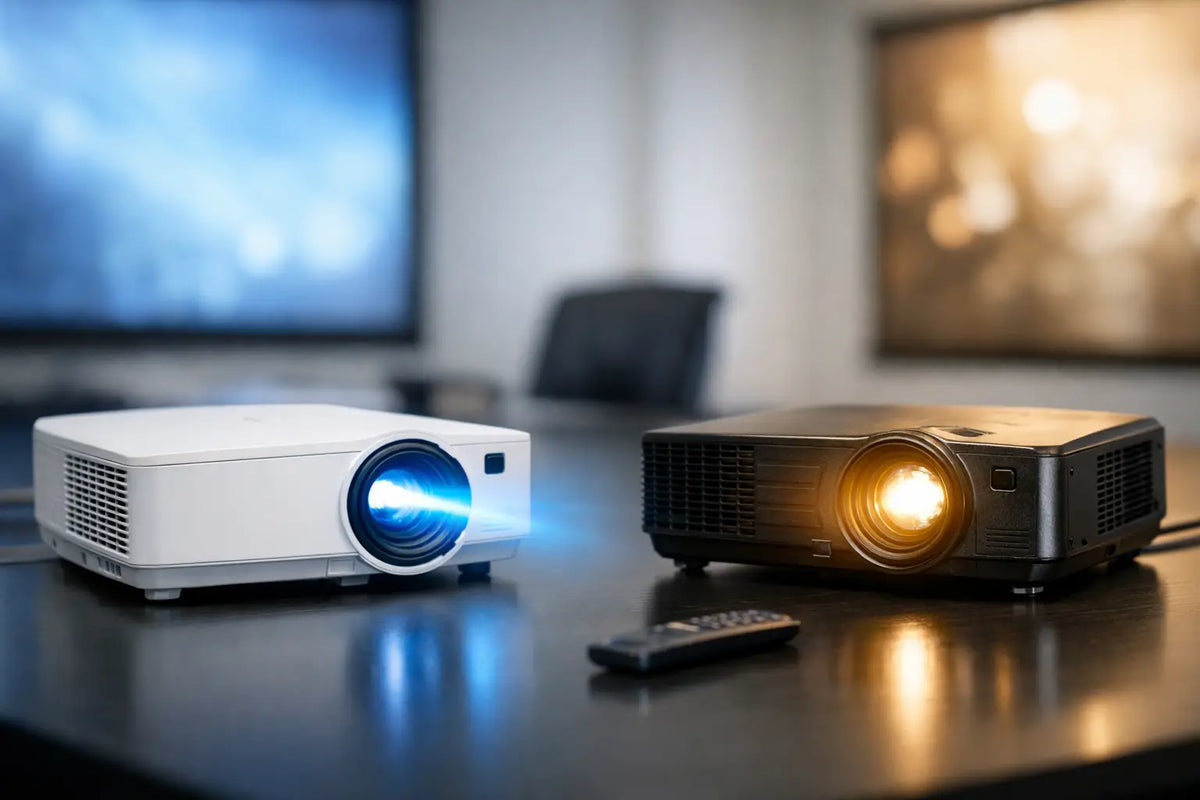
A projector is rarely an isolated purchase in a premium home. It must work with the room’s daylight, screen size, ceiling design, control system, acoustics, and the way the family actually watches. The choice between laser versus lamp projectors shapes all of those decisions, from image consistency to long-term ownership costs.
For a dedicated cinema with controlled lighting, a high-performance lamp projector can still produce an exceptional, cinematic image. For a bright family room, villa majlis, training room, or commercial space that runs for long hours, laser projection often offers a more practical and polished answer. The better technology is not simply the newer one. It is the one engineered around the space.
Laser Versus Lamp Projectors: The Essential Difference
The core difference is the light source. Traditional lamp projectors use a high-intensity bulb, commonly an ultra-high-pressure lamp, to create light that passes through the projector’s imaging system. Laser projectors use a laser light engine instead.
That change affects far more than brightness. A laser light engine typically maintains more stable performance over thousands of hours, turns on and off quickly, and requires less routine intervention. Lamp-based units usually cost less at the outset and remain highly respected in dedicated theaters because certain models deliver nuanced black levels, natural color, and a film-like presentation that enthusiasts value.
Neither format guarantees better picture quality on its own. Lens quality, video processing, native resolution, contrast capability, screen material, and room control still determine whether the final image feels truly immersive.
Brightness Is About the Room, Not Just the Specification
Brightness figures can be misleading when viewed without context. A projector rated for high output may look washed out on a large screen if the room has uncontrolled windows, pale reflective finishes, or bright architectural lighting. Conversely, an extremely powerful projector in a fully dark cinema can feel unnecessarily intense if it is not calibrated correctly.
Laser projectors are particularly compelling in multipurpose rooms. Their consistent light output makes them well suited to living rooms, media lounges, gyms, classrooms, retail displays, and boardrooms, where some ambient light is unavoidable. A laser model can deliver a clear, confident image for sports, gaming, presentations, and casual daytime viewing without demanding complete darkness.
A lamp projector can be a superb choice for a dedicated home cinema where blackout control, dark wall treatments, and carefully considered screen placement are already part of the design. In that environment, the goal is not maximum brightness. It is depth, shadow detail, accurate color, and the sense that the screen disappears into the room.
Screen Size Changes the Equation
As screen size increases, available brightness is spread across a larger surface. A projector that looks excellent at 100 inches may require a more capable light source at 140 or 160 inches. This is especially relevant in luxury cinemas, entertainment lounges, auditoriums, and large villas where the screen is intended to make a visual statement.
Screen gain also matters. A higher-gain screen can enhance perceived brightness, but it may narrow viewing angles or introduce visible texture in some conditions. Ambient-light-rejecting screens can help in brighter spaces, although they are not a substitute for proper lighting control. The projector and screen should always be selected as a system.
Lifespan, Maintenance, and Ownership Experience
Laser’s strongest practical advantage is longevity. Many laser projectors are designed for roughly 20,000 hours of use before their light output declines significantly. For a household watching several hours a day, that can translate to many years without a light-source replacement. For commercial installations operating daily, the benefit is even more substantial.
Lamp projectors have a shorter lamp life, often ranging from several thousand hours depending on the model and operating mode. The lamp will eventually need replacement, which adds a predictable maintenance cost and can require recalibration to restore the preferred image balance. Brightness also declines gradually as the lamp ages, so the image may not look identical in year four as it did on installation day.
This does not make lamp projectors inconvenient by default. In a private theater used mainly for weekend movie nights, a lamp may last a long time. The lower purchase price can make financial sense, particularly when the projector is part of a carefully balanced cinema budget that also includes premium audio, acoustic treatment, seating, and automation.
Laser projection is often the more elegant ownership experience for clients who prefer consistent performance with minimal maintenance. There is no warm-up period to plan around, and the system is ready quickly when a scene is selected from a wall keypad, touch panel, or integrated control interface.
Picture Quality: Contrast, Color, and the Character of the Image
The popular assumption that laser always looks better is too simplistic. High-end lamp projectors remain capable of beautifully cinematic results, especially in dark rooms where black level and contrast take priority. Some film enthusiasts also appreciate the visual character of a carefully calibrated lamp-based model.
Laser projectors can offer vivid color, excellent brightness stability, and wide color performance in the right model. However, the laser light source can reveal image artifacts or speckle in certain projector and screen combinations. Premium equipment and professional specification reduce these risks, but this is one reason a demonstration and site evaluation are more valuable than choosing based on a specification sheet alone.
For either technology, professional calibration is the finishing layer. A projector should be tuned to the screen, room finishes, intended content, and viewing preferences. A cinema designed mainly for films requires a different target from a space used for high-impact sports, console gaming, and streaming.
Heat, Noise, and Installation Design
Projectors create heat, and heat must be managed intelligently. Lamp projectors generally require more cooling, which can mean higher fan noise and more demanding ventilation considerations. In a quiet home theater, even modest fan noise can become noticeable during softer scenes.
Laser projectors also use cooling systems, but many designs are quieter and more efficient in typical use. The exact result depends on the specific model, brightness setting, and mounting arrangement. A projector mounted in a ceiling recess, equipment room, or purpose-built hush enclosure requires detailed airflow planning regardless of light source.
Installation geometry deserves equal attention. Throw distance, lens shift, projector position, structural support, cable pathways, and service access should be resolved before ceilings are closed. A refined cinema should not compromise its architecture with exposed wiring, awkward equipment placement, or a projector that is impossible to maintain.
When a Lamp Projector Is the Better Choice
A lamp projector remains a strong option when the space is a dedicated dark theater, viewing is occasional to moderate, and the budget prioritizes maximum image performance per dollar. It can be particularly appealing for homeowners who want to allocate more of the investment toward a larger acoustically transparent screen, immersive surround sound, acoustic isolation, or bespoke interior finishes.
It also suits clients who value a specific projector model’s contrast performance and are comfortable with planned lamp replacement over the life of the system. The key is to treat replacement lamps as part of the ownership plan, rather than an unexpected expense.
When Laser Projection Makes More Sense
Laser is often the preferred route for a premium multipurpose space. It is especially compelling where the projector will be used frequently, where viewing begins in brighter conditions, or where the installation must operate reliably with little attention from the owner.
For commercial environments, laser’s long operating life can simplify maintenance schedules and reduce disruption. In hospitality, fitness, education, retail, worship, and corporate settings, reliable daily performance often matters more than the lower upfront cost of a lamp unit.
For upscale residences, laser also complements the expectation of intelligent living. A one-touch “Cinema” scene can lower shades, adjust lighting, power the AV system, and start projection without asking the homeowner to manage warm-up times or remember lamp-life intervals.
Choose the System Around the Experience
The most successful projection systems begin with a conversation about the room. Is it a blacked-out cinema designed for reference-level movie nights? Is it an open living space where children watch animation in the afternoon and guests gather for major sporting events? Will the projector operate for a few hours each week or for eight hours every day?
Those answers guide the correct balance of brightness, contrast, screen type, audio design, and automation. At I-Trust Systems, that engineering-first approach allows the projector to become part of a complete environment rather than a standalone device mounted to the ceiling.
A well-chosen projector should feel invisible when the lights dim: no distracting fan noise, no compromised image, no awkward controls, and no question about whether the room can perform when it matters. That is the standard worth designing for.
مشاركة:
Acoustic Foam for Refined, Better-Sounding Rooms
Is Home Cinema Worth It for a Luxury Home?