

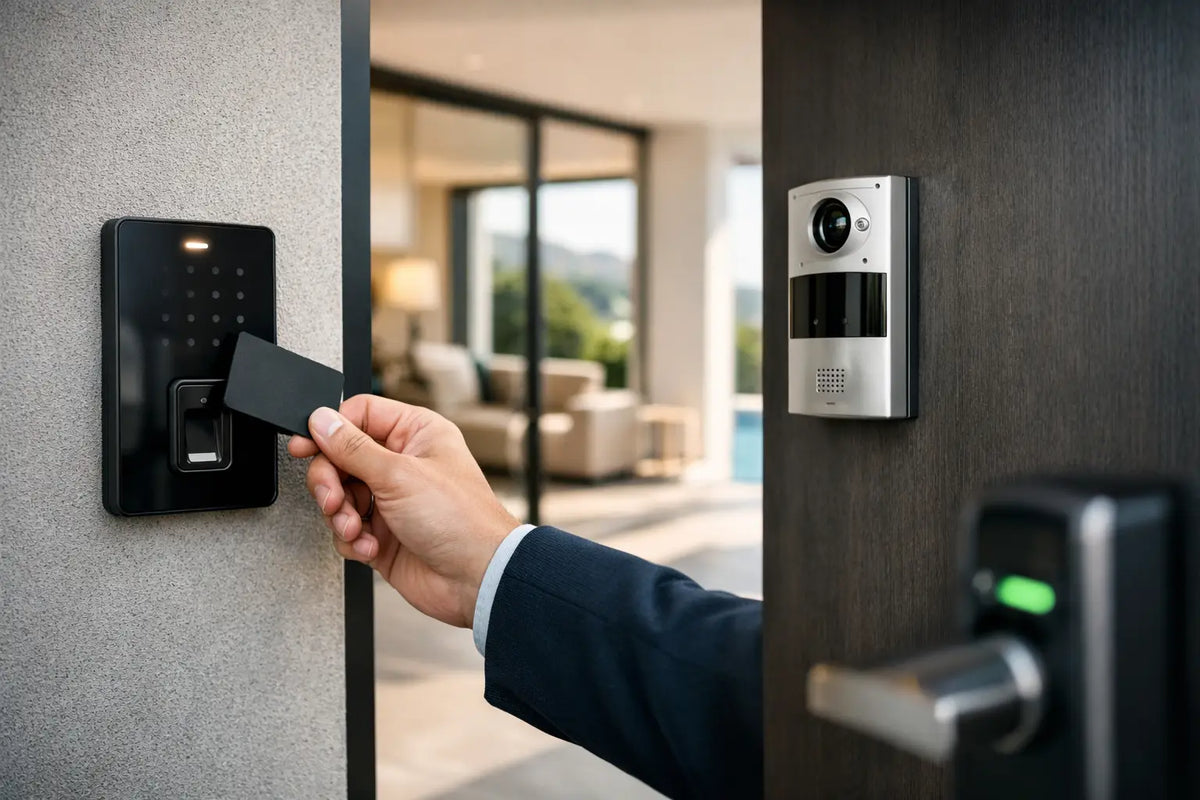
A beautiful property should feel open and effortless for the people who belong there, yet highly selective for everyone else. That balance is precisely how access control improves security: it replaces a single, easily copied key with a considered system that recognizes who may enter, where they may go, and when that permission should end.
For villas, executive offices, private gyms, retail environments, and hospitality spaces, access control is not simply a lock upgrade. It is a foundation for a more intelligent security strategy, designed around the way a property is actually used. When specified well, it provides stronger protection without filling a refined interior with visible hardware or adding friction to daily life.
Why traditional keys leave security gaps
A mechanical key offers very little accountability. It can be copied without the owner's knowledge, passed from one person to another, or retained after a contractor, employee, tenant, or household staff member no longer requires access. If a key is lost, the only reliable response may be to rekey or replace locks throughout the affected area.
That limitation becomes more significant in larger homes and commercial properties, where access is naturally shared. A villa may have family members, domestic staff, drivers, gardeners, maintenance teams, and delivery personnel. An office or school may have employees, managers, vendors, and visitors moving through different areas at different times. Treating every person as though they need the same unrestricted access creates unnecessary exposure.
Access control changes the model from possession to permission. Entry credentials can take the form of encrypted cards, mobile credentials, PIN codes, biometric readers, or a combination of methods. More importantly, those credentials can be assigned, adjusted, and withdrawn without changing the door hardware.
How access control improves security at every entry point
The central advantage of access control is precision. Rather than asking whether a person has a key, the system verifies whether that specific credential is authorized for that specific door at that specific time.
Permissions can match real responsibilities
A household manager may need full access to service areas and selected living spaces. A cleaner may only require entry on weekday mornings. A pool technician may need access to an exterior gate and equipment room, but not the main residence. These boundaries are simple to establish with a professionally designed system.
In a commercial setting, permissions can be even more granular. Finance records, IT rooms, medication storage, AV control rooms, executive suites, and stock areas can be restricted to approved personnel. This reduces accidental access as well as intentional misuse, while keeping day-to-day operations organized.
The right level of control depends on the property. A compact family residence may only need managed access at the front gate, main entrance, and service door. A multi-building development, mosque, school, or mall requires a more structured hierarchy. The objective is not to overcomplicate movement through the space. It is to protect higher-risk areas with appropriate discretion.
Lost credentials no longer mean compromised doors
When a physical key disappears, there is often no way to know where it went or who may have copied it. A digital credential can be removed immediately. The former user simply loses access, while everyone else continues using the system as normal.
This is especially valuable after staffing changes, construction work, short-term occupancy, or an event. Temporary credentials can be issued with automatic expiration dates, avoiding the common problem of retrieving keys after the work is complete. For properties with frequent visitors or service personnel, this creates a cleaner, more controlled process.
Entry events create meaningful oversight
Professional access control systems can maintain an activity record showing which credential was used, at which door, and at what time. For a homeowner, this can provide clarity around staff arrival and contractor access. For a business, it supports stronger management, incident review, and operational accountability.
An event record is not a substitute for attentive security management, and it should be handled with respect for privacy. It is, however, far more useful than guessing who had a key. When combined with properly positioned cameras, it can help security teams review an incident with greater confidence and act quickly when something appears out of place.
Sensitive areas can require stronger verification
Not every door deserves the same authentication method. A garden gate may be suitable for a mobile credential or keypad. A private office, server room, safe room, or controlled storage area may call for two-factor entry, such as a card plus PIN or biometric confirmation.
Biometrics can offer exceptional convenience because a fingerprint or facial credential cannot be casually handed to another person. Yet they are not automatically the best choice for every application. Privacy expectations, local regulations, user comfort, reader placement, and environmental conditions all deserve consideration. A premium system is selected around the risk level and the experience required, not because it includes the most features.
Security becomes more effective when systems work together
Access control delivers its greatest value as part of an integrated environment. A door opening is not an isolated event. It can inform lighting, cameras, alarms, intercoms, and property management routines.
For example, an authorized resident arriving at a gate can trigger exterior lighting and a discreet notification, while an unrecognized attempt after hours can prompt camera recording and alert the designated contact. In an office, a staff credential can allow access to permitted zones while keeping restricted areas protected. For a cinema room, wine cellar, or private wellness suite, access can be limited without compromising the interior design or the sense of hospitality.
Integration must be designed carefully. Convenience should never become an unintended bypass of security. A mobile app, remote release function, or automation scene needs appropriate user roles, strong account protection, and a dependable network. The most elegant experience is one that feels simple to the user because the engineering behind it has been considered in detail.
Design matters as much as the technology
In luxury projects, security hardware must support the architecture rather than interrupt it. Reader finishes, door hardware, gate stations, keypads, intercom panels, and camera locations should be coordinated early with the architect and interior designer. This allows cabling to be concealed, materials to be selected intentionally, and equipment to be positioned for both reliable operation and visual restraint.
There are practical factors behind this refinement. Outdoor readers must withstand heat, moisture, dust, and heavy use. Gates may need long-range credentials or intercom verification for vehicles. Fire-rated doors, glass partitions, heritage finishes, and custom joinery all affect the hardware and installation method. A beautifully specified reader is of little value if it is difficult to use, vulnerable to weather, or poorly aligned with the door system.
For this reason, access control should be addressed during design and construction whenever possible. Retrofitting is entirely possible, but early planning creates better options for concealed wiring, power resilience, door preparation, and centralized equipment locations.
Choosing the right access control approach
The strongest solution is rarely the one with the longest feature list. It is the one that fits the property's people, routines, risk profile, and future plans. Before selecting equipment, consider the number of users, the doors or gates to be managed, visitor frequency, the need for remote administration, and whether the system will connect with surveillance, alarm, or smart home controls.
A cloud-managed platform may suit an owner who travels frequently and wants secure administration from anywhere. A locally managed system may be preferred where on-site control, network independence, or specific data policies are priorities. Both approaches can be highly effective when installed and maintained correctly.
Reliability also deserves attention. Critical doors should have appropriate backup power, secure release behavior during emergencies, and a clear plan for network outages. Life-safety requirements must always guide the design. Security should protect occupants without ever obstructing safe egress.
At I-Trust Systems, access control is approached as part of the wider living or working environment: coordinated with security, automation, AV, and the finishes that define the space. That perspective helps transform a collection of devices into a property that is easier to manage and more reassuring to occupy.
The best access control system does not announce itself with complexity. It quietly gives residents, staff, and guests the right experience at the right door, while giving the owner confidence that every protected space remains exactly that.
مشاركة:
Multi Zone Audio Guide for Luxury Spaces
Office Access Systems That Protect Every Entrance