

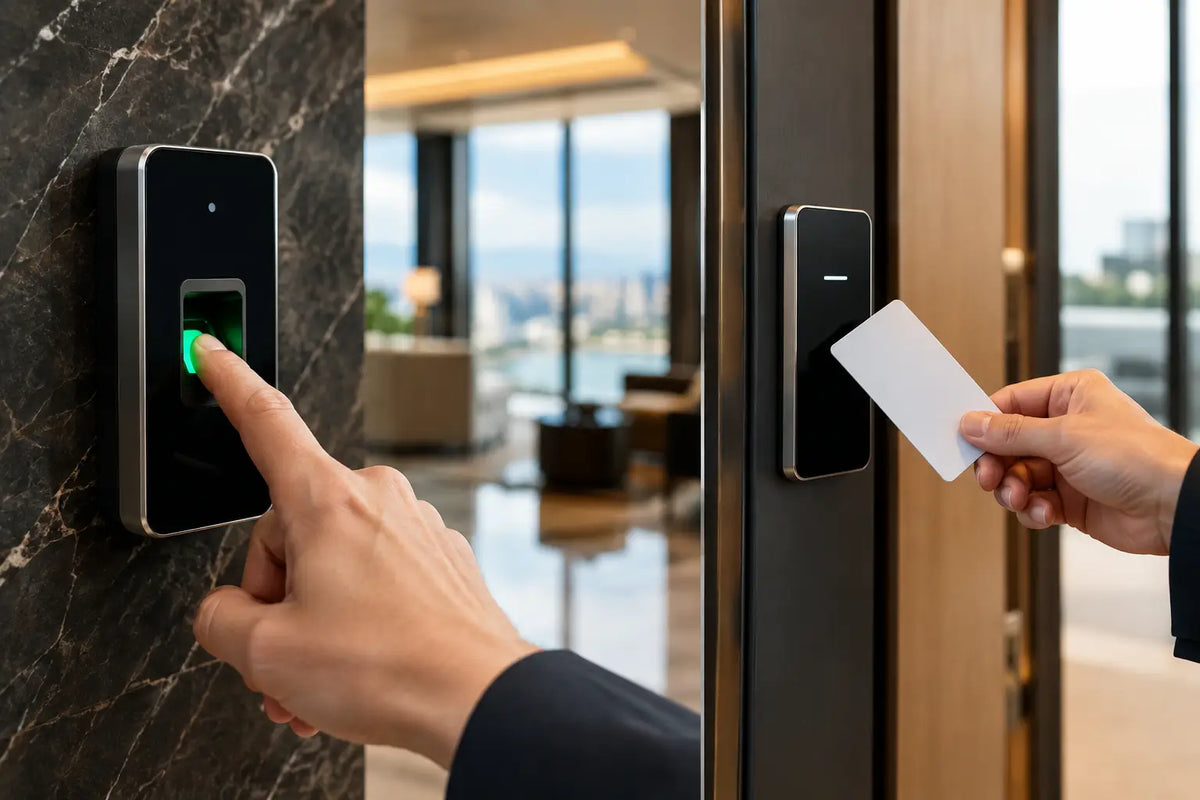
A villa entrance should feel composed and effortless, not like a point of friction between the architecture and the people who live there. The decision around biometric versus card access shapes more than security at the door. It affects daily convenience, visitor management, visual design, privacy, and the way an access system connects with gates, lighting, cameras, elevators, and wider automation.
For premium homes and professionally managed commercial properties, neither option is automatically superior. The best specification depends on who enters, how often access changes, what level of auditability is required, and whether the entrance is intended to make a discreet architectural statement or a more visible security statement.
Biometric Versus Card Access: The Core Difference
Card access verifies something a person possesses. A credential card, key fob, wristband, or mobile credential is presented to a reader, which checks whether that credential has permission to enter at that time and location. The experience is familiar, fast, and well suited to environments with many users.
Biometric access verifies something a person is. Depending on the selected technology, the system may recognize a fingerprint, face, palm, iris, or another physical characteristic. Its central appeal is straightforward: the credential cannot be casually left at home, loaned to another person, or copied in the same way as a standard card.
That distinction matters most where identity, rather than merely possession of a credential, is the priority. A private wine room, executive suite, server room, controlled storage area, or family residence may benefit from knowing exactly who has requested access. Yet this added certainty brings design, privacy, and operational considerations that deserve careful planning.
Where Biometric Access Performs Best
A well-designed biometric system removes the small interruptions that occur at a busy entrance. Residents arriving with shopping bags, gym equipment, or children do not need to find a card. Authorized staff can move through a secure service entrance without managing physical tokens. For luxury villas, this hands-free convenience can make security feel less visible and more refined.
Biometrics are also valuable when shared credentials would create an unacceptable risk. Cards can be passed between people, intentionally or otherwise. A biometric reader provides a stronger deterrent against credential sharing, particularly for restricted rooms and sensitive commercial areas.
Modern facial recognition and palm-recognition solutions can support touchless entry, which is useful at high-traffic doors. However, performance should never be assumed from a specification sheet alone. Lighting at an exterior gate, camera angle, glare from polished surfaces, hats, sunglasses, and the approach path all influence the real-world experience. A reader that performs beautifully in a controlled lobby may need additional engineering at a sun-exposed driveway.
Fingerprint systems are compact and can be highly effective, but they are often less forgiving in dusty, wet, or high-use environments. Construction teams, garden staff, gyms, and industrial-adjacent spaces may be better served by a touchless biometric method or a carefully planned card-based alternative.
Privacy Must Be Designed Into the System
Biometric data calls for greater care than ordinary access credentials. Property owners and operators should understand what the system stores, where it is stored, how long it is retained, who can administer it, and how a user can be removed when access is no longer required.
The strongest approach is to use systems that store protected biometric templates rather than raw images whenever possible, with clearly defined administrator permissions and secure enrollment procedures. For commercial projects, legal and workplace requirements may also affect how biometric data is collected and retained. The question is not whether biometric access is advanced. It is whether it is appropriate, transparent, and responsibly managed for the people using the space.
Why Card Access Remains a Premium Choice
Card access is sometimes dismissed as conventional, but a professionally specified system is far from basic. It remains one of the most flexible access methods for villas, offices, schools, fitness facilities, hospitality venues, and mixed-use developments.
Its greatest strength is administration. A card or fob can be assigned, scheduled, suspended, replaced, or deleted in moments. If a contractor finishes a project, their credential can be removed without re-enrolling anyone. If a resident loses a card, the lost credential can be canceled immediately and a new one issued. That simplicity is especially valuable where users change frequently.
Cards also give designers more freedom at the entry point. Discreet readers can be integrated into gate posts, joinery, reception desks, lift lobbies, and architectural metalwork with minimal visual impact. In a high-end residence, the reader can complement the material palette instead of competing with it.
Security depends heavily on the credential technology selected. Older proximity cards can be vulnerable to duplication, while encrypted smart credentials offer stronger protection against cloning. A premium access design should avoid treating all cards as equal. The reader, card technology, controller, encryption standard, and installation method must work together.
Card access also supports practical contingencies. A household can issue temporary credentials for guests, nannies, drivers, cleaners, and maintenance teams without permanently expanding access. A commercial manager can provide time-limited entry to a vendor without handing over mechanical keys or changing locks afterward.
Reliability at the Gate, Door, and Network
The access method is only one part of system reliability. Power supply design, door hardware, network resilience, emergency egress, controller location, cabling, and backup operation have equal influence on performance.
For example, a biometric reader may recognize an authorized resident flawlessly, but the entrance still fails as an access solution if the lock hardware is poorly specified or the gate controller has no appropriate backup. Likewise, a card system may be easy to administer but create a security weakness if doors are left unmonitored or credentials are issued without clear rules.
For both systems, a layered design is often the most credible approach. Cameras can verify activity at the perimeter, access control can manage entry, intrusion detection can protect the building after hours, and automation can respond intelligently. An approved arrival might trigger pathway lighting, disarm a selected zone, or notify the household. An after-hours access attempt may preserve video footage, alert a designated contact, and keep internal doors secured.
A luxury system should also have a considered response to power loss and internet disruption. Local operation, backup power, mechanical override where appropriate, and safe egress requirements should be agreed on before installation. Convenience is valuable, but residents and staff must never be left without a clear, safe way to enter or exit.
Choosing the Right Approach by Application
For a private villa with a small, stable household, biometric access can be compelling at the main pedestrian entrance, private garage, or selected internal spaces. The result is a discreet arrival experience with fewer credentials to manage. A card or mobile credential can still serve as a practical backup for household staff, visitors, and exceptional situations.
For offices, gyms, schools, and retail environments, card access usually provides the better operational foundation because users, schedules, and permissions change more often. It enables clear audit trails and quick credential replacement without the administrative sensitivity of biometric enrollment.
For high-security rooms, the strongest answer may be two-factor access: a card plus a biometric verification. This is appropriate when the property needs confidence that the person presenting the credential is the person authorized to use it. It should be reserved for areas that justify the extra step, rather than applied to every door out of habit.
For mosques, auditoriums, hospitality venues, and other community-facing spaces, inclusivity and throughput deserve special attention. A system that delays entry or struggles with changing light conditions can undermine the user experience. Card-based access for staff-only areas, paired with professionally monitored entrances, may be more appropriate than biometrics at public-facing doors.
Design the User Journey, Not Just the Door
The most successful access systems begin with a map of real behavior. Who arrives at each entrance? At what times? Are they driving, carrying items, escorting guests, or managing deliveries? Which doors need permanent access, scheduled access, or supervised access? These questions reveal whether a biometric reader will feel effortless or unnecessary.
At I-Trust Systems, access control can be considered as part of a wider intelligent environment, rather than an isolated device mounted beside a door. This allows the security strategy, architectural finishes, AV infrastructure, lighting scenes, gate control, and home automation to support one coherent experience.
A thoughtful access system should give owners confidence without making everyday life feel procedural. Select the technology that respects the property, the people moving through it, and the level of control the space genuinely requires.
مشاركة:
Home Theater Wiring for a Refined Cinema Room
Acoustic Door Seal Solutions for Quiet Luxury