

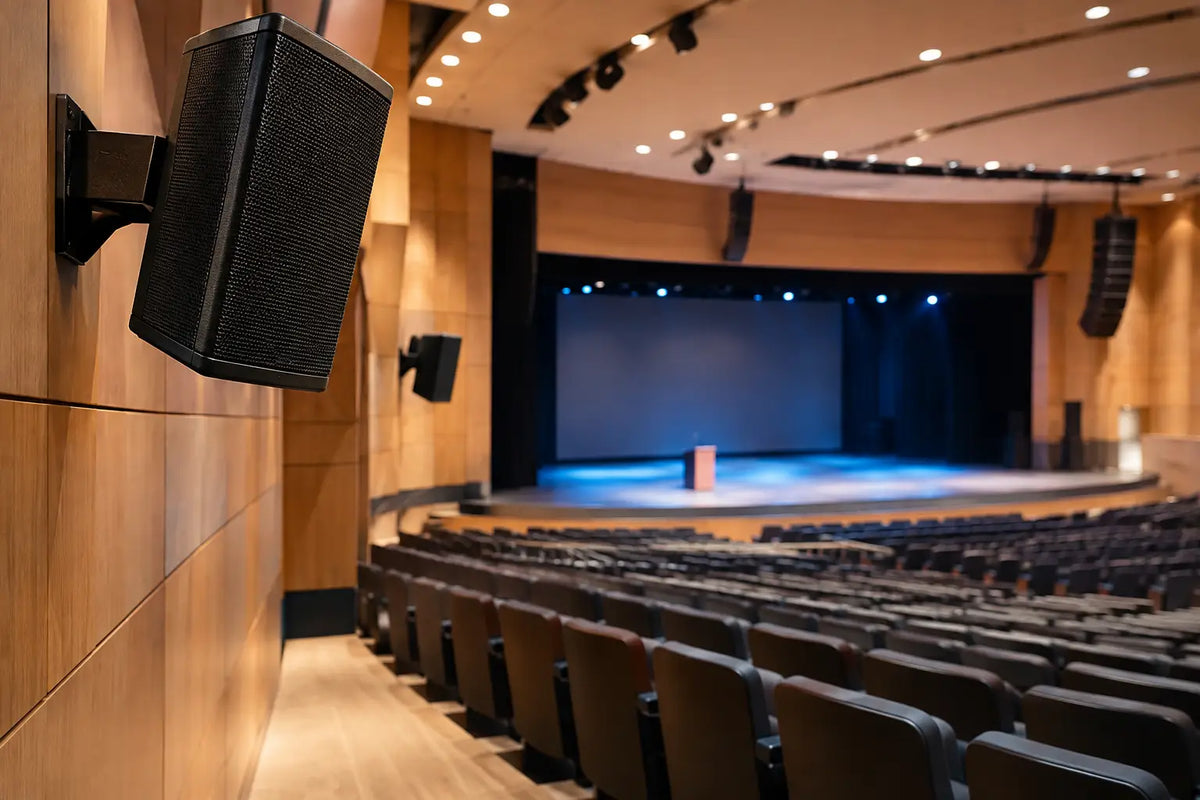
A beautiful auditorium can still disappoint the moment a presenter begins to speak. If the back rows strain to hear, music loses its impact, or feedback interrupts an event, the room is not performing at the level its architecture promises. A considered auditorium sound upgrade restores clarity, authority, and emotional impact across every seat - whether the space hosts school assemblies, corporate presentations, worship services, performances, or formal events.
The goal is not simply more volume. Premium audio design creates consistent coverage, natural speech intelligibility, controlled bass, and simple operation without filling the ceiling and walls with visually intrusive equipment. It is an engineering exercise, but it should feel effortless to the audience.
What an Auditorium Sound Upgrade Should Achieve
Every auditorium has a different acoustic personality. A room designed for lectures requires excellent vocal definition. A multipurpose venue may need to move from a keynote presentation to live music, video playback, and a panel discussion in the same day. A mosque or worship space often demands particularly clear speech over long reverberation times, while schools need systems that remain dependable for staff with varied technical experience.
A successful upgrade begins by defining how the room is actually used, not by selecting speakers from a catalog. The right system should make spoken words easy to understand at low and moderate listening levels, retain musical detail without harshness, and provide adequate headroom for peak moments. It must also respect sightlines, interior finishes, ceiling height, and the practical needs of the operators.
Consistency matters as much as power. A front-row guest should not be overwhelmed while a guest at the rear receives a weak, distant version of the program. Proper loudspeaker placement, aiming, delay settings, and digital signal processing create a cohesive listening experience throughout the room.
Start With the Room, Not the Equipment
Before specifying a single component, a professional team should assess the room’s dimensions, surface materials, seating layout, stage position, ceiling geometry, and existing infrastructure. Hard stone, glass, painted gypsum, and exposed concrete can produce reflections that smear speech. Thick carpeting and upholstered seating absorb energy differently, especially once the room fills with people.
The most useful question is often simple: what is failing now? In some auditoriums, the existing speakers are serviceable but incorrectly positioned or poorly tuned. In others, undersized amplification, aging wiring, or a lack of zoning creates the real limitation. A room with excessive reverberation may never achieve articulate speech through louder speakers alone.
This assessment should also account for microphones, source devices, and operator workflow. A premium loudspeaker system cannot compensate for low-quality microphones, poor gain structure, or an unreliable connection between the presentation computer and display system. Audio must be considered as one integrated signal path.
Speech Intelligibility Is the First Test
For most auditoriums, the audience should understand every spoken word without effort. This is influenced by speaker coverage, reverberation time, background noise, microphone technique, and the relationship between direct sound and reflected sound.
A distributed speaker system may be ideal for a long, shallow room, delivering sound closer to the audience at lower levels. A carefully designed line-array or column-based solution can suit tall spaces where controlled vertical coverage is essential. The right approach depends on the architecture and program requirements. There is no single speaker format that is superior in every auditorium.
Design Coverage for Every Listening Position
A common mistake is placing a pair of powerful speakers at the front of the room and expecting the entire auditorium to sound balanced. This can make the front section excessively loud while the rear receives less clarity and more reflected sound. Greater wattage does not solve uneven distribution.
A better design begins with acoustic modeling. This predicts coverage patterns, sound pressure levels, and potential interaction between speakers before installation begins. It allows the system to be tailored around balconies, stepped seating, structural columns, video screens, and decorative ceilings.
For large venues, front-fill speakers can support the first rows, while delay speakers reinforce distant seating areas in time alignment with the main system. Subwoofers may be included for performance, cinematic playback, or high-energy events, but they require disciplined integration. Poorly placed low-frequency speakers can create powerful bass in one area and weak bass only a few seats away.
The visual result deserves equal attention. Premium auditorium design often calls for discreet finishes, custom paint matching, concealed cabling, and placement that complements the interior rather than competing with it. The equipment should support the experience without becoming the room’s dominant visual feature.
Acoustic Treatment Is Part of the Upgrade
When a space is overly reflective, electronic correction has limits. Digital processing can refine and protect a system, but it cannot remove the acoustic character created by bare walls, high ceilings, and hard parallel surfaces. In these cases, acoustic treatment is a central part of the auditorium sound upgrade.
The objective is not to make the room acoustically dead. A refined auditorium should still feel open and energetic. The aim is to reduce uncontrolled reflections, manage reverberation, and improve definition while retaining an appropriate sense of scale.
Absorptive wall panels, ceiling treatments, bass management, diffusive elements, and acoustically transparent finishes can be selected to suit both performance requirements and interior design. Treatment should be positioned strategically, especially at early reflection points and expansive rear surfaces. This is where acoustic engineering and aesthetic craftsmanship must work together.
Build Control Around Real Operators
Even a finely engineered AV system can become frustrating if it is difficult to operate. Auditorium controls should be intuitive enough for staff, presenters, or facility teams to use confidently. A touch panel can provide clear modes for presentation, lecture, performance, prayer, background music, or cinema playback, with the appropriate audio routing and levels prepared for each scenario.
Professional digital signal processing allows microphones, wireless systems, music sources, hearing assistance, and video conferencing platforms to work together cleanly. Features such as feedback suppression, automatic mixing, priority paging, and preset recall can protect the experience when multiple users share the space.
Reliability should guide every decision. Commercial-grade amplification, ventilation, labeled racks, protected power, service access, and organized cable management are rarely glamorous, but they are what keep a venue ready for important events. For high-profile environments, redundancy for critical microphones and playback paths may also be appropriate.
Plan the Project Around the Building
The ideal time to upgrade an auditorium is during construction or renovation, when cable pathways, speaker recesses, acoustic treatments, and equipment rooms can be incorporated into the design. Yet existing venues can also be transformed with a phased strategy that minimizes disruption.
A typical project begins with site evaluation and performance goals, followed by acoustic analysis, system design, equipment selection, installation, commissioning, and user training. Commissioning is especially important. It is the stage where equalization, delays, crossover points, limiters, and presets are adjusted for the completed room rather than left at generic factory settings.
Budget should be allocated intelligently. Investing only in visible speakers while overlooking acoustics, microphones, processing, installation quality, and tuning often produces an uneven result. Conversely, not every venue requires concert-level production infrastructure. The right scope depends on room capacity, content, frequency of use, and the standard expected by the organization.
At I-Trust Systems, auditorium projects are approached as complete environments, bringing AV engineering, acoustic treatment, automation, and refined installation under one coordinated design process. This protects both system performance and architectural intent.
Let the Space Speak With Confidence
An auditorium should give every speaker presence, every performance energy, and every guest the same sense of inclusion, regardless of where they sit. When audio is designed around the room, the audience, and the people operating it, the technology fades into the background and the experience takes its proper place at center stage.
مشاركة:
How to Select Distributed Audio for Luxury Spaces
Smart Thermostat Controls for Refined Living