

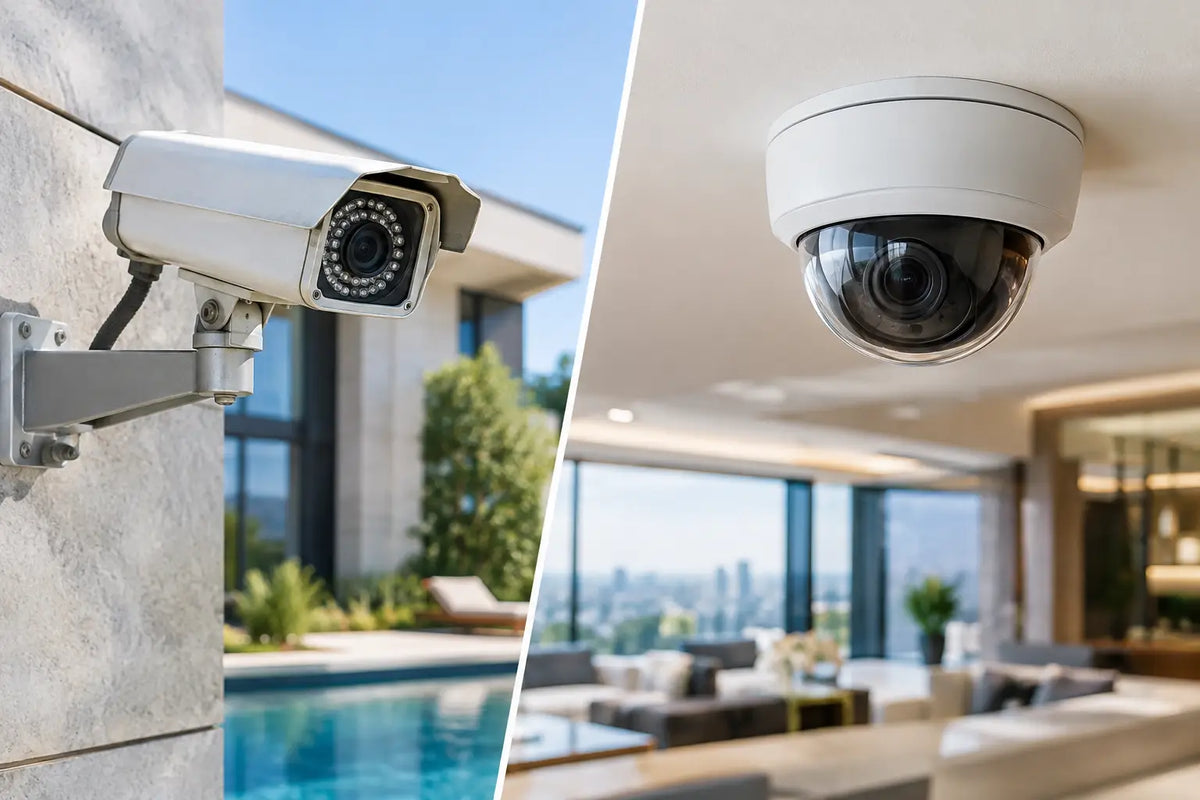
A camera system can either disappear into the architecture or become a daily source of uncertainty. That distinction is at the heart of analog versus IP surveillance for a luxury villa, corporate office, retail destination, or hospitality project. The question is not simply which camera costs less. It is which system delivers the visibility, resilience, design integration, and future flexibility the property requires.
For some sites, a well-designed analog system remains a sensible, cost-conscious choice. For others, IP surveillance is the clear foundation for intelligent security, remote management, and detailed forensic evidence. The right decision starts with how the property will be used, protected, and managed over time.
Analog Versus IP Surveillance: The Core Difference
Analog surveillance transmits video from cameras to a digital video recorder, usually over coaxial cable. In modern installations, this often means HD analog formats that produce far better images than legacy CCTV systems. The architecture is straightforward: cameras, coaxial runs, power, and a central recorder.
IP surveillance uses network cameras that transmit digital video across an Ethernet network to a network video recorder, server, or cloud-connected management platform. Each camera is a network device with its own address, processing capability, and configuration options. Power can often be delivered through the same Ethernet cable using Power over Ethernet, reducing the need for separate local power supplies.
That technical difference shapes nearly every practical consideration. Analog systems are generally simpler and can be highly effective for clearly defined coverage areas. IP systems offer greater resolution, intelligence, and scalability, but place higher demands on network design, cybersecurity, and professional commissioning.
Image Detail Changes What Security Can Prove
The most visible advantage of IP surveillance is image quality. Network cameras are available in high resolutions that make it easier to identify faces, read license plates, follow activity across a wide scene, and digitally inspect footage without losing critical detail. This matters at vehicle gates, perimeter walls, main entrances, reception areas, jewelry displays, loading bays, and expansive outdoor grounds.
An analog camera may still be entirely appropriate for a corridor, staff access point, service room, or secondary coverage zone where the goal is to confirm movement rather than capture fine identification detail. Modern HD analog cameras can provide a clean, reliable image at an attractive project cost.
Resolution alone should not decide the system. A poorly positioned high-resolution camera can be less useful than a properly selected analog camera with correct lighting, lens choice, and angle. Security design should begin with the desired outcome for each location: detection, observation, recognition, or identification. A camera at a grand entrance may need to identify a visitor. A camera in a long hallway may only need to show that someone entered the space.
Low-Light Performance Deserves Equal Attention
Luxury properties often feature dramatic exterior lighting, reflective finishes, shaded landscaping, and large expanses of glass. These conditions can challenge any surveillance system. Camera sensor quality, infrared illumination, wide dynamic range, and careful placement matter more than a headline megapixel number.
IP cameras tend to offer more advanced low-light tuning and analytics, particularly at the premium end of the market. Yet analog cameras can perform very well when the scene is controlled and the equipment is selected professionally. For perimeter coverage, gates, and dark garden zones, the solution may also include architectural lighting and purpose-built infrared coverage rather than relying on a camera to solve every visibility issue alone.
Integration Is Where IP Surveillance Pulls Ahead
In a premium residence or commercial environment, security should feel coordinated rather than fragmented. IP surveillance is particularly well suited to integration with access control, video intercoms, intrusion alarms, gate automation, and smart home or building control platforms.
A visitor presses the gate intercom, the relevant camera view appears on a touch panel or mobile device, and the resident can speak, verify, and grant access. In a commercial project, an access event can call up the associated video clip for review. These are practical operational benefits, not technology for its own sake.
IP systems can also support analytics such as line crossing, people counting, loitering alerts, object detection, and smart search. Analytics should be selected with restraint. An alert that is constantly triggered by passing cars, trees, or staff movement soon becomes background noise. Properly configured, however, it can help security teams focus on events that deserve attention.
Analog systems can integrate with broader security infrastructure, but their capabilities are usually more limited and dependent on the recorder. They are best suited to projects where reliable video recording is the priority and advanced automation or data-driven monitoring is not essential.
Installation, Infrastructure, and Aesthetic Control
For renovations, analog can be the pragmatic answer. Existing coaxial cabling may be reused, avoiding disruptive wall work and shortening installation time. Where a property already has a functioning coaxial camera layout, an HD analog upgrade can provide a meaningful improvement without rebuilding the entire security infrastructure.
IP surveillance is often the stronger choice for new construction, major renovations, and projects with a properly planned structured cabling network. Cat6 cabling, managed network switches, secure equipment racks, backup power, and dedicated recording storage create a more adaptable foundation. The initial investment is higher, but the system is designed for future additions and changing security requirements.
Neither option should compromise the interior or exterior design. Camera placement must consider ceiling details, façade materials, sightlines, landscaping, and the visual language of the property. Discreet domes, carefully positioned turrets, and purpose-finished mounts can preserve a refined environment while maintaining effective coverage. The finest installation is one that feels intentional, not added as an afterthought.
Cybersecurity Is Part of the IP Conversation
An IP camera is a connected device, which means it must be protected accordingly. This is not a reason to avoid IP surveillance. It is a reason to insist on correct engineering.
A professional IP deployment should use strong unique credentials, current firmware, restricted remote access, segmented networks, encrypted connections where supported, and carefully managed user permissions. The camera network should be planned as part of the property’s wider digital infrastructure, not attached casually to the same network used by family devices, guest Wi-Fi, and entertainment systems.
Analog cameras have a smaller network attack surface at the camera level, though a connected recorder still requires secure configuration. For clients who value simple, isolated operation and do not require remote functionality, this can be appealing. But simplicity should not be mistaken for complete protection. Recorders, remote apps, and network gateways still need thoughtful administration.
Cost: Consider the Full System, Not the Camera Price
Analog surveillance usually carries a lower upfront cost, especially when existing coaxial infrastructure can be retained. Cameras and recorders are generally less expensive, and the system can be fast to deploy across straightforward sites.
IP systems may cost more because they require quality network cameras, PoE switches, storage planning, network configuration, and potentially upgraded cabling. Higher-resolution footage also consumes more storage and bandwidth, so recorder capacity must be designed around the number of cameras, frame rate, retention period, and recording rules.
The more useful financial question is what the system must deliver over five to ten years. A lower initial price can lose its appeal if the footage cannot establish what happened at a gate, entrance, or high-value asset area. Conversely, installing premium IP cameras in every utility room may not be a prudent use of budget. The best systems allocate investment according to risk and purpose.
When Analog Is the Right Choice
Analog remains compelling for smaller properties, simple standalone systems, budget-sensitive upgrades, and locations with reusable coaxial cable. It offers dependable recording, familiar operation, and strong value where basic monitoring is sufficient. It can also be a smart supporting layer in a larger project, covering lower-priority areas while IP cameras protect critical zones.
It is less suited to a client who expects ultra-detailed images, intelligent alerts, extensive remote control, or deep integration with a wider smart property ecosystem.
When IP Surveillance Is Worth the Investment
IP surveillance is generally the better fit for luxury villas, large estates, multi-building properties, offices, retail spaces, schools, and sites where image evidence and centralized management carry real value. It is especially compelling when security needs to work alongside intercom, access control, automation, and mobile management.
For a bespoke project, I-Trust Systems approaches surveillance as part of the complete environment: camera coverage, network architecture, access pathways, control interfaces, equipment placement, and the visual integrity of the space. That integrated view prevents the common result of excellent individual products performing poorly as a system.
A Better Starting Point Than Camera Selection
Before choosing analog or IP, walk the property from the perspective of the people who use it and the people who may try to enter it. Consider arrival routes, gates, deliveries, staff circulation, blind spots, valuables, children’s areas, vehicle access, and how quickly footage must be found after an event.
The right surveillance system should offer quiet confidence. It should provide clear answers when they are needed, respect the design of the property every day, and leave room for the way the space will evolve.
مشاركة:
Luxury Villa Technology Guide for Better Living
What Is AV Over IP and Why Does It Matter?